Repeated Numbers in Codewords: How They Work and Why They Matter
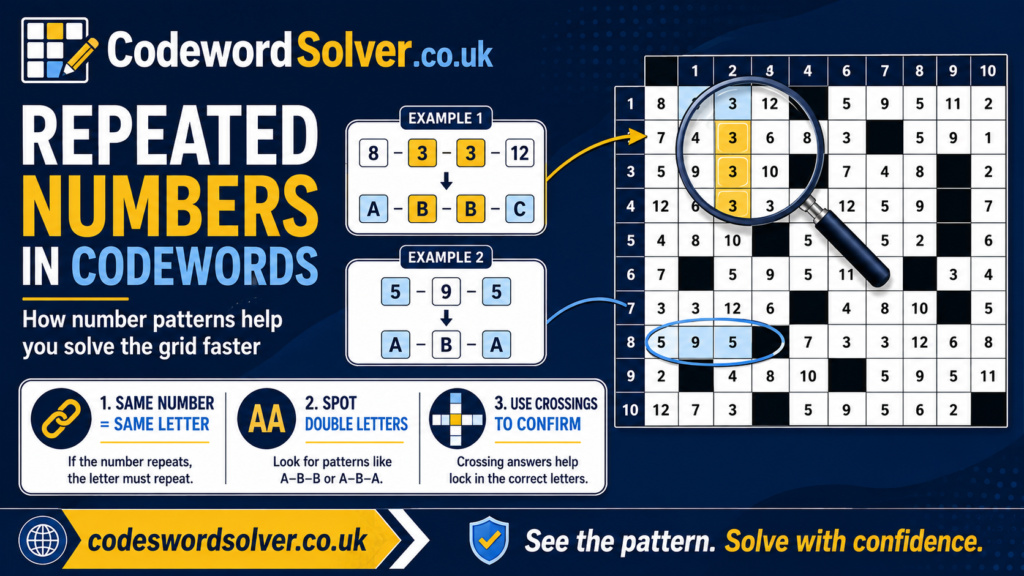
Codeword puzzles look like crosswords, but they replace clues with numbers. At first, the grid can look more like homework than entertainment. However, that number system is what makes the puzzle logical.
In a standard Codeword, each number from 1 to 26 represents one letter of the alphabet. The same number keeps the same letter throughout the grid, while different numbers represent different letters. Puzzler describes a Codeword as a completed crossword grid in which numbers replace letters. AmuseLabs gives the same core rule.
That fixed relationship makes repeated numbers in Codewords especially useful. They reveal repeated letters before you know what those letters are. Once you identify one number-letter pair, you can apply it everywhere that number appears.
What Repeated Numbers in Codewords Mean
The basic rule is simple: the same number means the same letter.
Suppose number 14 represents E. Every square marked 14 must contain E, whether it appears in a short word or several places across the grid.
The reverse rule matters too. In the standard format described by Puzzler, different numbers represent different letters. Therefore, if 14 is E, another number cannot also represent E.
This creates a one-to-one mapping. In that sense, the puzzle shares a feature with a monoalphabetic substitution cipher. Merriam-Webster defines that system as one in which each plaintext letter keeps the same cipher equivalent.
The comparison explains the logic, although a Codeword remains a word puzzle rather than a cryptography exercise. No trench coat is required.
Why Repeated Number Patterns Give You Clues
Repeated numbers tell you about a word’s structure before they reveal the word itself.
Imagine this sequence:
8 – 3 – 3 – 12
The second and third positions must contain the same letter. You can describe the pattern as A-B-B-C. BOOK follows that structure because its two middle letters match.
That does not prove the answer is BOOK. It simply rules out candidates with different letters in positions two and three.
Now consider 5 – 9 – 5. The first and third letters must match, while the middle letter must differ. The pattern is A-B-A, as in EYE.
So, repeated numbers narrow the possibilities, while crossings and confirmed mappings help verify the answer.
Double Numbers Usually Point to Double Letters
Adjacent repeated numbers are among the easiest patterns to spot. For example:
11 – 4 – 4 – 7
Positions two and three contain the same letter. Therefore, the answer has a doubled letter in the middle. NEED fits the A-B-B-C pattern.
Puzzler specifically recommends watching for double letters when solving Codewords. Its guide lists common pairs such as ll, ee, ss, oo, tt, ff, rr, nn, pp, and cc.
However, a repeated pair does not identify the double letter by itself. A crossing or solved number can narrow the choice.
Treat the pattern as a strong clue, not a complete answer. This is one reason repeated numbers in Codewords can be so informative. Otherwise, one enthusiastic guess can turn a tidy grid into a small crime scene.
Repeated Numbers Do Not Need to Sit Together
Beginners often notice double numbers but miss separated repeats.
Consider 6 – 13 – 4 – 6. The first and fourth positions contain the same letter, so the word follows an A-B-C-A pattern. Any candidate with different first and last letters fails.
A longer entry can reveal even more. Suppose a sequence reads:
2 – 8 – 5 – 2 – 11 – 8 – 9
Its pattern is A-B-C-A-D-B-E.
Even without known letters, the structure helps you reject impossible answers.
Why Repeated Numbers Across the Grid Matter More
The greatest value of repeated numbers in Codewords appears when the same number occurs in several entries.
Suppose you prove that number 17 represents R. You can then place R in every square marked 17. That deduction may add letters to several across and down entries at once.
AmuseLabs explains that the same number represents the same letter throughout the puzzle. As a result, each confirmed mapping can affect many cells rather than only one word.
Those new letters may expose another word, which can reveal another number-letter pair. In other words, Codeword solving creates a chain of deductions.
One correct letter can therefore create a surprisingly large breakthrough. The grid starts behaving like a set of dominoes.
How to Solve Repeated Numbers in Codewords
A consistent method works better than random guessing.
Start With the Given Letters
Standard Codewords normally provide some decoded letters to get you started. Puzzler recommends entering each starter letter wherever its matching number appears.
Do this before guessing. A starter may become far more useful when copied across the grid.
Scan for Repeated-Number Patterns
Next, look for adjacent repeats, matching endpoints, or numbers that recur inside one entry.
For example, 4 – 12 – 12 – 9 – 4 becomes A-B-B-C-A: matching endpoints plus a double in the middle.
Combine Patterns With Known Letters
Now add letters confirmed by crossings or starter mappings. Combined evidence gives you a stronger clue.
Therefore, avoid solving from shape alone when more evidence is available.
Check the Full Mapping
Before committing to a word, test every numbered position. If your candidate requires one number to represent two letters, reject it.
Likewise, two different numbers cannot represent the same letter in the standard one-to-one system.
Spread Confirmed Letters Through the Grid
Once you confirm a number-letter pair, enter it everywhere and scan the affected words again.
This cycle of mapping, checking, and spreading letters forms the heart of Codeword solving.
Do Not Treat Letter Frequency as Proof
Letter frequency can help, but it should remain a supporting clue.
A frequent number may represent a common English letter. However, Puzzler warns that ordinary frequency rankings do not work perfectly because Codeword grids use a particular selection of words.
Puzzler also notes that setters may restrict common letters, plurals, and familiar suffixes to keep a grid challenging. Therefore, the most common number does not automatically represent E.
Frequency gives you a hypothesis. Repeated-number structure gives you a constraint.
If you guess E from frequency and the rest of the grid disagrees, the guess must go. The puzzle does not care how confident you looked while writing it in.
A Worked Example
Imagine a five-letter entry with this sequence:
7 – 18 – 7 – 3 – 3
The first and third letters match, and the fourth and fifth letters also match. Number 18 represents a different letter. The pattern is A-B-A-C-C.
If a crossing confirms that 18 represents D, you now have D second, matching first and third letters, and a doubled ending.
You still may not know the answer. However, you can reject any candidate that breaks those structural rules.
Repeated numbers remain useful even without an immediate answer because they reduce the possibilities.
Common Mistakes With Repeated Numbers in Codewords
The first mistake is forgetting that a number keeps the same letter throughout the puzzle. If number 10 represents S in one area, it cannot become T elsewhere.
The second mistake is watching only for double letters. Separated repeats can reveal equally useful patterns. For example, 3 – 8 – 11 – 3 tells you that the first and last letters match.
Another mistake is treating a plausible word as confirmed. A candidate should fit the number pattern, known letters, crossings, and the full one-to-one mapping.
Finally, do not protect a bad guess because it worked for one word. If it creates contradictions elsewhere, remove it and test another option.
Are Repeated Numbers the Best Place to Start?
Often, repeated numbers are useful, especially when starter letters already reveal part of a word.
Puzzler advises solvers to enter starter letters first and then look for words that suggest themselves. Its guide also highlights double letters and common endings as useful features.
Still, no single opening move works for every grid. Sometimes a nearly completed word provides the clearest route.
Follow the strongest available constraints, and verify each deduction against the rest of the grid.
Final Thoughts
Repeated numbers in Codewords turn an unfamiliar grid into a system of reusable clues. The same number represents the same letter throughout the puzzle. In the standard format, different numbers represent different letters.
Inside a word, repeated numbers reveal matching positions and double letters. Across the grid, they connect several entries through the same number-letter mapping. As a result, one confirmed letter can unlock multiple words.
The key is to treat patterns as evidence rather than answers. Use starter letters, repeated numbers, crossings, and word structure together. Use frequency only as a hint, and reject any guess that breaks the mapping.
Once you read number sequences as letter patterns, the puzzle becomes easier to reason through. You are solving a consistent substitution system.
Ready to try the solver?
Put what you've learned into practice with our free Codeword Solver.
Try the Codeword Solver