Most Common 4-Letter Words in Codewords
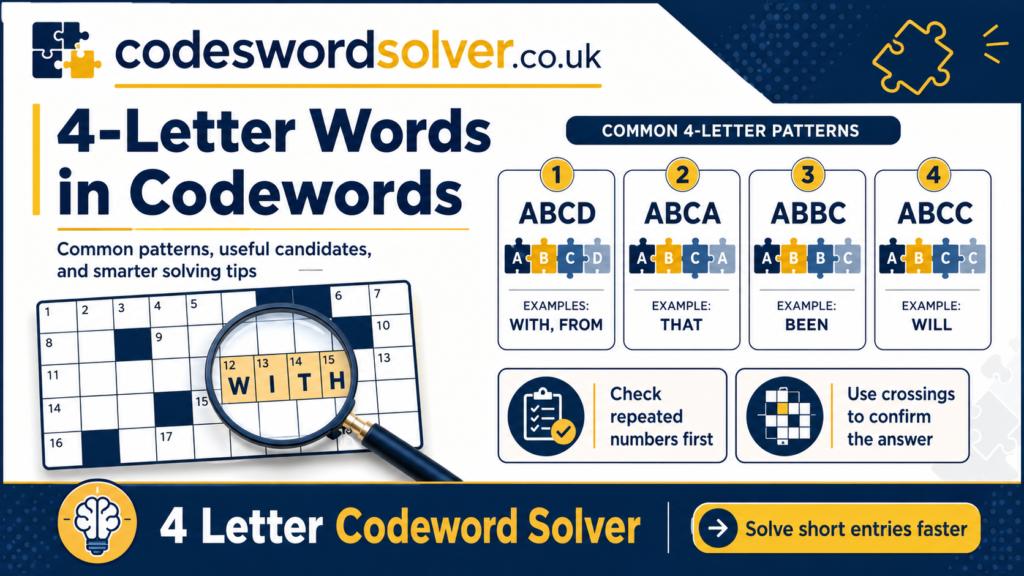
The most common 4-letter words in Codewords can give you a useful starting point, but they are not a magic answer key. Words such as THAT, WITH, THIS, HAVE, FROM, THEY, WERE, WHEN, MORE, and WILL occur frequently in written English. In a Codeword grid, however, a word only works when its number pattern and crossing letters agree.
That distinction matters. There is no single public database that ranks every four-letter answer used by every Codeword publisher. A reliable guide should not pretend otherwise. Instead, you can combine verified English word-frequency evidence with the structural rules of Codeword puzzles.
What Is a Codeword Puzzle?
A Codeword, also called a codecracker, uses a completed crossword-style grid. Each letter is replaced by a number from 1 to 26, and the same number represents the same letter wherever it appears.
Puzzler explains that a standard Codeword includes every letter of the alphabet at least once and usually provides starter letters. It also recommends looking for common word endings and double letters when solving.
Any Puzzle Media describes the same basic system. Its Codeword puzzles use standard English words and exclude proper nouns, multiple-word entries, and acronyms.
So, you are not solving traditional crossword clues. You are solving a substitution system inside a crossword grid. That is why patterns matter as much as vocabulary.
Most Common 4-Letter Words in Codewords: Strong Candidates
Peter Norvig’s analysis of Google Books Ngram data gives a useful source for general English word frequency. His processed dataset contained 97,565 distinct words and more than 743 billion word mentions. In that data, THAT ranked eighth among all words. WITH, THIS, FROM, HAVE, THEY, WERE, BEEN, MORE, WHEN, and WILL also appeared among the most frequent words overall.
These are high-frequency English words, not a proven ranking of Codeword answers. Still, they make sensible candidates when the grid supports them.
THAT
THAT follows the pattern A-B-C-A because the first and last letters match.
If a four-cell answer repeats the same number in positions one and four, THAT becomes possible. Crossings must still confirm the letters.
WITH, THIS, HAVE, and FROM
WITH, THIS, HAVE, and FROM each use four different letters. Therefore, none can fit an entry that repeats a number.
WITH and THIS also contain the familiar TH pair. If you already know T or H, either word may become easier to test. However, do not choose a word simply because two letters look familiar.
THEY and THEM
THEY and THEM share their first three letters. That makes a T-H-E-? pattern especially useful.
Instead of guessing the final letter, find the last code elsewhere in the grid. A crossing may reveal whether it represents Y, M, or another letter.
WILL and WELL
WILL follows A-B-C-C because its final two letters match. WELL has the same structural pattern.
Puzzler specifically recommends watching for double letters and lists LL among common double-letter pairs. Even so, the pattern does not prove either answer. TELL, FELL, BELL, and other words can share a similar shape.
WHEN, WERE, MORE, and BEEN
WHEN and MORE use four different letters. WERE repeats E, while BEEN repeats E in the middle.
That contrast shows why 4-letter words in Codewords should be learned together with their patterns. A repeated code can rule out several familiar options before you guess a single letter.
Why Letter Patterns Beat Random Guessing
Before asking, “Which four-letter word fits?”, ask a better question: “What pattern can fit?”
Suppose an entry uses the numbers 7-12-12-5. The middle two numbers match, so the middle two letters must match. That removes THAT, WITH, THIS, HAVE, FROM, THEY, WHEN, and MORE immediately.
BEEN has the pattern A-B-B-C, so its structure could fit. You would still need known letters or crossings before entering it with confidence.
The reverse also works. If all four numbers differ, any word with a repeated letter is impossible.
This habit prevents a classic Codeword mistake: forcing a familiar word into a pattern that cannot support it. The grid may be stubborn, but at least it is consistently stubborn.
Use Double Letters and Common Endings Carefully
Puzzler recommends double letters and common endings as useful clues. However, it also notes that compilers may limit obvious patterns to keep puzzles challenging.
Puzzler lists LL, EE, SS, OO, TT, FF, RR, NN, PP, and CC as common double-letter pairs. It also discusses endings such as ING, ED, EN, EST, ABLE, IST, and NESS as possible solving aids.
For 4-letter words in Codewords, doubled letters can be especially helpful because the pattern is easy to spot. WILL, WELL, BEEN, GOOD, and LOOK all contain repeated letters, although each has a different structure.
Do not treat every repeated code as LL or EE. Use repetition to create a smaller candidate set, then verify the word through crossings.
Why TH Can Be a Helpful Letter Pair
TH appears in several familiar four-letter words, including THAT, THIS, WITH, THEY, THEM, and THAN.
Norvig’s Google Books study also analyzes common letter sequences, not just whole words. That supports a broader point: recurring English letter combinations can help once you have identified a few codes.
For example, if you know T and H and see the same pair elsewhere, check the surrounding pattern. One confirmed pair may help you solve several entries.
Still, ordinary English frequency does not map perfectly onto a Codeword grid. Puzzler notes that puzzle vocabulary includes dictionary words beyond the most common language used in everyday writing and speech.
Why General Word Frequency Has Limits
Frequency data helps, but context changes everything.
Norvig’s dataset comes from scanned books in the Google Books Ngram corpus. It measures words used in books, not words chosen by Codeword constructors. Therefore, it can show that THAT or WITH is common English, but it cannot prove how often either word appears in published Codeword puzzles.
Puzzler makes a similar point about letter frequency. It explains that Codeword vocabulary and compiler choices can change the expected distribution. Setters may also restrict obvious letters, plurals, and common suffixes.
So, treat frequency as a probability clue rather than a rule. A common word may deserve an early test, but a less frequent word wins whenever the pattern and crossings support it.
A Simple Method for Solving 4-Letter Words in Codewords
When several four-letter entries remain unsolved, use a repeatable process.
- Enter every starter letter. Apply each confirmed number-letter match throughout the grid.
- Mark repeated codes. Note patterns such as A-B-B-C, A-B-C-A, or A-B-C-C.
- Rule out impossible words. A repeated code requires a repeated letter in the same position.
- Test common candidates. Consider THAT, WITH, THIS, HAVE, FROM, THEY, WERE, WHEN, MORE, and WILL only when the pattern supports them.
- Check double letters and endings. Use them as clues, not conclusions.
- Verify with crossings. A strong answer should support surrounding entries.
- Undo weak guesses quickly. One wrong number-letter match can spread across the grid.
This method combines vocabulary with constraint solving. You are not guessing harder; you are reducing the number of possible answers.
Do Common 4-Letter Words Always Appear in Codewords?
No. Even common 4-letter words in Codewords are not guaranteed to appear in a particular puzzle.
A grid must satisfy crossing patterns, alphabet coverage, vocabulary rules, and the setter’s design choices. Those constraints can favor a less common word over a frequent one.
For that reason, be cautious with any “top 10 Codeword words” list unless its publisher explains the puzzle corpus behind the ranking.
The safer approach is simple: know common English words, recognize their patterns, and let the grid confirm the answer.
Final Thoughts
The most common 4-letter words in Codewords are useful because they provide realistic candidates. THAT, WITH, THIS, HAVE, FROM, THEY, WERE, WHEN, MORE, WILL, and BEEN can help you move faster when their number patterns fit.
However, frequency is only the first filter. Repeated codes, known letters, double letters, endings, and crossings provide stronger evidence inside the puzzle itself.
So, memorize a shortlist if you enjoy that sort of thing. Just do not bully every four-cell gap into becoming THAT. The numbers have receipts.
The best solvers combine common-word knowledge with pattern logic. Once you do the same, four-letter entries become less like guesses and more like small, testable equations.
Sources
Puzzler — Codeword Puzzles Guide: Used for Codeword rules, starter letters, double-letter guidance, common endings, compiler behavior, and the limitations of raw frequency analysis.
Peter Norvig — English Letter Frequency Counts: Mayzner Revisited: Used for Google Books Ngram word counts, general English frequency, and letter-sequence analysis.
Any Puzzle Media — Codeword Puzzles: Used for the number-to-letter system, standard English vocabulary rules, and restrictions on proper nouns, multiple-word entries, and acronyms.
Ready to try the solver?
Put what you've learned into practice with our free Codeword Solver.
Try the Codeword Solver