How to Solve Codewords Without Guessing
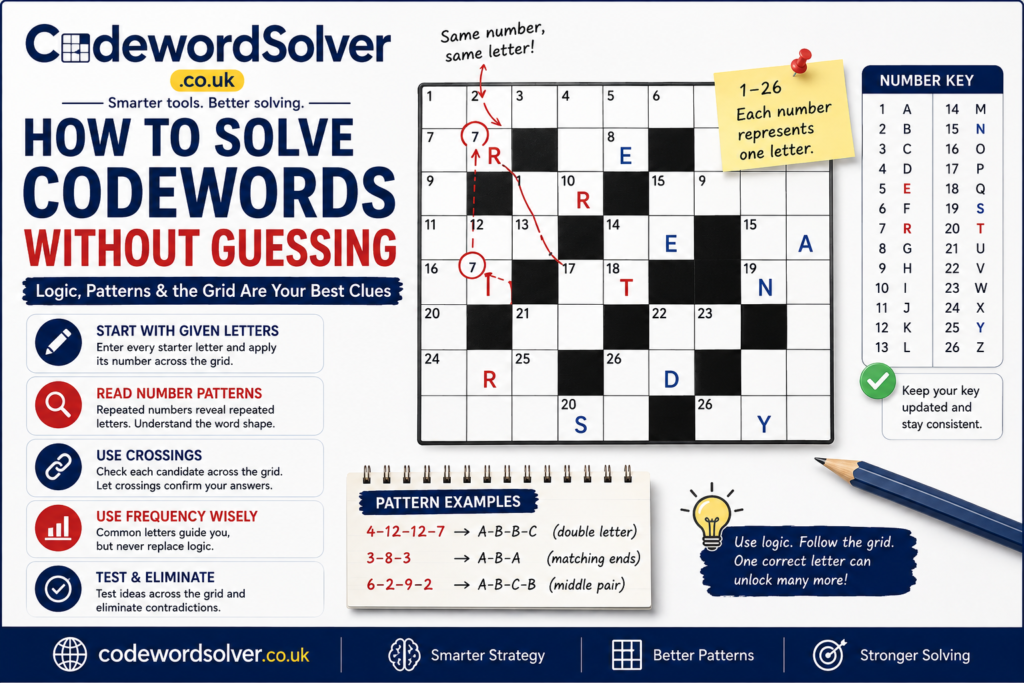
Codewords look like crosswords with the clues removed and the letters replaced by numbers. The format seems mysterious at first, but the core rule is simple. Each number represents a letter, and the same number keeps that value throughout the grid.
If you want to learn how to solve Codewords without guessing, focus on evidence rather than lucky word choices. Start with known letters, study number patterns, use crossings, and test each new letter across the grid. As a result, one sound deduction can unlock several words at once.
Understand the Codeword Rules
A standard Codeword uses a crossword-style grid but does not provide normal crossword clues. Instead, numbered squares stand for letters. The same number always represents the same letter wherever it appears. Standard versions commonly use numbers from 1 to 26 for the alphabet.
That shared code is your main advantage. You are not solving separate words in isolation. Every word connects to the same number-to-letter key.
For example, if you prove that 7 represents R, every 7 becomes R. Those new letters may complete other patterns and reveal more answers. Therefore, progress often comes from a chain of small deductions.
Start With the Given Letters
Many Codeword puzzles provide a few solved letters to help you begin. Collins describes The Times Codeword in this way: solvers start with solved letters, then use logic and vocabulary to uncover more letters.
Enter every starter letter first. Then locate every occurrence of its number.
Also keep a number-to-letter key beside the grid. Cross off confirmed letters as you solve them. A clean key prevents conflicts and makes the final stages much easier.
Work on the Most Constrained Words
Do not begin with the longest word simply because it looks important. Instead, choose the entry that gives you the most information.
A pattern such as C _ D E has fewer realistic completions than _ _ _ _. Likewise, a word with three known letters and two blanks usually helps more than a long, completely unknown entry.
Crossings add even more value. If one candidate supplies letters to several other words, it can trigger a larger breakthrough. Therefore, prioritize entries with known letters, clear patterns, or several crossings.
Use Repeated Numbers to Read Word Shapes
Repeated numbers reveal repeated letters before you know which letters they represent.
Suppose a five-letter entry has the pattern 4-12-12-7-9. The second and third letters must match. That immediately rules out words without a double letter in that position.
Similarly, 3-8-3 tells you that the first and last letters match. A pattern such as 6-2-9-2 tells you that the second and fourth letters match.
Instead of asking, “What word might fit here?” ask, “What word fits this exact pattern and agrees with the crossings?”
That question removes far more possibilities.
Let Crossings Confirm Your Candidates
A word can look perfect and still be wrong. That is why crossings matter.
Suppose a partial entry has several possible completions. Do not choose the first familiar word. Instead, check each uncertain number wherever it appears elsewhere.
If one candidate creates sensible patterns across the grid, it gains support. However, if it creates contradictions, reject it. In this way, the puzzle checks your work.
This habit lies at the heart of how to solve Codewords without guessing. You can form a hypothesis, but confirm it only when other parts of the grid agree.
Use Short Words and Common Word Structure
Short words can help because they contain fewer positions. However, they may also have several possible answers.
For example, a three-letter pattern could become THE, AND, FOR, NOT, or another common word. Without enough crossings, you may not have enough evidence to choose.
Longer words offer another useful tool: familiar English structure. Endings such as -ING, -ED, -ER, -LY, and -TION can narrow possibilities. Prefixes such as RE-, UN-, DIS-, and PRE- may help too.
Still, treat these patterns as clues rather than proof. Test the suspected letters elsewhere before adding them to your permanent key.
Use Letter Frequency as Supporting Evidence
Letter frequency can help when the grid offers few obvious openings. Cornell teaching material on substitution ciphers places letters such as E, T, N, O, R, I, A, and S among the higher-frequency letters in English.
However, frequency does not guarantee an answer. Cornell also explains that frequency analysis works better when the text is reasonably long. A Codeword grid provides a much smaller sample, so its most common number does not have to represent E.
Therefore, use frequency to rank possibilities rather than declare an answer. If one number appears often, common letters may deserve attention first. Then let crossings and word patterns decide.
In other words, frequency should point the flashlight. It should not grab the pencil.
Track Unused Letters and Use Elimination
As you confirm more letters, the unused alphabet becomes a useful clue.
Imagine that only five letters remain. Every unresolved number must come from that smaller set. Therefore, a word that looked uncertain earlier may suddenly have one realistic completion.
A contradiction can help too. If a trial letter creates impossible patterns in several words, remove it. That is logical testing rather than blind guessing.
Keep temporary ideas separate from confirmed letters. A hypothesis earns a place in the key only after the grid supports it.
What to Do When You Get Stuck
When progress stops, move away from the word you have been staring at. Repeating the same mental search rarely creates new evidence.
Instead, scan the entire grid again. Look for a newly constrained word, a repeated-number pattern, or a familiar ending you missed earlier. Also review your newest letter assignments.
Sometimes one weak assumption blocks several correct answers. If removing a recent choice restores sensible patterns, you have found useful evidence.
Your puzzle is not being stubborn. It just has an excellent memory for your mistakes.
How to Solve Hard Codewords With No Starter Letters
Some difficult Codewords provide no solved letters. Collins says the hardest puzzles in The Times Codeword series can omit starter letters, so solvers must rely on logical strategies from the beginning.
In that situation, start with structure. Look for repeated letters, distinctive number patterns, short entries with useful crossings, and numbers that occur often.
Next, use English word patterns and letter frequency to build cautious hypotheses. Then test each idea across several entries before accepting it.
Hard puzzles require more patience, but the method stays the same. Use consistent evidence to crack the shared code.
How to Solve Codewords Without Guessing: A Simple Routine
Follow this process throughout the puzzle:
- Enter every starter letter and copy it to matching numbers.
- Update your key and cross off confirmed letters.
- Find words with strong patterns, known letters, or useful crossings.
- Build a candidate from word shape and normal English structure.
- Check each uncertain number everywhere else.
- Reject any candidate that creates contradictions.
- Confirm letters only when several clues support them.
- Repeat the scan after each useful deduction.
- Use remaining letters to finish through elimination.
The routine feels cautious, but it prevents one weak assumption from spreading across the entire puzzle.
Common Codeword Mistakes to Avoid
The first mistake is committing to a word because it looks familiar. Several answers can fit the same partial pattern, so check the shared numbers elsewhere.
Another mistake is treating letter frequency as a rule. E appears frequently in general English, but the most repeated number in a small puzzle is not automatically E.
Also avoid solving each word independently. The number key connects the whole grid, so every answer must agree with the rest.
The goal is not to find a word that works once. You need a letter mapping that keeps working everywhere.
Frequently Asked Questions
Can You Solve a Codeword Without Guessing?
Yes. Publishers describe logic and vocabulary as core tools for solving Codewords. You may need to test possibilities, but checking a hypothesis against several crossings differs from committing to a random guess.
Should the Most Common Number Always Be E?
No. E is highly frequent in general English, but frequency analysis becomes more dependable with larger text samples. A single Codeword can have a different distribution.
Can a Codeword Have No Starter Letters?
Yes. Collins notes that the hardest puzzles in The Times Codeword series can contain no solved letters. In those grids, patterns, crossings, vocabulary, and elimination become even more important.
Final Thoughts
Learning how to solve Codewords without guessing comes down to controlling uncertainty. Do not ask whether a word merely looks possible. Ask whether its number pattern, crossings, unused letters, and the rest of the grid support it.
Start with confirmed information. Then use repeated letters, word structure, frequency clues, and elimination to build the next deduction. When a candidate creates a contradiction, remove it and learn from the result.
Most importantly, let the shared code check your work.
Once you develop that habit, a Codeword stops looking like a random collection of numbers. It becomes a connected logic puzzle in which every correct letter helps prove the next one.
Ready to try the solver?
Put what you've learned into practice with our free Codeword Solver.
Try the Codeword Solver