Most Common Double Letters in English: Rules, Examples, and Spelling Patterns
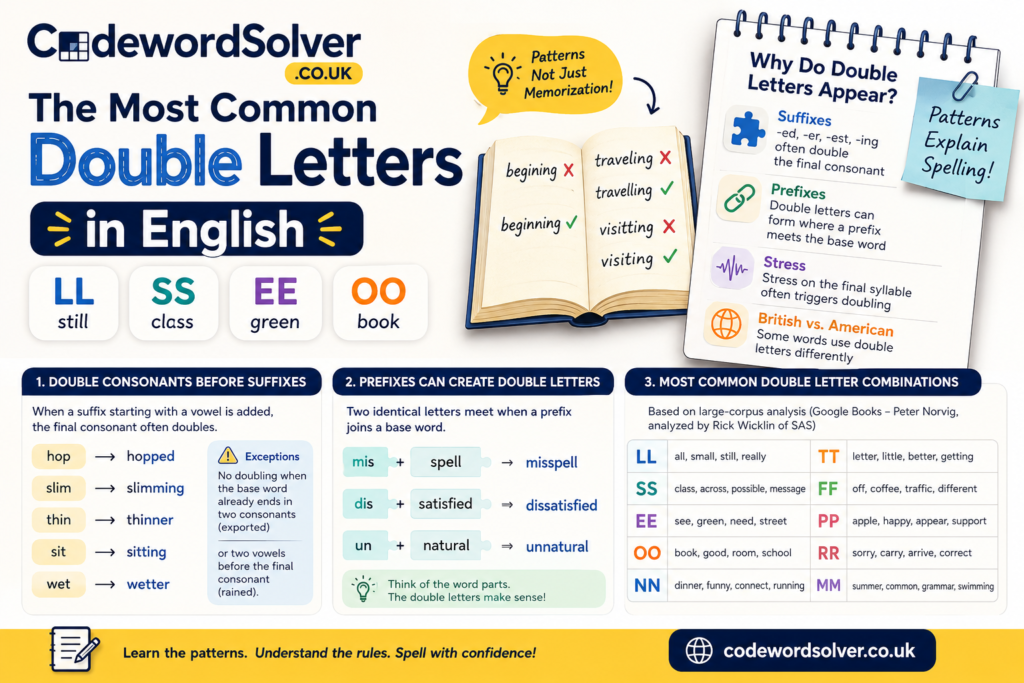
The most common double letters in English appear in words we use every day. Think of LL in still, SS in class, EE in green, or OO in book.
Yet double letters often cause spelling mistakes. Should you write begining or beginning? Is it traveling or travelling? Why does running need two n’s while visiting keeps only one t?
Fortunately, double letters in English follow several recognizable patterns. Some appear because of suffixes. Others come from prefixes, established vowel spellings, or differences between British and American English.
This guide explains the most common combinations, the rules behind them, and the exceptions worth remembering.
What Are the Most Common Double Letters in English?
There is no universal ranking that applies to every piece of English writing. Results depend on the corpus, its size, and the type of text it contains.
However, we do have useful large-scale evidence.
Peter Norvig analyzed letter sequences using data derived from a huge Google Books corpus. Rick Wicklin of SAS later examined the doubled-letter bigrams in that data.
In that analysis, LL was the most frequent double-letter combination, accounting for about 0.6% of all bigrams. The next two were SS and EE. The analysis then placed OO, TT, FF, PP, and RR in the next common group.
So, based on that corpus, the most notable double-letter combinations include:
| Double letters | Examples |
|---|---|
| LL | all, small, still, really |
| SS | class, across, possible, message |
| EE | see, green, need, street |
| OO | book, good, room, school |
| TT | letter, little, better, getting |
| FF | off, coffee, traffic, different |
| PP | apple, happy, appear, support |
| RR | sorry, carry, arrive, correct |
| NN | dinner, funny, connect, running |
| MM | summer, common, grammar, swimming |
Keep one detail in mind. These frequencies describe letters in running text, not the percentage of dictionary words containing each pair.
That distinction matters because common words can heavily influence corpus frequency.
What Is a Double Letter?
A double letter occurs when the same letter appears twice in a row within a word.
For example, letter contains tt, while green contains ee.
English has two broad types: double consonants and double vowels.
Double consonants include combinations such as ll, ss, tt, ff, pp, rr, nn, and mm. Double vowels include combinations such as ee and oo.
Some words contain more than one doubled pair.
For example, committee contains mm, tt, and ee. Merriam-Webster confirms that spelling.
The word bookkeeper is even more memorable. It contains oo, kk, and ee in succession. Merriam-Webster lists bookkeeper in exactly that form.
If English wanted to demonstrate double letters, bookkeeper clearly volunteered for overtime.
Why Does English Have Double Letters?
Double letters exist for several reasons. English spelling developed from multiple linguistic influences, but modern spelling also follows practical word-building patterns.
For learners and writers, suffixes and prefixes provide some of the clearest explanations.
Cambridge Dictionary identifies doubling letters as one of the basic areas of English spelling. Its guidance covers suffixes, prefixes, stress patterns, and differences between British and American usage.
Understanding those patterns makes unfamiliar spellings easier to predict.
Double Consonants Before Suffixes
One of the most useful English spelling patterns appears when you add a suffix beginning with a vowel.
Cambridge explains that English often doubles a final consonant before endings such as -ed, -er, -est, and -ing.
Examples include:
hop → hopped
slim → slimming
thin → thinner
sit → sitting
wet → wetter
The same pattern explains familiar forms such as run → running, stop → stopped, and fit → fitted.
However, do not turn this into the rule that “every word ending in a vowel plus consonant doubles the consonant.”
English is rarely that generous.
Cambridge notes that several conditions affect doubling. For example, English normally does not double the final consonant when the base already ends in two written consonants.
Therefore, export becomes exported, not exportted.
Likewise, words with two written vowels before the final consonant normally avoid doubling. Rain becomes rained, not rainned.
Stress Can Decide Whether a Letter Doubles
Stress becomes especially important in words with more than one syllable.
When the final syllable carries the stress, English often doubles the final consonant before a vowel-starting suffix.
Cambridge gives examples such as:
admit → admitting
prefer → preferred
forget → forgetting
transmit → transmitted
occur → occurrence
Now compare those forms with visit → visiting and enter → entered.
The stress in visit and enter falls earlier in the word. As a result, standard spelling does not give us visitting or enterred.
This stress rule explains many double consonants in English that may otherwise seem arbitrary.
So, when a longer word causes doubt, say it naturally. Listening for the stressed syllable can provide a useful clue.
Prefixes Can Also Create Double Letters
Some double letters do not result from a doubling rule at all.
Instead, two identical letters meet when a prefix joins a base word.
Cambridge explains that adding a prefix normally does not require removing letters from either part.
For example:
mis + spell → misspell
dis + satisfied → dissatisfied
un + natural → unnatural
Here, the doubled letters mark the meeting point between meaningful word parts.
This pattern can make spelling easier because you can separate the word mentally.
If you know misspell contains mis- plus spell, the two s’s suddenly look much less suspicious.
Double Vowels in English Work Differently
Not all double letters in English are consonants.
Two of the highest-ranking doubled combinations in the Google-derived corpus are EE and OO.
You can find ee in words such as see, need, green, and street.
Meanwhile, oo appears in book, room, food, good, and school.
These combinations belong to established word spellings. They do not follow the consonant-doubling rule used in forms such as running or stopped.
Pronunciation also varies. For instance, food and good both contain oo, but speakers pronounce the vowel differently in standard varieties of English.
Therefore, learners should treat ee and oo as common vowel spelling patterns rather than extensions of the final-consonant rule.
British and American English Use Some Double Letters Differently
British and American spelling can disagree about consonant doubling.
A familiar example involves words related to travel.
British English commonly uses:
traveller
travelling
American English usually prefers:
traveler
traveling
Cambridge also gives the British forms labelling and labelled, while American English generally uses labeling and labeled.
Neither system is automatically wrong.
Instead, choose the spelling convention that matches your audience and use it consistently.
A website aimed at readers in the United States will usually favor American forms. A site aimed at a British audience will normally follow British spelling.
Consistency creates a cleaner reading experience and makes editorial standards easier to maintain.
Common Words With Double Letters That Cause Mistakes
Some words deserve extra attention because writers frequently hesitate over their doubled letters.
Examples include address, beginning, committee, occurrence, necessary, and successful.
Rather than memorizing every word as a random sequence of letters, look for patterns where possible.
For instance, beginning comes from begin + -ing. The final consonant doubles as the suffix joins the base.
Cambridge also specifically gives occur → occurrence as an example of consonant doubling in a stressed final syllable.
Other words simply require familiarity and dictionary checking.
When you are unsure, consult an established dictionary instead of choosing the version that “looks about right.” English spelling has fooled better people than all of us.
How to Learn Double Letters in English More Easily
The easiest approach is to learn patterns before lists.
First, recognize common consonant changes such as run/running, stop/stopped, and admit/admitting.
Next, learn common double-vowel patterns through familiar words such as green, need, book, and room.
Also, notice prefix boundaries in words such as misspell and unnatural.
Finally, keep a short personal record of words you often misspell. That approach gives you practice with words that actually affect your writing.
Repeated reading helps as well. The more often you see the correct spelling, the easier it becomes to recognize an incorrect version.
Frequently Asked Questions About Double Letters in English
What is the most common double letter in English?
LL ranks as the most common doubled-letter bigram in Rick Wicklin’s analysis of Peter Norvig’s Google-derived English corpus.
LL represented about 0.6% of all bigrams in that dataset. SS and EE ranked next, while OO, TT, FF, PP, and RR formed another common group.
However, rankings can change when researchers use a different corpus.
What are the most common double letters in English?
Large-corpus evidence identifies LL, SS, EE, OO, and TT among the most common double-letter combinations.
Other frequent pairs include FF, PP, and RR.
Are double letters always consonants?
No.
English contains both double consonants and double vowels. LL, SS, TT, and PP are consonant examples, while EE and OO are common double vowels.
Why does “running” have two n’s?
Run ends in a pattern that triggers consonant doubling when the vowel-starting suffix -ing is added.
Therefore, run becomes running.
Cambridge documents the same type of doubling in forms such as sit → sitting and slim → slimming.
Why is it “visiting” and not “visitting”?
Stress helps explain the spelling.
In visit, the stress falls on the first syllable rather than the final one. Cambridge uses visit → visiting specifically to illustrate why the consonant does not double in this case.
Is “traveling” or “travelling” correct?
Both forms are correct within their respective spelling conventions.
American English commonly uses traveling, while British English commonly uses travelling.
Final Thoughts on the Most Common Double Letters in English
The most common double letters in English include LL, SS, EE, OO, and TT in a major Google-derived corpus analysis. FF, PP, and RR also occur frequently.
However, frequency tells only part of the story.
To spell double-letter words more confidently, learn how suffixes affect final consonants. Pay attention to stress in longer words. Look for prefix boundaries, and remember that double vowels follow different spelling patterns.
Also, keep British and American spelling differences in mind.
Once you understand these patterns, double letters become less mysterious. You will still meet exceptions, because this is English and apparently complete predictability was never invited.
Still, a few reliable rules can save you from a great deal of second-guessing.
Ready to try the solver?
Put what you've learned into practice with our free Codeword Solver.
Try the Codeword Solver