Most Common 3-Letter Words in Codewords: A Practical Solving Guide
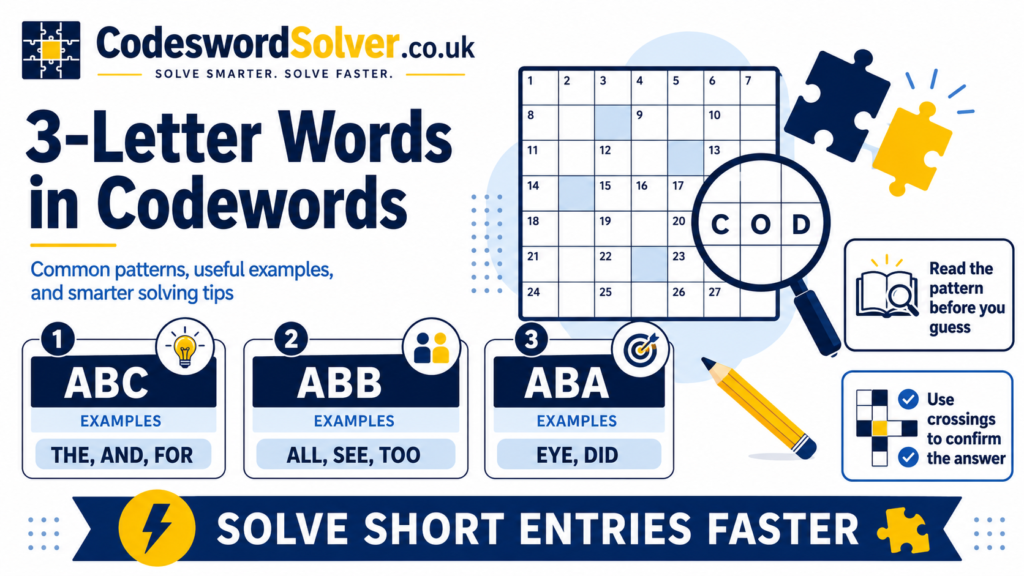
Three-letter words may look simple, but they can unlock a large part of a Codeword puzzle. A short entry can reveal several number-to-letter matches. Those matches may then open longer words across the grid.
That is why 3-letter words in Codewords deserve special attention. However, a good solver does not assume every short gap must be THE, AND, or FOR. Codewords reward pattern recognition and cross-checking, not hopeful guessing.
This guide explains useful three-letter candidates, repeated-letter patterns, and practical ways to test each answer.
What Is a Codeword Puzzle?
A Codeword is a crossword-style word puzzle without normal clues. Each letter of the alphabet corresponds to a number from 1 to 26. The same number represents the same letter throughout the grid.
Puzzler describes Codeword, also known as Code-Breaker or Code-Cracker, as a completed crossword grid in which numbers replace letters. It also says standard puzzles normally provide starter letters to give solvers a way into the grid.
DKM Games uses the same basic format. Its CodeWords puzzles replace letters with numbers from 1 to 26 and provide three starter letters.
Why 3-Letter Words in Codewords Matter
Three-letter entries sit in a useful middle ground. Two-letter words can leave many possibilities. Longer entries may contain too many unknown letters early in a puzzle.
A three-letter entry often provides enough structure to build a useful shortlist.
General English frequency can help too. The Brown Corpus contains about one million words from 500 written texts. In its frequency list, THE ranks first and AND ranks third, with 69,971 and 28,852 occurrences respectively.
Those figures make THE and AND sensible candidates. However, they do not show how often individual Codeword publishers use them. Treat general frequency as supporting evidence, not proof.
Common 3-Letter Words in Codewords to Check
No universal public database ranks every three-letter answer used by every Codeword publisher. Therefore, a practical list should combine common English usage with useful letter patterns.
| Word | Why it is useful | Pattern |
|---|---|---|
| THE | Very common English function word | ABC |
| AND | Very common conjunction | ABC |
| FOR | Common preposition | ABC |
| NOT | Common negative word | ABC |
| YOU | Common pronoun | ABC |
| ARE | Common form of “be” | ABC |
| WAS | Common past form of “be” | ABC |
| HIS | Common possessive form | ABC |
| HER | Common determiner or pronoun | ABC |
| ONE | Common number word and pronoun | ABC |
| CAN | Common verb | ABC |
| HAD | Common past-tense verb | ABC |
| BUT | Common conjunction | ABC |
| ALL | Final two letters repeat | ABB |
| SEE | Final two letters repeat | ABB |
| TOO | Final two letters repeat | ABB |
| OFF | Final two letters repeat | ABB |
| EYE | First and last letters repeat | ABA |
| DID | First and last letters repeat | ABA |
This is a solving shortlist, not an official frequency ranking. In fact, Puzzler notes that Codeword compilers may control common letters and avoid predictable forms to keep puzzles challenging.
Read the Number Pattern Before You Guess
The number pattern gives you firm information. Word popularity only gives you a possibility.
For example, suppose a three-letter entry shows 4-11-19. All three numbers differ, so the answer must contain three different letters. That rules out ALL, SEE, TOO, OFF, EYE, and DID.
Now imagine the pattern is 7-12-12. The last two letters must match. Therefore, ALL, SEE, TOO, and OFF have the right ABB structure. THE and AND do not.
An ABA pattern, such as 8-15-8, tells you that the first and last letters match. EYE and DID fit that shape.
Should You Try THE or AND First?
THE and AND deserve attention because both appear very often in written English. In addition, Puzzler’s cryptogram-solving guidance identifies recurring three-letter words as possible AND or THE candidates.
Still, “common” does not mean “correct.”
An ABC pattern can represent many words. If you decide that every promising entry must be THE, one wrong assumption can damage several crossings.
Instead, test each candidate across the whole grid. When you assign a letter to a number, check every other cell carrying that number.
If several crossings suddenly create unlikely combinations, reconsider the guess.
Double Letters Can Reveal Short Words
Repeated numbers deserve special attention because they reveal repeated letters immediately.
Puzzler recommends looking for double letters when solving Codewords. Its cryptogram guidance also notes that a three-letter word ending in a repeated letter may suggest ALL or TOO.
For an ABB pattern, useful candidates include ALL, SEE, TOO, and OFF.
For an ABA pattern, familiar candidates include EYE and DID.
The pattern alone cannot prove the answer. However, it can shrink the candidate list, and a crossing may settle the choice.
Use Crossings to Confirm 3-Letter Words
A short entry becomes much stronger when another word supplies a known letter.
Imagine that you have T-E. Several words could fit, including THE, TIE, TOE, or TEE, depending on the number pattern.
Now suppose another entry confirms that the middle number represents H. THE becomes the clear fit.
That H may also appear elsewhere, so one confirmed word can reveal parts of several longer answers.
This chain reaction explains why common 3-letter words in Codewords are so useful. You are building one consistent substitution key, not solving isolated vocabulary questions.
Use Letter Frequency With Caution
Letter frequency can support a solve, but it should not lead it.
Puzzler says detailed frequency analysis has limited value in Codewords because a grid is not a large sample of ordinary prose. It contains a selected set of puzzle words. In addition, compilers may limit predictable letters to preserve difficulty.
Therefore, do not assume that the most common number must represent E.
Instead, start with stronger evidence. Use starter letters, repeated-number patterns, partial words, common endings, and crossings first. Then use frequency to support a plausible hypothesis.
Think of frequency as a helpful witness, not the judge.
A Reliable Way to Solve Short Codeword Entries
First, enter every starter letter and copy it to all matching numbers.
Next, scan the three-letter entries. Separate ABC patterns from ABB and ABA patterns. Repeated numbers will narrow your choices immediately.
Then, focus on entries with one or two known letters. A partial word such as -HE gives you more evidence than a completely blank ABC entry.
After that, test common candidates such as THE, AND, FOR, NOT, YOU, ARE, or ONE only when the pattern supports them.
Finally, carry every confirmed letter across the grid and check the affected words again.
This method prevents one weak guess from spreading through half the puzzle.
Common Mistakes With 3-Letter Codeword Words
The biggest mistake is committing too early. A familiar word can feel right before the grid proves it.
Another common error is ignoring repeated-number structure. An ABA entry cannot contain three different letters. Likewise, an ABC entry cannot be ALL or EYE.
Also, avoid treating English frequency as a fixed Codeword rule. Puzzle vocabulary and compiler choices can produce different letter distributions.
Most importantly, do not solve one word in isolation. Every number-to-letter match affects the entire grid.
Frequently Asked Questions
What are the most common 3-letter words in Codewords?
Useful candidates include THE, AND, FOR, NOT, YOU, ARE, WAS, HIS, HER, ONE, CAN, HAD, and BUT. Pattern-rich words such as ALL, SEE, TOO, OFF, EYE, and DID can also help.
These are practical candidates, not an official publisher-wide ranking.
Is THE always the best 3-letter Codeword word to try first?
No. THE is common in English, but pattern and crossings matter more. If the entry contains a repeated number, THE cannot fit because all three letters differ.
What does an ABB pattern mean?
It means the second and third letters match. ALL, SEE, TOO, and OFF are familiar three-letter examples.
What does an ABA pattern mean?
It means the first and third letters match. EYE and DID are common examples.
Do Codewords always use numbers from 1 to 26?
Standard full Codewords use numbers to represent the 26 letters of the alphabet. Puzzler and DKM Games both describe this format. Related puzzle variants may use smaller letter sets.
Should I use a word-frequency list?
Yes, but cautiously. General frequency can suggest candidates. However, number patterns and crossings provide stronger evidence inside an individual puzzle.
Final Thoughts
The most useful 3-letter words in Codewords combine common vocabulary with clear pattern logic.
THE, AND, FOR, NOT, YOU, ARE, and ONE make sensible candidates when three different letters fit. Meanwhile, ALL, SEE, TOO, OFF, EYE, and DID become especially useful when repeated numbers reveal their shapes.
The best method is straightforward: read the number pattern, use known crossings, test a small shortlist, and confirm each letter across the grid.
Common words can point you toward an answer. Logic should decide whether it stays.
That approach works far better than guessing THE everywhere and hoping the puzzle eventually gets tired of arguing with you.
Ready to try the solver?
Put what you've learned into practice with our free Codeword Solver.
Try the Codeword Solver