Common Codeword Word Endings: A Solver’s Pattern Guide
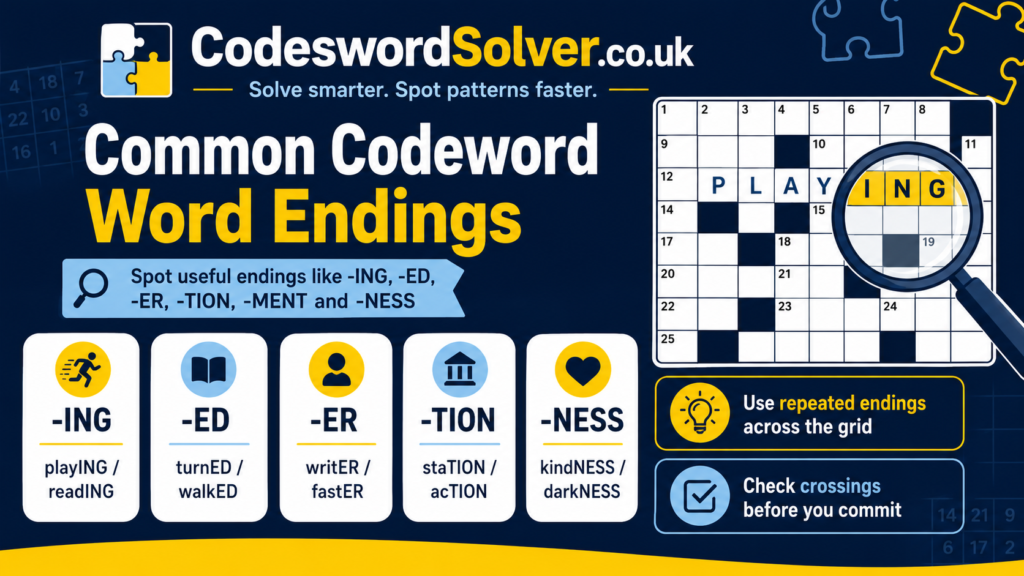
Codeword puzzles become easier once you learn to recognise common codeword word endings. Instead of treating every numbered square as a separate mystery, you can look for familiar English patterns such as -ING, -ED, -ER, -TION, -MENT, and -NESS.
A codeword, sometimes called a code-breaker or code-cracker, uses a completed crossword-style grid in which numbers stand for letters. Puzzler explains that its standard format assigns numbers from 1 to 26 to letters and uses the same number for the same letter throughout the grid. Starter letters then give the solver a way into the puzzle.
Word endings offer another useful route into that system. However, they work best as patterns to test, not answers to force.
What Are Codeword Word Endings?
A word ending is the final letter or group of letters in a word. Some endings are grammatical suffixes, while others are simply recurring letter patterns.
Cambridge Dictionary defines a suffix as a letter or group of letters added to the end of a word to make a new word. English uses familiar suffixes such as -ness, -ment, -tion, -able, -er, -ist, and -ly.
In a codeword, though, grammar is only part of the job. You need an ending that fits the possible word and agrees with the number-to-letter mapping everywhere else in the grid.
That second check is what separates a deduction from a hopeful guess.
Why Common Codeword Word Endings Help
Codewords reward pattern recognition because one confirmed letter can appear in many places.
Suppose the same three numbers repeatedly occur at the ends of longer words. If crossing letters suggest I, N, and G, testing -ING makes sense. Once that mapping works throughout the puzzle, you can enter those letters wherever the same numbers appear.
Puzzler specifically recommends looking for common word endings and double letters. It also explains that compilers may restrict obvious suffixes because those patterns can make a codeword too easy to crack.
The Puzzlers Club gives similar advice. Its codeword guide mentions common endings, repeated letters, starter letters, and suffixes as useful solving tools.
Therefore, an ending gives you leverage. It does not give you a licence to guess wildly.
Common Codeword Word Endings to Check
Several endings deserve attention because they create recognisable patterns in English words.
| Ending | What it can indicate | Examples |
|---|---|---|
| -ING | An -ing verb form or gerund | reading, playing |
| -ED | A regular past or -ed form | walked, turned |
| -ER | A noun or comparative ending | writer, faster |
| -EST | A superlative ending | fastest, widest |
| -LY | Often an adverb ending | slowly, clearly |
| -TION | A common noun suffix | action, station |
| -MENT | A common noun suffix | movement, payment |
| -NESS | A noun-forming suffix | kindness, darkness |
| -ABLE | An adjective-forming suffix | readable, portable |
| -IST | A noun suffix found in many words | artist, pianist |
| -S / -ES | Often a plural or verb ending | books, boxes |
Cambridge Grammar lists -ment, -ness, -sion/-tion, -er/-or, and -ist among common noun suffixes. It also identifies -able/-ible as adjective suffixes and -ly as a common adverb-forming suffix.
Meanwhile, Puzzler specifically mentions -ing, -ed, -en, -est, -able, -ist, and -ness as familiar suffixes that codeword compilers may try to limit.
How to Spot the -ING Ending
The -ING pattern is one of the most useful endings to test.
Cambridge Grammar explains that regular verbs generally add -ing to the base form. Spelling changes occur in some words, such as move → moving and sit → sitting.
Puzzler adds a practical codeword tip: when a word ends in G, the two letters before it might be I and N.
Start with evidence you already have. If a known G sits at the end of a long entry, test I and N before it. Next, check every newly assigned letter wherever its number appears.
Do not decide that every final G belongs to -ING. English also has words such as dog and young.
Patterns help. They do not repeal the dictionary.
Using -ED, -ER and -EST
The -ED ending often provides a useful two-letter pattern.
Cambridge Grammar confirms that regular verbs generally form the past simple and the -ed form by adding -ed. Spelling changes occur in forms such as love → loved and apply → applied.
If you already know E or D, the final pattern may help identify the other letter. Still, check the proposed mapping against crossing words before committing to it.
The endings -ER and -EST can help as well. Cambridge gives comparative and superlative forms such as easy → easier → easiest and gentle → gentler → gentlest.
However, -er also forms nouns such as writer and driver.
That flexibility makes -ER useful, but it also makes it easy to overguess.
Longer Endings: -TION, -MENT, -NESS and -ABLE
Longer endings can reveal several letters through one successful deduction.
Cambridge Grammar identifies -tion, -ment, and -ness as common noun-forming suffixes. It also lists -able as an adjective-forming suffix. Examples include population, disappointment, happiness, and portable.
In a codeword, -TION becomes especially useful when one or two letters are already known.
For example, if the final N is confirmed and the other numbered cells could fit T-I-O, the pattern deserves investigation. You can then check those proposed letters everywhere else they occur.
The same logic applies to -MENT, -NESS, and -ABLE.
Long patterns can unlock more letters. Of course, a wrong long pattern can also spread more mistakes, rather like inviting one badly behaved guest who brings five friends.
Use Repeated Endings Across the Grid
Repeated number sequences provide strong evidence.
Under the standard codeword system, the same number represents the same letter wherever it appears. Therefore, if the same three-number sequence ends several entries, it must produce the same three letters each time.
Start with the entry that already contains the most known letters. Work out the most plausible ending there, then test it against every other appearance of the sequence.
The Puzzlers Club recommends entering starter letters wherever their numbers occur and then working from the words that begin to emerge.
Puzzler recommends essentially the same starting method.
This approach is safer than solving one word in isolation because every choice must survive the whole grid.
Combine Endings With Double Letters
Common codeword word endings become even more useful when you combine them with repeated-letter patterns.
Puzzler lists LL, EE, SS, OO, TT, FF, RR, NN, PP, and CC as common double-letter combinations worth watching in codewords.
Imagine that an entry appears to end in -NESS. If the final two coded cells contain the same number, the repeated S structure supports that possibility.
You should still check N and E across the grid. However, the ending now has more than one piece of evidence behind it.
That is much stronger than “this looks right,” a phrase responsible for the early retirement of many pencil erasers.
Be Careful With Letter Frequency
Letter frequency can help, but it should remain a supporting clue.
Puzzler explains that ordinary English frequency rankings do not transfer perfectly to codeword grids. Puzzle vocabulary can include dictionary words that occur less often in everyday writing, while compilers may restrict common letters to control difficulty.
As a result, a number that appears frequently may represent a common letter, but frequency alone cannot prove the mapping.
Use frequency to form a hypothesis. Then let crossings, word shapes, suffixes, repeated endings, and double letters confirm or reject it.
British and American Spellings Can Change Patterns
Spelling convention can affect the ending you expect.
Oxford University’s style guide lists familiar British and American differences such as colour/color, organise/organize, and centre/center. It also shows broader patterns such as British -our versus American -or and British -re versus American -er.
Therefore, the publisher’s preferred form of English can matter when you solve a codeword.
Before rejecting a strong answer, check the publication’s normal spelling style. A sequence that looks wrong under British spelling may work in American English, or vice versa.
English already provides enough traps without inventing an extra one.
Common Mistakes With Codeword Endings
The biggest mistake is turning a possibility into a certainty too early.
A word may look as though it ends in -ING, yet another pattern may fit the same known letters. Likewise, -ER may form a comparative, a noun, or simply appear as the last two letters of another word.
Another mistake is ignoring the rest of the grid.
Every number-to-letter assignment affects every matching number. If one idea creates a perfect word but several impossible crossings, the “perfect” word was probably a coincidence.
Finally, do not expect compilers to offer a parade of obvious suffixes. Both Puzzler and the Puzzlers Club explain that setters may restrict familiar endings and plurals to preserve the challenge.
How to Use Common Codeword Word Endings Safely
Start with the supplied letters and enter them wherever their numbers appear.
Next, scan longer entries for -ING, -ED, -EN, -EST, -TION, -MENT, -NESS, -ABLE, -IST, and -LY. Keep each possibility provisional until the crossing words support it.
Then check repeated number sequences and double letters. These structural clues can confirm or reject an ending quickly.
After that, revisit shorter entries. They usually become easier once longer words reveal additional letters.
Finally, test every new assignment across the grid. Keep a proposed letter when the surrounding words remain plausible. If the mapping causes problems elsewhere, erase the assumption and try another route.
This method uses common codeword word endings as evidence rather than shortcuts, which makes your deductions much more reliable.
Final Thoughts on Common Codeword Word Endings
Learning common codeword word endings gives you a practical way to turn number patterns into language patterns.
Endings such as -ING, -ED, -ER, -EST, -TION, -MENT, -NESS, and -ABLE can reveal letters and connect different parts of a grid. Starter letters, double letters, spelling conventions, repeated sequences, and crossings make those deductions stronger.
Still, no suffix works as a magic key. Good compilers know the same patterns you do, and they may deliberately hide or limit them.
The best method remains simple: notice a pattern, test it, cross-check it, and only then trust it.
Once you build that habit, a codeword stops looking like random arithmetic and starts behaving like what it really is: a word puzzle with its clues hiding inside the words.
Verified Sources
- Puzzler — Codeword Puzzles Guide: codeword rules, starter letters, common endings, frequency cautions, double letters, and compiler practices.
- The Puzzlers Club — Puzzle Tips: codeword mechanics, starter-letter strategy, common suffixes, and endings.
- Cambridge Dictionary / English Grammar Today: suffix definitions, word formation, -ING and -ED forms, noun suffixes, adjective suffixes, and adverb suffixes.
- University of Oxford Style Guide: British and American spelling differences.
Ready to try the solver?
Put what you've learned into practice with our free Codeword Solver.
Try the Codeword Solver