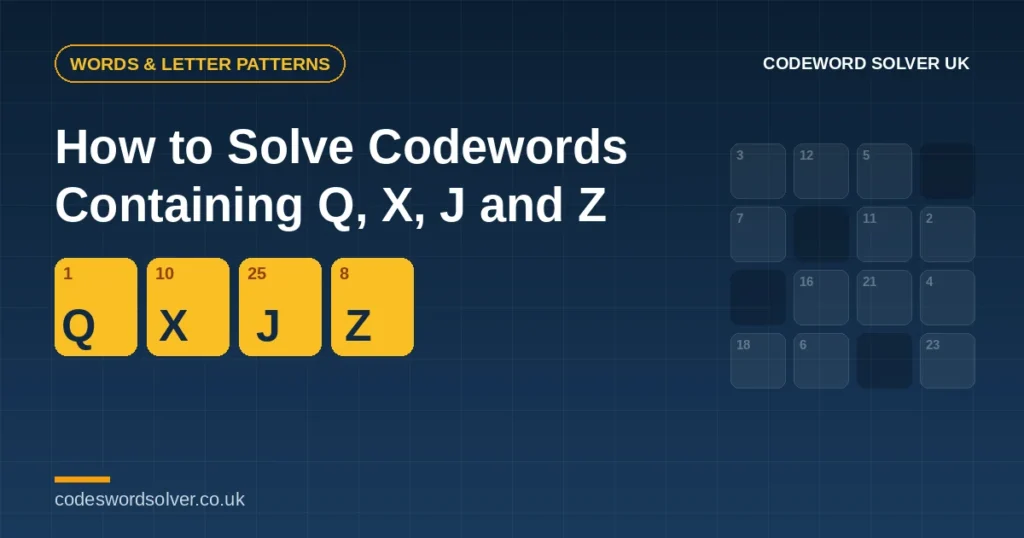
To solve rare codeword letters such as Q, X, J and Z, look for entries where the surrounding confirmed letters make one of these letters plausible. Test the complete word, then carry the proposed mapping through the grid. A number’s low frequency can suggest where to investigate, but it cannot identify a rare letter on its own.
These letters can be useful precisely because familiar words containing them have recognisable spellings. They can also mislead you if you assume that every Q needs U or that the last four unresolved numbers must be Q, X, J and Z.
The examples below show how to examine each letter separately. They are original teaching fragments and reference words, not claims about the most frequent answers in a particular newspaper.
Check what the puzzle promises about the alphabet
Some codeword formats explicitly use every letter of the alphabet. Puzzler describes that requirement for its codewords. Read the instructions for your actual puzzle before relying on it, especially with small practice grids or variants.
If all 26 letters are guaranteed and exactly one letter remains unassigned after every other mapping is established, alphabet coverage can settle the final mapping. If four numbers remain and four letters are unused, you still need evidence about their order.
Without an all-letters rule, the absence of Q proves nothing. Do not insert a rare letter merely to complete an alphabet checklist. A consistent key and valid entries remain the main requirements.
Q: test QU first, but do not make it compulsory
Words such as QUICK, QUIET, QUOTE and SQUARE provide familiar QU combinations. When a supported Q candidate appears, inspect the next position for U and check whether the number there already has a mapping.
For example, a five-letter entry reading ?UICK makes QUICK a strong candidate. Before assigning its first number to Q, compare every position with the key. Q must be available, and the number under U must agree with the established U mapping.
However, Q is not always followed by U in English dictionary words. QI and QAT are examples recorded by Cambridge Dictionary. Their inclusion in a dictionary does not guarantee that a particular codeword publisher allows them.
Use the ordinary QU pattern as a useful starting hypothesis. Consider less familiar alternatives only when the length, confirmed letters and puzzle’s word rules support them.
Repeated letters can make a Q word distinctive
QUEUE contains five letters but only three different letters: Q, U and E. Its pattern is A–B–C–B–C. Positions two and four match, and positions three and five match.
An entry numbered 5–7–9–7–9 could therefore represent QUEUE if the existing key permits 5 = Q, 7 = U and 9 = E. An entry with five different numbers cannot represent it.
This is a spelling check, not a pronunciation check. Although QUEUE sounds much shorter than its written form, all five letters occupy separate squares.
X: inspect the whole word, not only EX
EX is worth noticing in words such as EXTRA and EXIST, but X also occurs in BOX, NEXT and SIXTY. Restricting your search to an EX beginning can hide a suitable answer elsewhere.
Consider a four-letter entry numbered 4–8–12–6. If the confirmed key gives 4 = N, 8 = E and 6 = T, the visible pattern is NE?T. NEXT proposes 12 = X, but NEST and NEAT illustrate why the blank is not automatically X.
Suppose another entry using number 12 reads E?TRA from independently established surrounding letters. EXTRA supports X in that position. Compare the two entries and verify that no different number already represents X before accepting the mapping.
Keep the independence of the evidence clear. If you obtained the letters of E?TRA by assuming NEXT first, the second entry is not independent confirmation.
J: use recognisable combinations without assuming its position
J appears initially in JAM, JOKE and JUMP, but it can also occur inside a word, as in ADJUST or ENJOY. A rule that rare letters belong at word beginnings would exclude these useful candidates.
Suppose the entry E?OY has four squares. ENJOY cannot fit because it has five letters. Even a promising rare-letter idea must pass the simplest length check.
For a correct five-position pattern E??OY, ENJOY proposes N and J in the two middle positions. Check both new mappings together. Confirming the whole word requires more than deciding that its fourth and fifth letters look familiar.
A better-supported fragment such as ?UMP still has several possibilities, including BUMP, DUMP, JUMP and LUMP. Use another occurrence of the first number to distinguish them rather than selecting J because it remains unused.
Z: watch for both single and double occurrences
Z can appear once, as in ZEBRA or FROZEN, or twice, as in PIZZA and BUZZ. Double Z is a useful pattern, but an adjacent repeated number could represent many other double letters too.
PIZZA follows A–B–C–C–D. The sequence 3–11–18–18–6 can represent it if the complete key permits P, I, Z and A at those numbers.
If the middle squares carry different numbers, PIZZA fails even when P, I and A fit the visible pattern. If number 18 already means L, you cannot change it to Z simply to rescue the candidate.
For a six-letter example, FROZEN has six different letters. That makes it structurally different from a six-letter candidate containing a double, even before any letters are known.
A compact rare-letter reference
| Letter | Examples | What to check |
|---|---|---|
| Q | QUICK, QUEUE, SQUARE | QU context and any repeated U or E |
| X | BOX, NEXT, EXTRA, SIXTY | Exact position; X need not follow E |
| J | JAM, JUMP, ENJOY, ADJUST | Initial or internal placement |
| Z | BUZZ, PIZZA, ZEBRA, FROZEN | Single Z versus repeated Z |
These examples are a starting vocabulary set. They do not replace the publisher’s dictionary, and they do not tell you how likely a particular number is to represent each letter.
For help reading their structures, see Codeword Number Patterns Explained. Pattern comparisons often reject a candidate more decisively than a judgement about how common the word feels.
Why low frequency is only a lead
Large English text datasets place Q, X, J and Z among the less frequent letters, but a codeword is a small, deliberately selected collection of words. Its distribution can depart from that of ordinary prose. A frequency table shows how often letters appear in English, but a small grid can depart from it.
A number appearing twice might represent Z in BUZZ, but it could also represent a more common letter that happens to occur only twice in the selected grid. There is no safe conversion from “two occurrences” to a particular letter.
Count occurrences when it helps you choose an investigation. Then use the entries around those occurrences to test actual assignments. The general guide to working through codewords with evidence explains why tentative ideas should remain separate from confirmed mappings.
Use a solver to compare, not to confirm your own assumption
Enter reliable letters into the Codeword Solver and examine candidates that fit the correct length. If Q or Z is uncertain, leave that position open for an initial search. Use the solver to fill in the missing letters only after the confirmed letters are entered.
A search containing your guessed rare letter will naturally return only words containing that letter in the specified position. That is useful for exploration, but it does not provide independent proof that your guess was correct. Check the pattern examples to see how repeated letters shape candidate words before accepting a guess.
Before accepting any suggestion, compare all repeated numbers and letters already assigned elsewhere. Keep a short note of why you rejected alternatives so you can revisit them if an earlier mapping changes.
Make the next assignment deliberately
Choose the rare-letter candidate with the strongest surrounding evidence, not the one that completes your alphabet most neatly. Check length, spelling, repeated positions and the complete key, then update every occurrence of the confirmed number. Before you confirm a rare letter, map the whole grid so the repeated positions agree with your choice.
If two letters still work, leave them unresolved and inspect another linked entry. A rare letter can be the turning point in a puzzle, but it deserves the same evidence standard as E, A or T.
Sources
- Puzzler: Codeword rules and letter-pattern guidance.
- Peter Norvig: English Letter Frequency Counts, Mayzner Revisited.
- Cambridge Dictionary: QI and QAT entries.

Codeword Solver Team
The Codeword Solver Team builds and maintains Codeword Solver UK, a free codeword, code cracker and coded crossword solver for British puzzles. We write the solving guides published on this site and test every tool against UK dictionary word lists and real newspaper style codeword patterns.
View this author's guides →