Letter frequency in codeword puzzles can help you choose a letter to investigate, but it cannot identify that letter on its own. A number that appears many times might stand for E, yet its positions and repeated patterns may point somewhere else. The useful question is: which candidate survives every place this number appears?
This guide explains how to count occurrences, separate general English statistics from puzzle evidence, and combine frequency with word structure. The examples are constructed teaching examples, so you can follow the reasoning without needing a particular newspaper grid.
What letter frequency actually measures
Letter frequency is a count of how often a letter occurs in a defined collection of text. The definition of that collection matters. Counting every appearance of THE in books gives its letters much more weight than counting each dictionary headword once.
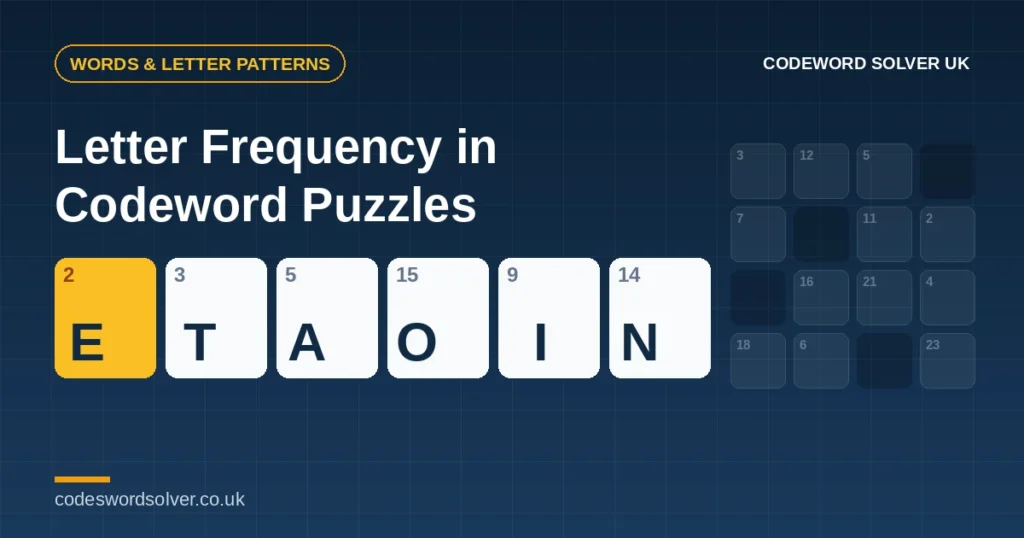
In Peter Norvig’s analysis of Google Books data, E accounted for 12.49% of letter occurrences, followed by T at 9.28% and A at 8.04%. Those are measurements from that dataset, not expected percentages for your codeword.
A codeword is a small, deliberately selected collection of intersecting words. It is not a random paragraph from a book. Treat a general frequency table as background knowledge, then let the grid supply the evidence that decides each assignment.
Why the most frequent number is not automatically E
Suppose you count twelve squares carrying number 8 and only seven carrying number 14. That tells you that the letter represented by 8, the most useful number, occurs more often in this grid. It does not tell you what either letter is.
The compiler’s vocabulary, word lengths and crossing arrangement can change the distribution. A handful of repeated-letter words can also boost the count for rare letters. Puzzler’s codeword guide specifically cautions against relying on ordinary written-English frequencies for a puzzle made from dictionary words.
There is another practical limit: if E is already confirmed as number 14, number 8 cannot also be E in a standard one-to-one codeword. A statistical hunch never overrides a confirmed mapping. Cross E off the candidate list for every other number.
Count the grid without counting crossings twice
Start by copying all supplied letters into the key and their matching squares. Then count each numbered cell once, scanning row by row. A crossing square belongs to an across and a down answer, but it is still one cell.
Counting letters separately in every across and down answer would give extra weight to checked squares. That might be useful for a different analysis, but it is not a simple count of occurrences in the grid. Keep your counting method consistent.
You do not need an elaborate spreadsheet. A short note beside the key is enough: number, occurrence count, and any striking positions. Record observations such as “appears at three word endings” or “forms an adjacent pair” separately from the raw count.
| Observation | What it establishes | What it does not establish |
|---|---|---|
| Number 8 appears twelve times | It has twelve cells in this grid | That it represents E |
| Two neighbouring cells both show 8 | The answer has a doubled letter there | Which doubled letter it uses |
| 8 appears at several word endings | Its candidate must fit those endings | That all those words share a suffix |
Read positions as well as totals
A letter can be frequent overall without being equally likely in every position. Initial, middle and final letters create different word possibilities. Use those positions to organise your search, rather than applying one fixed alphabetical ranking everywhere.
For example, an unknown in ?AKE could form BAKE, CAKE, LAKE, MAKE, RAKE, SAKE, TAKE or WAKE. A high occurrence count does little to choose between them. A confirmed appearance of the same number elsewhere may settle the question immediately.
Compare this with LE?EL. LEVEL is a strong ordinary-word candidate, and its repeated positions provide much tighter information. Check the number pattern before treating the word as solved: the two L positions must match, as must the two E positions.
Our guide to first letters to investigate offers starting possibilities. Use this frequency method when you want to test those possibilities systematically rather than simply work down a list.
Combine frequency with repeated-letter structure
This is how number patterns work: repeated numbers give exact relationships. If the six cells are 7 2 9 9 2 11, positions two and five must match, and positions three and four must match. All four different numbers must represent different letters.
LETTER and BETTER both have that structure. LITTER does not: its second and fifth letters differ. This is a useful demonstration of why a plausible-looking word can fail before you even consider how common its letters are.
If number 7 is already confirmed as L, BETTER is eliminated. LETTER remains a candidate and proposes 2 = E, 9 = T and 11 = R. Now inspect those numbers everywhere else. Keep looking for alternatives until the wider evidence supports the assignment.
The double-letter guide can help you recognise possible pairs. Remember that recognition supplies candidates; the repeated-number constraints decide whether those candidates are structurally possible.
A worked frequency check across several entries
Continue the constructed example with 7 = L confirmed. You notice that number 2 is frequent and appears twice in 7 2 9 9 2 11. That makes E worth testing, but the count is only a reason to inspect it.
- Write LETTER as a provisional candidate for the six-letter entry.
- Record its proposed mappings separately from supplied letters.
- Find another entry containing number 2, such as
11 2 10. - Substitute the proposal to get
RE?; RED is possible, but other dictionary words may also fit. - Look for independent evidence fixing number 10, rather than accepting RED merely because you recognise it.
If an independently solved crossing establishes 10 = D, RED supports the proposed E and R. If instead a confirmed mapping makes the entry impossible under the publisher’s word rules, revisit LETTER. Do not rescue the hypothesis by changing a supplied letter.
Notice what happened: the initial frequency observation suggested where to look, while number relationships and independent crossings did the verification. Several attractive words created by the same unproved assumption are not independent confirmations.
Use short words and tools carefully
Short entries are convenient places to test a mapping because fewer positions need checking. However, a blank three-letter answer still has many possibilities. Start with the patterns in shorter entries that match its actual repetitions and confirmed letters.
A solver can help when you have exhausted the candidates you can recall. Enter the length, known letters and repeated-number relationships as accurately as the tool allows. Read the tool’s instructions because a wildcard may not preserve the relationship between two equal numbers.
Use the test a pattern with our tool to generate possibilities, then map the whole grid. A candidate list reflects a particular word collection and the constraints entered; it is not proof that the first result is the intended answer.
A reliable routine for your next puzzle
Begin with starter letters, then scan for constrained words and repeated-number shapes. Count occurrences only when that count will help you choose between sensible next steps. There is little benefit in analysing every frequency if an almost completed word already offers a direct deduction.
When you test a frequent number, keep its candidate letters visible. Remove candidates only for a reason: a conflicting mapping, an incompatible repeated pattern, a confirmed crossing, or a word restriction stated by the publisher.
After confirming a letter, update every matching square and scan again. The best next move may now involve a rare number in a nearly finished answer. Let each new piece of evidence change your priorities.
Frequently asked questions
Should I memorise an exact letter-frequency order?
You do not need to. Familiarity with common letters helps generate possibilities, but a fixed order can distract from stronger evidence. Remember the checking process before memorising a ranking.
Can a rare letter be the easiest one to solve?
Yes. A nearly completed word may identify it with very little ambiguity. Frequency measures repetition, whereas ease depends on how much useful information surrounds the unknown.
What should I do when a frequency guess fails?
Remove the provisional mapping and any deductions that depended on it. Keep independently confirmed letters. Record why the candidate failed so you do not repeat the same test later.
Sources

Codeword Solver Team
The Codeword Solver Team builds and maintains Codeword Solver UK, a free codeword, code cracker and coded crossword solver for British puzzles. We write the solving guides published on this site and test every tool against UK dictionary word lists and real newspaper style codeword patterns.
View this author's guides →