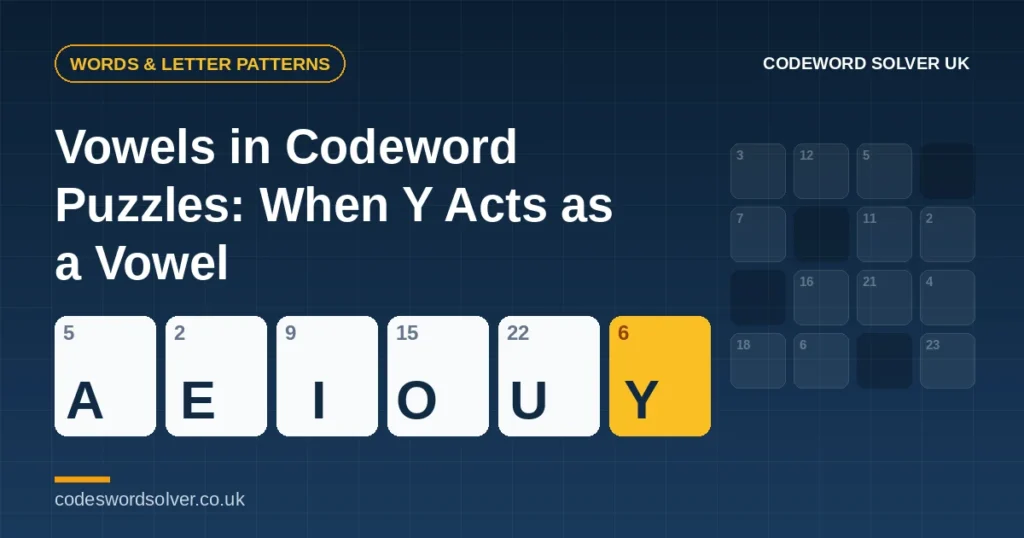
Vowels in codeword puzzles are useful clues, but they do not form a separate set of substitution rules. Test A, E, I, O and U against the actual entries, and remember that Y can represent a vowel sound in words such as MYTH. A word without A, E, I, O or U is not automatically invalid.
The practical goal is to identify a letter that works everywhere its number appears. Calling an unknown number “probably a vowel” can help you organise possibilities, but it is still a hypothesis until the grid supports a particular assignment.
This guide explains what vowel patterns can tell you, where Y matters and how to check a vowel idea without allowing it to turn into an unsupported answer.
Separate vowel sounds from written letters
A, E, I, O and U are the five letters usually introduced as English vowel letters. Y can also represent a vowel sound, as in MY, GYM and HAPPY. In YES, it represents the consonant-like sound at the start of the word.
A codeword asks for written letters, not a phonetic transcription. The number assigned to Y remains the same whether Y appears in YES, MYTH or HAPPY. You never create a separate number for “vowel Y”.
This distinction prevents a common mistake: rejecting Y because the same numbered square appears at the beginning of one word and near the end of another. The letter can occupy both positions without violating the code.
Pronunciation can suggest vocabulary, but exact spelling determines the answer. Silent letters still occupy squares, and a pair of letters representing one sound still needs two positions. When you start a grid, the best first letters to try are usually the common vowels, tested against the word lengths.
Why apparent vowel gaps deserve attention
An entry containing several confirmed consonants and one unknown position can provide a useful place to test vowels. However, inspect the complete spelling possibilities rather than demanding a simple consonant-vowel alternation.
English permits adjacent consonants and adjacent vowel letters. STREET begins with three consonants and contains EE. QUEUE contains several adjacent vowel letters. Neither structure is a reason to reject the word.
There is also no universal rule that every three-letter word has its vowel in the middle. ATE and EAT place two vowel letters together, while TRY uses Y. The guide to Most Common 3-Letter Words in Codewords offers candidates to check against your actual pattern.
Words where Y matters to a codeword solver
The following examples contain no A, E, I, O or U. They show why excluding Y from a candidate search can remove perfectly ordinary possibilities. This is a small reference list, not a claim that each word appears equally often in puzzles.
| Length | Examples | Pattern detail |
|---|---|---|
| 2 | BY, MY | Two different letters |
| 3 | CRY, DRY, FLY, GYM, SHY, TRY | Three different letters |
| 4 | MYTH | Four different letters |
| 5 | CRYPT, NYMPH | Five different letters |
| 6 | RHYTHM | H repeats in positions two and five |
Always check the repeated-letter structure as well as the vowel observation. RHYTHM is not a six-different-letter answer: it requires matching numbers under both occurrences of H.
Y also occurs with other vowel letters. HAPPY contains A as well as Y, and DAY ends in the letter pair AY. You therefore cannot infer “this must be Y” simply because one position appears to need a vowel sound.
A worked example: testing MYTH
Consider an original teaching entry numbered 4–12–8–6. Your confirmed key gives 4 = M, 8 = T and 6 = H, leaving M?TH.
MATH and MOTH demonstrate that A and O deserve consideration. MYTH shows why Y must remain possible too. This is an illustrative set of candidates, not an exhaustive dictionary search. The same care applies to two-letter words, where a missing vowel can still leave several candidates open.
Now suppose A already belongs to number 2 and O belongs to number 9. Because the unresolved square is number 12, those two candidates conflict with the existing key. Under the standard one-to-one rule, number 12 cannot also represent A or O.
MYTH remains viable if Y is unassigned. Test 12 = Y wherever number 12 occurs. If another partly filled entry becomes a supported word, that adds evidence. If it contradicts a confirmed letter, review the candidate rather than forcing it into the key.
The deduction depends on the full key and available word candidates. It does not come from a rule that M?TH always means MYTH.
Use repeated vowels as exact constraints
A repeated number requires the same letter in each position, regardless of whether you believe it is a vowel. BOOK has the pattern A–B–B–C, while BOAT has four different letters.
If an entry has matching middle numbers, BOOK may fit its structure but BOAT cannot. If all four numbers differ, the reverse structural distinction applies. Known letters and the rest of the key may then narrow the surviving candidates further.
Do not treat OO, EE or any other double as interchangeable merely because both positions seem vowel-like. Each candidate proposes a particular letter for a particular number. The article on checking double-letter patterns gives additional examples.
A practical method for testing a vowel hypothesis
Start with the entry that provides the clearest context. Write its exact numbers and confirmed letters, then list a few plausible candidates. Identify which letter each candidate proposes for the uncertain number.
Next, find another occurrence of that number in an entry with independent confirmed letters. Compare the consequences. If 14 = O makes one entry plausible but another impossible, the first word alone is not enough to accept O.
Remove letters already assigned to other numbers. Then inspect repetitions that your candidate would require. These checks often eliminate an attractive vowel guess before you need a longer word list.
Record the outcome as “14 could be O or U” rather than “14 is a vowel”. The more specific note tells you which alternatives remain and which future crossing could distinguish them.
Do not turn vowel frequency into a guarantee
A frequent unresolved number may be worth investigating as a vowel, but frequency cannot identify it by itself. The words selected for one grid may produce a distribution unlike that of a long passage of prose. The letter-frequency guide explains how to read a frequency table before relying on it.
Even if E seems promising, test it in real entries. If accepting E requires two different numbers to share the letter or breaks a supplied starter, the hypothesis fails.
Conversely, a number occurring only a few times may still represent a vowel. Counting occurrences can help choose where to look, but the count does not overrule exact constraints. Reliable mappings come from compatible spellings and a consistent key.
Search without accidentally excluding Y
If you use the Codeword Solver Missing Letters, enter confirmed letters and the correct number of unknown positions. Searching M?TH leaves the unknown position open instead of restricting it to the five traditional vowel letters.
Check each result against the original numbered entry. A wildcard does not necessarily preserve shared-number relationships, and a local pattern may omit letters already used elsewhere in your puzzle. Use wildcards for the unknown positions so Y stays in the candidate list.
If no result appears, review the pattern and selected dictionary before deciding the word is impossible. An unsupported vowel restriction, a mistyped starter or a missing position can all make a valid answer disappear from a search.
Common questions about vowels and Y
Must every answer contain A, E, I, O or U?
No. MYTH and GYM are clear counterexamples. What matters is that the complete entry is allowed by the puzzle’s word rules and fits the shared key.
Does Y always occur at the end?
No. GYM and MYTH place it inside the word, while YES begins with it. Test its position in the particular candidate rather than applying a general location rule.
Can a number represent a vowel in one word and a consonant in another?
It must represent the same written letter everywhere. If that letter is Y, its sound can differ between words. The sound change does not change the number-to-letter assignment.
What should I check before accepting a vowel?
Confirm the spelling, length, repeated positions and complete key. Then inspect another occurrence where possible. These checks remain the same for Y, the five usual vowel letters and every other letter in the alphabet.
Sources
- Merriam-Webster: The Truth About Y: It’s Mostly a Vowel.
- Puzzler: Codeword rules and discussion of letter frequency.
- Codes Word Solver: Missing Letters Solver instructions.

Codeword Solver Team
The Codeword Solver Team builds and maintains Codeword Solver UK, a free codeword, code cracker and coded crossword solver for British puzzles. We write the solving guides published on this site and test every tool against UK dictionary word lists and real newspaper style codeword patterns.
View this author's guides →