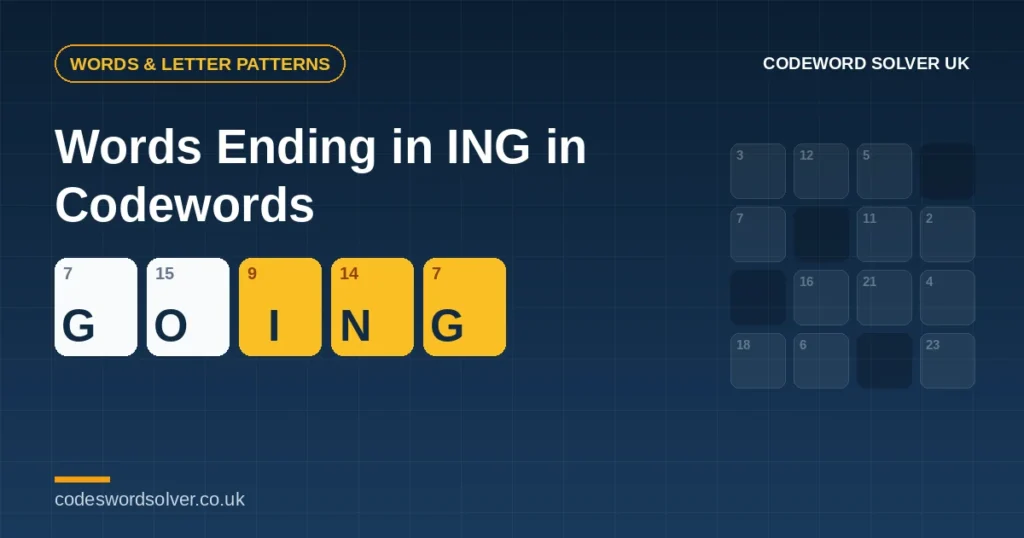
Words ending in ING can be useful in codeword puzzles because the final three letters suggest a recognisable sequence. Examples include BRING, MAKING, READING and SITTING. However, the ending is only a possibility until its numbers agree with the rest of the grid.
Use this reference to compare word lengths, spot repeated letters and test a proposed ING ending. Some examples contain the grammatical suffix -ing, while others simply finish with those letters. Both can be relevant to a numbered word pattern.
ING words grouped by length
The table below contains familiar examples, not a complete dictionary or a frequency ranking. Count the cells before using the list, and check any candidate against the publisher’s accepted vocabulary.
| Length | Examples | Pattern feature to notice |
|---|---|---|
| 5 letters | BRING, CLING, FLING, SLING, STING, THING | Each example has five different letters |
| 6 letters | ACTING, BAKING, MAKING, RIDING, RISING, TIMING | Some repeat I; others have all different letters |
| 7 letters | READING, RUNNING, SITTING, WAITING, TALKING, WALKING | RUNNING and SITTING have distinctive repeats |
| 8 letters | SWIMMING, SPEAKING, SLEEPING | Compare all repeated positions, not just doubles |
| 9 letters | FOLLOWING, HAPPENING | The complete word may contain several repeats |
| 10 letters | TRAVELLING | The British double L changes length and structure |
A list is most useful after the pattern has narrowed your search. Do not work through every example when a confirmed first letter or repeated number already excludes most of them.
When is ING worth testing?
A confirmed final G gives you a reason to inspect the preceding two cells. If those cells are unknown, I and N may be candidates. They are not guaranteed merely because G appears at the end.
You may also notice the same three-number sequence at the end of several entries. That establishes a shared ending, but it does not identify the letters. Compare the word lengths and any confirmed letters before proposing ING.
For a wider set of alternatives, review other endings that can narrow a word. Looking at several plausible endings can prevent an early ING guess from controlling the rest of your solve.
The three letters I, N and G are different. Therefore, the three final numbers must also be different in a standard one-to-one codeword. An ending with the pattern 6 9 6 cannot represent ING.
Distinguish the ending from the grammatical suffix
The British Council describes -ing forms as having several grammatical uses, including verb forms and uses as nouns or adjectives. In a codeword, you usually do not have a sentence to identify that role.
More importantly, BRING, THING and KING end in the letters ING without being formed by adding the usual -ing suffix to a base verb. They remain perfectly useful word-pattern candidates when their length and mappings fit.
This means that removing the last three letters is not always a meaningful test. Removing ING from THING leaves TH, but that does not make THING an invalid answer. Evaluate the complete dictionary word. The same care applies to words ending in TION, which are not formed by adding a separate suffix.
Spelling changes can alter the number pattern
When a word does use the suffix, its base spelling may change. MAKE becomes MAKING, RUN becomes RUNNING, and LIE becomes LYING. British Council spelling guidance explains that suffix formation can involve dropped or doubled letters.
Do not build the answer by simply attaching three letters to a remembered base form. MAKEING is not the required spelling of MAKING, and RUNING is not the required spelling of RUNNING. Test the base against the suffixes to check.
Those changes have direct codeword consequences. RUNNING has an adjacent NN and another N later in the word. MAKING has six distinct letters. Their complete structures therefore differ much more than the shared final ING suggests.
Use the guide to recognising double-letter forms when a candidate involves a spelling change. Check the actual word rather than applying a doubling rule to every verb.
A worked example with SITTING
Consider the constructed seven-cell entry 7 4 9 9 4 12 2. Suppose 7 = S and 2 = G are confirmed. The visible pattern is S?????G.
The repeated numbers give more information than the visible letters. Positions two and five match, while positions three and four match. The complete abstract structure is ABCCBDE.
SITTING fits that full structure: S I T T I N G. It proposes 4 = I, 9 = T and 12 = N. The I in the proposed ING ending also appears in position two, so both places must agree.
RUNNING does not share the same repeat structure. Its pattern is ABCC DCE, or ABCCDCE without spaces: R U N N I N G. Positions two and five differ, and N appears in three positions.
After identifying SITTING as a candidate, inspect every 4, 9 and 12 elsewhere. If N is already confirmed at another number, the candidate fails. If the proposed letters fit independent crossings, you gain stronger support.
Compare six-letter candidates carefully
TIMING and RISING share the pattern ABC BDE, written as ABCBDE. Each repeats I in positions two and four. MAKING and BAKING, by contrast, have six different letters.
If the second and fourth cells carry the same number, MAKING cannot fit. If those numbers differ, TIMING cannot fit. This distinction is available even when none of the actual letters has been established.
A confirmed initial T would favour TIMING over RISING, but you should still compare the remaining mappings with the key. A matching first letter is not permission to ignore the other five positions.
For more examples of these relationships, see checking every repeated position in a candidate.
Check the ending across the whole grid
Suppose you propose 4 = I, 12 = N and 2 = G. Find all three numbers throughout the puzzle, including entries that do not physically cross the original word.
Ask whether those substitutions conflict with supplied letters or use a letter already allocated elsewhere. Then look for entries that become tightly constrained. Those entries are good places to seek independent confirmation.
Do not count several words built from the same unproved ending as separate proofs. They may all depend on the initial ING assumption. Keep the mappings provisional until other evidence establishes them.
If the proposal fails, remove the assumption and revisit any deductions that depended on it. Preserve letters that were confirmed independently.
Use a search tool without forcing the result
You can search using the letters already established when you cannot recall a fitting word. Enter the correct length and follow the tool’s pattern instructions.
Search confirmed information first. If ING is only a hypothesis, treat a second search ending in ING as a separate test. Otherwise, the tool will exclude every non-ING answer because you instructed it to do so.
Compare returned words with the original numbers. Some searches match fixed letters but do not enforce every shared-number or used-letter constraint. The final check belongs in the grid.
British spelling and longer answers
TRAVELLING illustrates why regional spelling can matter. Its ten-letter British form includes two Ls, while TRAVELING has nine letters. The length of your entry immediately affects which form can be considered. See the guide to British word endings.
Follow the publisher’s dictionary policy when a variant is possible. For a long entry, use breaking longer answers into manageable sections while preserving the full repeated-number pattern. For the shortest forms, start with five-letter words.
Frequently asked questions
Does a final G always mean ING?
No. It is a useful possibility, but words can end in other sequences. Test the final three numbers and the complete word.
Can two different final numbers both represent N?
Not in the standard one-to-one format. Different numbers require different letters, regardless of how plausible a word seems.
What should I check first?
Check length, confirmed letters and the exact repeats. Then test every new mapping elsewhere before accepting the ending.
Sources
- British Council LearnEnglish: -ing forms.
- British Council: How to improve your English spelling.
- University of Oxford: Word usage and spelling.

Codeword Solver Team
The Codeword Solver Team builds and maintains Codeword Solver UK, a free codeword, code cracker and coded crossword solver for British puzzles. We write the solving guides published on this site and test every tool against UK dictionary word lists and real newspaper style codeword patterns.
View this author's guides →