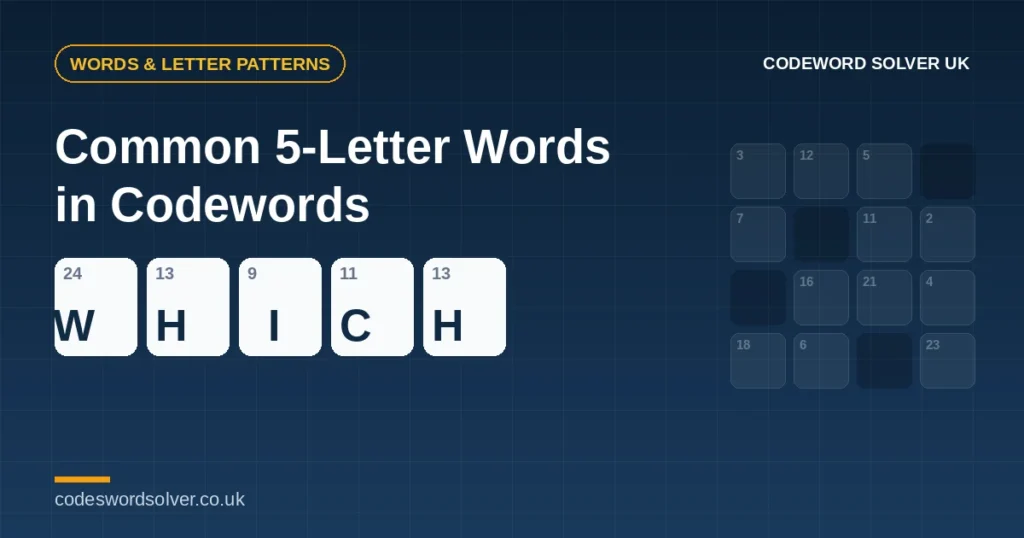
Common 5-letter words in codewords include everyday candidates such as ABOUT, AFTER, OTHER, THEIR, THERE, THREE, WATER and WHERE. Repeated-letter words such as APPLE, GREEN and LEVEL are also useful to recognise. The most helpful word is the one that matches the numbered pattern and confirmed letters in front of you.
This reference groups examples by structure, so you can use it while solving. It does not claim a measured ranking of newspaper answers. The lists are starting points, and every candidate still needs checking against the rest of the grid.
Start with the five-cell number pattern
Before searching for a word, count five cells and copy their numbers in order. Then replace each different number with a pattern letter, beginning with A. Use the same pattern letter whenever the same number returns.
For example, 8 3 3 11 6 becomes ABBCD, written without spacing as ABBCD. The second and third letters must match. APPLE and ADDLE both have this structure, while ANGLE does not.
A pattern letter describes a relationship; it is not necessarily the real letter. In an ABBCD pattern, A simply means “the first distinct letter”. If this notation is unfamiliar, review how numbered cells describe word shapes.
Five-letter words with no repeated letters
These examples have five different letters and therefore follow ABCDE. They can fit only an entry whose five numbers are also different in a standard one-to-one codeword.
| Group | Examples | What to check |
|---|---|---|
| Everyday words | ABOUT, AFTER, OTHER, THEIR | All five positions use different letters |
| Objects and places | CHAIR, TABLE, HOUSE, PLANT | Known positions must match exactly |
| Actions and descriptions | BUILD, WRITE, BLACK, BROWN | Do not reuse a letter assigned to another number |
| Further candidates | WATER, LIGHT, WORLD, UNDER | Consider the complete grid before committing |
Having no repeats does not make an answer easier or harder by itself. It removes repeated-letter clues, but several confirmed letters can still make an all-different entry highly constrained.
General word-frequency research, such as Peter Norvig’s analysis of a book corpus, can explain why some words feel familiar. It cannot establish which of these examples is most frequent in a particular codeword publication.
Five-letter words with useful repeat patterns
Repeated letters often provide a stronger filter than familiarity. Compare the complete arrangement, including repeats that do not sit next to each other.
| Pattern | Examples | Matching positions |
|---|---|---|
| ABBCD | APPLE, ADDLE | 2 and 3 |
| ABCCD | GREEN, SHEEP | 3 and 4 |
| ABCDA | SITES, STARS | 1 and 5 |
| ABCBA | LEVEL, REFER | 1 and 5; 2 and 4 |
| ABCDD | SMALL, STILL | 4 and 5 |
| ABCDC | THERE, WHERE | 3 and 5 |
Keep the comparison literal. GREEN and SHEEP share a structure because each repeats its third letter in position four. They do not share the same actual letters in their other positions.
For a wider explanation, see checking repeated letters across an answer. The same rules apply whether the repeat is a double letter, a pair at opposite ends, or two different repeated letters.
A worked example with BROWN and GREEN
Consider a constructed entry with numbers 4 7 12 18 9. Suppose number 7 is confirmed as R and number 9 as N. The visible letters are ?R??N, and all five numbers differ.
BROWN, GROWN and GREEN may spring to mind. BROWN and GROWN have five different letters. GREEN repeats E in positions three and four, so it cannot fit the two different numbers 12 and 18.
That leaves at least BROWN and GROWN in our small candidate set. Do not assume they are the only dictionary possibilities. The key point is that GREEN is structurally excluded even though it fits the visible R and N.
Now suppose an independent crossing establishes 4 = B. BROWN fits and proposes 12 = O and 18 = W. Check both proposed mappings elsewhere before treating the answer as confirmed. A correct first letter is valuable evidence, but the remaining assignments still need support.
Use known letters in their exact positions
A search for “five-letter words containing A and E” is much broader than a search for a codeword pattern with fixed positions. In a codeword, the placement of those letters matters as much as their presence.
For instance, ?A?E? can suggest WATER or LATER, while A??E? asks a different question. Moving a confirmed letter to make a word fit breaks the mapping, even if the result is a perfectly ordinary word.
Write position numbers above your notes if you keep transposing letters. A quick sequence of 1, 2, 3, 4, 5 helps you compare the candidate cell by cell. This is particularly useful when the same letter appears more than once.
Check the letter-to-number direction too. If a candidate introduces T at number 12, but T is already confirmed at number 5, reject it. A word can fit the visible cells while still conflicting with the global key.
Check endings without assuming a word family
Five-letter entries may end in common suffixes such as ER, ED or ING. These can help recall words, but the ending must fit the actual numbers and the complete spelling.
For ??ING, possible familiar words include BRING, CLING, FLING, SLING, STING and THING. They are not all formed by adding the grammatical suffix ING to a verb. The letters are useful as a pattern regardless of the word’s history.
Likewise, a final S is not automatic evidence of a plural. GLASS ends in S and has a doubled final letter, while STARS has a repeat at its first and last positions. Treat the full structure as the deciding filter.
Our guide to using endings to narrow a candidate list explains this distinction in more detail.
How to use a five-letter solving tool
Open the tool for checking five-cell patterns when you need help recalling candidates. Use the syntax described on that page and include all confirmed letters.
If the input format supports linked unknowns, preserve the repeated-number relationships. If it accepts only ordinary unknown-letter placeholders, check a pattern with missing letters against the original numbered entry afterwards.
Do not feed a guessed letter into the tool as though it were confirmed without recording that assumption. Otherwise, the results may appear to support a candidate only because you forced the search to begin with it.
A useful two-pass approach is to search confirmed information first, then test a provisional assignment separately. Keep track of which results depend on the extra assumption. This makes it easier to step back when a crossing fails.
Connect a five-letter answer to shorter entries
An unresolved five-letter word may share a number with long codeword words or an almost finished three- or four-letter answer. Work on the smaller uncertainty first, then return with the new mapping.
The reference for shorter four-letter patterns can help when three-letter words are easier to recognise. You are solving the shared number, not necessarily the word you first noticed.
After confirming a new letter, update every occurrence throughout the grid. An answer on the opposite side of the puzzle can help even when it does not physically cross the five-letter entry.
Frequently asked questions
Is this a complete five-letter dictionary?
No. It is a compact set of familiar examples organised for solving. Use a suitable dictionary or candidate tool when the pattern suggests another word.
Can APPLE fit five different numbers?
No. Its two Ps must share a number in a standard one-to-one codeword. A five-distinct-number pattern requires five distinct letters.
What if two words survive every check so far?
Keep both provisional and investigate a number on which they differ. A further crossing or established mapping may separate them.
Your next step
Copy one five-letter pattern, mark its repeated positions and add the confirmed letters. Use the relevant table to recall candidates, then check each proposed mapping elsewhere. That routine is more reliable than choosing the first familiar word that appears to fit.
Sources
- Codeword rules and solving guidance.
- Peter Norvig: English letter-frequency and word-count analysis.
- Codeword Solver: Repeated letters in codeword puzzles and four-letter word patterns.

Codeword Solver Team
The Codeword Solver Team builds and maintains Codeword Solver UK, a free codeword, code cracker and coded crossword solver for British puzzles. We write the solving guides published on this site and test every tool against UK dictionary word lists and real newspaper style codeword patterns.
View this author's guides →