Common Codeword Suffixes: A Practical Guide to Solving Word Endings Faster
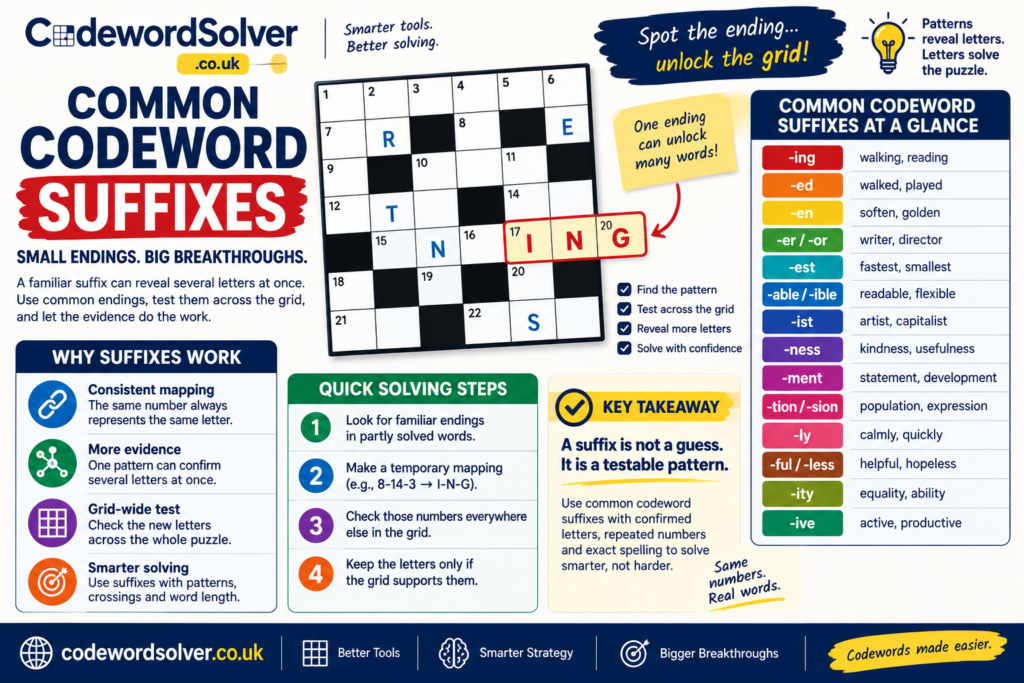
Common codeword suffixes can give you a useful way into a difficult Codeword puzzle. When the same number pattern appears at the ends of several words, a familiar ending may reveal several letters at once.
That does not make suffix spotting a shortcut to every answer. Good solving still depends on confirmed letters, repeated patterns, double letters, spelling, and careful testing. Treat a suffix as evidence, not a guaranteed solution.
What Are Common Codeword Suffixes?
A Codeword is a completed crossword-style grid in which numbers replace letters. Puzzler explains that each letter uses the same number wherever it appears, while a few starter letters help the solver begin. Once you identify a letter, you can enter it everywhere that number occurs.
A suffix is a letter or group of letters added to the end of a word to create another word or word form. Cambridge Dictionary lists common examples such as -ment, -ness, -tion, -able, -ful, -less, -ist, and -ly.
These endings matter in Codewords because they create recognizable letter patterns. Puzzler specifically tells solvers to watch for suffixes such as -ing, -ed, -en, -est, -able, -ist, and -ness.
However, not every familiar group of final letters functions as a suffix in every word. King, for example, ends in “ing,” but it is not “k” plus the suffix -ing. For puzzle solving, the spelling pattern may still help, but the distinction keeps your reasoning accurate.
Common Codeword Suffixes at a Glance
| Suffix | Typical role | Examples | Codeword value |
|---|---|---|---|
| -ing | Verb form or participle ending | walking, reading | Distinctive three-letter pattern |
| -ed | Regular past-tense or participle ending | walked, played | Useful repeated two-letter ending |
| -en | Verb or adjective ending | soften, golden | Puzzler lists it as a pattern to watch |
| -er / -or | Often forms nouns | writer, director | Common short ending patterns |
| -est | Often marks a superlative | fastest, smallest | Recognizable three-letter ending |
| -able / -ible | Often forms adjectives | readable, flexible | Can expose several letters |
| -ist | Often forms nouns | artist, capitalist | Useful three-letter ending |
| -ness | Often forms nouns | kindness, usefulness | Double S gives an extra pattern clue |
| -ment | Often forms nouns | statement, development | Longer ending can reveal more letters |
| -tion / -sion | Often forms nouns | population, expression | Distinctive multi-letter patterns |
| -ly | Common adverb ending | calmly, quickly | Helpful when L or Y is known |
| -ful / -less | Common adjective endings | helpful, hopeless | Useful in partly solved words |
| -ity | Often forms nouns | equality, ability | Recognizable three-letter pattern |
| -ive | Often forms adjectives | active, productive | Useful in longer entries |
Cambridge lists these forms among common English suffixes and shows that suffixes can change a word’s grammatical class. For a Codeword solver, their main value is the predictable spelling pattern they create.
Why Suffixes Work in Codeword Puzzles
Codewords reward consistent letter mapping. If number 8 represents I, every 8 in the grid must represent I. That rule turns a possible suffix into a grid-wide test.
Imagine that one unfinished word ends with 8-14-3. You suspect -ing. Your hypothesis becomes 8 = I, 14 = N, and 3 = G.
Now check those numbers everywhere else. If the new letters create believable fragments in several words, the idea gains support. If they create impossible combinations, reject it.
This approach is stronger than guessing a single letter because one pattern must explain several parts of the puzzle at once.
Which Suffixes Should You Test First?
The best suffix depends on the letters already available. However, some patterns offer especially useful checks.
-ING, -ED, and -EST
Puzzler specifically notes that when a word ends in G, the two preceding letters might be I and N. That makes -ing a natural pattern to test, but never an automatic answer.
The ending -ed appears in many regular past-tense and past-participle forms. Because it contains only two letters, it works best when E or D is already known or when the same number pair repeats.
The suffix -est often appears in superlative adjectives such as fastest and smallest. Its three letters can provide more evidence than a two-letter ending.
-NESS
The suffix -ness deserves special attention because it ends with a double S.
In a standard Codeword, identical letters use the same number. Therefore, a word ending in -ness should show the same number in its final two positions.
That repeated-number pattern does not prove -ness. However, it gives you another structural test.
-ABLE, -MENT, and -TION
Longer endings can produce bigger breakthroughs. Puzzler includes -able among the suffixes worth recognizing, while Cambridge classifies -able and -ible as common adjective-forming suffixes.
Cambridge also lists -ment as a noun-forming suffix and groups -sion, -tion, and -xion among common noun suffixes. If existing letters support one of these longer patterns, you may identify several mappings at once.
However, long guesses spread mistakes quickly. Test every proposed letter across the grid before you commit to the suffix.
Watch for Spelling Changes
Suffixes do not always attach to an unchanged base word.
Cambridge notes that adding a suffix can alter spelling. For example, happy becomes happiness, while create becomes creation.
For Codeword solving, focus on the final spelling of the complete word. Do not reject a valid possibility only because the base changes when the suffix appears.
At the same time, do not invent a spelling just to save a favorite theory. If the completed pattern does not form a valid English word, reconsider the mapping.
How to Test a Possible Codeword Suffix
Start with letters the puzzle has already confirmed. Then examine longer unfinished words and repeated number sequences near their ends.
If an ending resembles -ing, -ness, -ment, -able, or another common pattern, make a temporary mapping. Apply those proposed letters to every matching number.
Next, look for consistency. A useful hypothesis should improve several words without creating obvious contradictions.
Double letters offer another check. Puzzler advises solvers to notice common pairs such as ll, ee, ss, oo, tt, ff, rr, nn, pp, and cc. A repeated number inside a suspected suffix must agree with the repeated-letter pattern.
Most importantly, keep every guess reversible. Codewords punish emotional attachment to bad theories. If the grid starts producing nonsense, let the suffix go. It will cope.
Do Compilers Try to Hide Common Suffixes?
Yes. Puzzler says compilers often try to restrict plurals and common suffixes such as -ing, -ed, -en, -est, -able, -ist, and -ness because obvious patterns can make a puzzle easier.
That changes how you should use common codeword suffixes. Do not expect every other word to contain one. Instead, use suffixes when known letters and number patterns already support the idea.
Puzzler also explains that simple letter-frequency analysis has limits because a Codeword can include a wider range of dictionary words. No fixed frequency rule works perfectly for every grid.
Therefore, suffix recognition works best alongside starter letters, repeated numbers, double letters, word length, and recognizable word shapes.
Common Mistakes to Avoid
The biggest mistake is treating a possibility as a fact. An ending that resembles -ing may represent something completely different.
Another mistake is ignoring the rest of the grid. One attractive word does not justify several broken ones. Every new number-to-letter mapping must work wherever that number appears.
Also, remember that a final letter sequence may look like a suffix without actually functioning as one in that word. Pattern recognition can still help, but accurate spelling matters more than forcing a grammar label.
Finally, do not rely on suffixes alone. Puzzler’s basic solving advice starts with entering the starter letters wherever they occur and then looking for words that suggest themselves.
Frequently Asked Questions
What are the most useful suffixes in Codeword puzzles?
Puzzler specifically highlights -ing, -ed, -en, -est, -able, -ist, and -ness.
Other common English suffixes, including -ment, -tion, -ly, -ful, -less, -ity, and -ive, can also create useful spelling patterns when the grid supports them. Cambridge documents these as established English suffixes.
Why are double letters useful?
The same letter uses the same number throughout a standard Codeword. Therefore, an ending such as -ness should contain matching numbers for its final SS. That gives you another way to test the pattern.
Should I guess a suffix when no letters are known?
Usually, wait for supporting evidence. A suffix becomes more useful when one or more letters are confirmed, the number pattern repeats, or the proposed mapping improves other words.
Guessing blindly may create more work than progress. Codeword puzzles already provide enough numbers without you adding imaginary ones to the problem.
Final Thoughts
Common codeword suffixes can turn a confusing number pattern into a testable set of letters. The key is restraint: recognize an ending, test it across the grid, and keep it only when the evidence agrees.
Use suffixes with starter letters, repeated numbers, double letters, and exact spelling. That combination keeps your solving logical instead of speculative.
Once you start noticing these patterns, a Codeword looks less like a wall of numbers and more like English wearing a numerical disguise. Fortunately, numbers are not very good at keeping secrets.
Sources
Puzzler — Codeword Puzzles Guide: Used for Codeword rules, starter-letter guidance, double-letter patterns, letter-frequency limitations, and the puzzle-specific suffixes -ing, -ed, -en, -est, -able, -ist, and -ness.
Cambridge Dictionary — English Grammar Today: Suffixes: Used for suffix definitions, grammatical functions, spelling changes, and established suffix groups such as -ment, -ness, -tion/-sion, -able/-ible, -ist, -ful, -less, -ity, -ive, and -ly.
Ready to try the solver?
Put what you've learned into practice with our free Codeword Solver.
Try the Codeword Solver