Codeword vs Code Cracker: What’s the Difference?
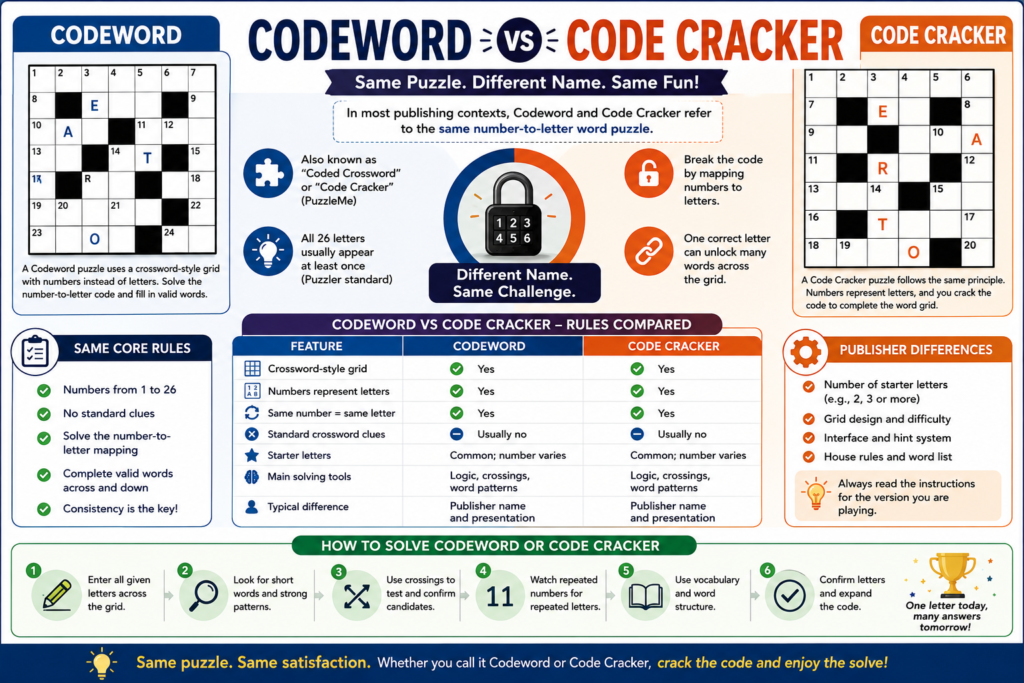
If you are comparing Codeword vs Code Cracker, the answer is simpler than the grids make it look. In most publishing contexts, the two names describe the same core number-to-letter word puzzle. Puzzler lists “Code-Cracker” as an alternative name for Codeword, while PuzzleMe by Amuse Labs says Codeword is also known as “Coded Crossword” or “Code Cracker.”
That does not mean every version looks identical. Publishers can change the number of starter letters, grid design, difficulty, interface, and hint system. However, the central rule stays familiar: numbers stand for letters, and the same number keeps the same letter throughout the puzzle.
So, this is not really a battle between two rival puzzle species. It is more like meeting the same puzzle in a different jacket.
What Is a Codeword Puzzle?
A Codeword puzzle uses a crossword-style grid but removes normal crossword clues. Instead, numbered cells represent letters. Your job is to work out the number-to-letter mapping and complete valid words across and down.
PuzzleMe describes the format with numbers from 1 to 26. Each number corresponds to one letter, and that mapping stays consistent across the grid. Puzzler gives a similar definition. In Puzzler’s standard format, every letter of the alphabet appears at least once.
Most puzzles also give you starter letters. Once you know that a number represents E, every matching number becomes E. One deduction can therefore open several words at once.
That chain reaction explains much of the puzzle’s appeal. Each correct letter gives you more information for the rest of the grid.
What Is a Code Cracker Puzzle?
A Code Cracker puzzle normally uses the same basic mechanism. Numbers replace letters in a crossword-style grid, and the solver must crack the mapping.
The terminology is well established. Puzzler lists Code-Cracker among its alternative names for Codeword. PuzzleMe also treats Code Cracker as another name for the format.
Code-Cracker’s own sample instructions follow the same principle. They state that each number represents a different letter and ask solvers to use supplied letters before working through the remaining words.
Someone who understands Codeword rules should therefore feel at home with a puzzle labelled Code Cracker. House rules may differ, but the solving system remains familiar.
The name “Code Cracker” emphasizes the act of decoding. “Codeword” names the puzzle format. Either way, the numbers are still refusing to identify themselves until you earn it.
Codeword vs Code Cracker: Is There Any Real Difference?
The main Codeword vs Code Cracker difference usually comes from the publisher, not the core rules.
For example, Puzzler says a standard Code Cracker usually gives three starter letters. HD Press uses two revealed letters in its daily Codeword. Both still ask players to decode numbers into letters and complete a word grid.
Digital versions can differ more in presentation. Puzzling.com says that when a player enters a letter for one code number, its interface fills every square carrying that number. It also offers optional “Solve Cell” and “Check for Errors” hints.
These features affect convenience and difficulty, not the core puzzle family. Therefore, always read the instructions for the version you are playing.
Codeword and Code Cracker Rules Compared
| Feature | Codeword | Code Cracker |
|---|---|---|
| Crossword-style grid | Yes | Yes |
| Numbers represent letters | Yes | Yes |
| Same number keeps the same letter | Yes | Yes |
| Standard crossword clues | Usually no | Usually no |
| Starter letters | Common; number varies | Common; number varies |
| Main solving tools | Logic, crossings and word patterns | Logic, crossings and word patterns |
| Typical difference | Publisher name and presentation | Publisher name and presentation |
One detail needs care. Puzzler defines its standard Codeword as using all 26 letters at least once. However, publisher implementations can vary. It is better to treat that as a documented format rule rather than a universal law for every puzzle carrying the name.
How Do You Solve a Codeword or Code Cracker?
Because the core rules match, the same solving methods work for both formats. First, enter every given letter wherever its number appears. Placing all matches gives you more patterns to inspect.
Next, examine short words and strong letter patterns. A three-letter entry with two known letters leaves fewer realistic options than a long word filled with unknowns. Crossings then help you test those possibilities.
Repeated numbers also matter. If one number appears twice in the same entry, the finished word must use the same letter in both positions.
Puzzler recommends watching for double letters and familiar endings. Still, avoid forcing a favourite pattern into the grid. A guess becomes useful when crossing words support it.
In short, treat every answer as part of a network. Codeword rewards deductions that improve several entries at once.
Should You Use Letter Frequency?
Letter frequency can help, but it works better as a supporting clue than a master key.
Some letters occur often in English. However, a Codeword grid contains a limited and deliberately selected set of words. As a result, its letter distribution may not match ordinary written English.
Puzzler makes this point in its solving guide. It explains that different collections of words produce different frequency patterns. Therefore, general letter-frequency rules will not work perfectly for every Codeword puzzle.
Use frequency carefully. A number that appears many times might represent a common letter, but crossings and word structure should confirm your theory.
Otherwise, you may spend ten minutes proving that your beautifully reasoned E was actually an A. Puzzles have a talent for keeping egos appropriately sized.
Are Smaller Codeword Puzzles Easier?
Not necessarily.
Puzzler argues that compact Code Cracker grids can become harder because they contain fewer instances of letters. With fewer repeated numbers, solvers receive less information from each deduction.
Grid size alone therefore does not determine difficulty. Starter letters, vocabulary, repeated patterns, and construction also matter.
A small grid can still hide plenty of trouble.
Is Codeword the Same as a Crossword?
No. The grid may look similar, but the solving process differs.
A conventional crossword gives you written clues. Codeword normally removes those clues and replaces letters with numbers. You identify the number-to-letter mapping and check the resulting words at their crossings.
PuzzleMe describes Codeword as a crossword-like puzzle with no conventional clues. Players instead use numbered cells, pre-revealed letters, logic, and word patterns to recover the hidden words.
Vocabulary helps, but Codeword does not test knowledge like a general-knowledge crossword. Instead, it makes you deduce words from the information already inside the grid.
Is Codeword a Cipher Puzzle?
Codeword borrows from substitution-cipher logic because one symbol consistently maps to one letter. In this case, the symbols are numbers.
However, intersecting words add another layer of information. You are not simply decoding one continuous encrypted sentence. Each crossing can support or challenge a possible letter choice.
HD Press describes Codeword as sitting between a crossword and a cipher puzzle. That description neatly captures the way the format combines a crossword-shaped grid with letter-decoding logic.
Which Is Better: Codeword or Code Cracker?
There is no meaningful winner because the names usually point to the same kind of puzzle.
Instead, compare the version in front of you. Check how many letters it reveals at the start, whether it offers hints, how large the grid is, and whether the interface updates matching numbers automatically.
Print fans may prefer a clear grid and letter key. Digital players may value automatic filling and error checking.
The better choice is the version that suits your preferred difficulty and playing style. The underlying decoding logic remains essentially the same.
Frequently Asked Questions
Is Code Cracker another name for Codeword?
Yes, in established puzzle-publishing usage. Puzzler lists Code-Cracker as an alternative name for Codeword, while PuzzleMe says Codeword is also known as Code Cracker or Coded Crossword.
Does the same number always mean the same letter?
Yes, within the standard format. If 12 represents A, every 12 in that grid represents A. This consistent mapping makes logical deduction possible.
Do Codeword puzzles have normal crossword clues?
Usually not. Standard Codeword puzzles replace conventional clues with numbered cells. Solvers rely on starter letters, crossings, spelling, vocabulary, and pattern recognition.
How many starter letters does a Codeword give you?
The number varies by publisher. Puzzler says a standard Code Cracker usually gives three starter letters, while HD Press currently uses two in its daily Codeword.
Is Codeword harder than Code Cracker?
Not as a general rule. Since both names commonly describe the same puzzle format, difficulty depends more on the grid, starter information, vocabulary, and publisher design.
Final Verdict on Codeword vs Code Cracker
The Codeword vs Code Cracker question has a straightforward answer: the terms usually describe the same core number-to-letter word puzzle.
Puzzler supports that conclusion by listing Code-Cracker as another name for Codeword. PuzzleMe also includes Code Cracker and Coded Crossword as alternative names.
Individual versions can still differ. One publisher may reveal two starter letters, another may use three, and a digital version may add hints or automatic filling. Those are meaningful format differences, but they do not change the basic puzzle.
In both cases, you decode numbers, apply each letter consistently, test words at their crossings, and continue until the grid makes sense.
So, choose the version whose layout and difficulty suit you. Whether the heading says Codeword or Code Cracker, the mission remains the same: crack the code without letting a three-letter word ruin your afternoon.
Ready to try the solver?
Put what you've learned into practice with our free Codeword Solver.
Try the Codeword Solver