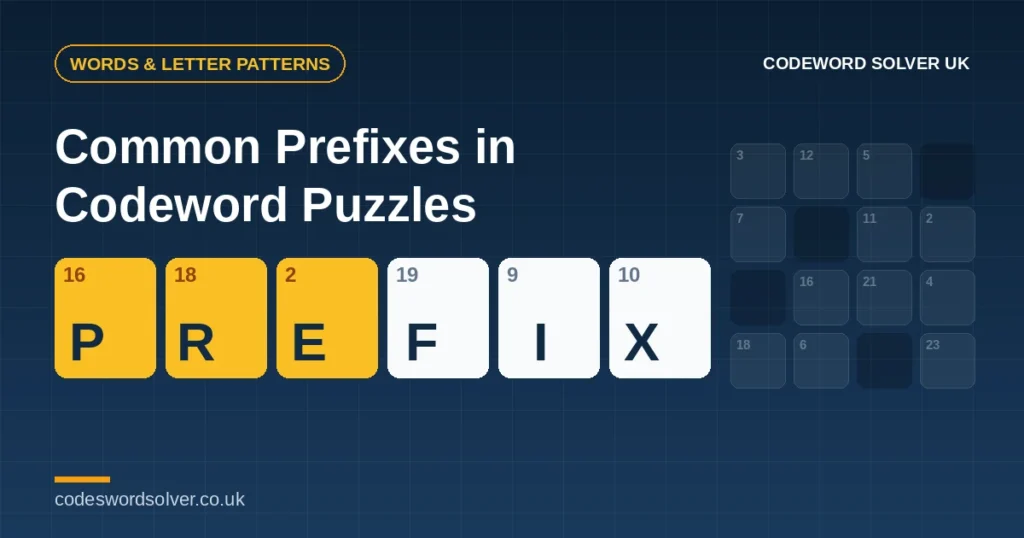
Common codeword prefixes include UN-, RE-, DIS-, MIS-, PRE- and NON-. They can help you recognise the beginning of a partly solved word and generate candidates for unknown numbers. A possible prefix is useful only when the complete word fits the grid.
Start with the letters you already know. If an entry begins UN?, you may be looking at a prefixed word such as UNFAIR, but you might also be looking at a word such as UNCLE. The first two letters alone do not tell you how the word was formed.
What is a prefix?
A prefix is a meaningful element added at the beginning of a word. For example, adding UN- to FAIR produces UNFAIR, and adding RE- to DO produces REDO. The BBC Skillswise prefix worksheet explains familiar examples of this word-building process.
A codeword does not normally supply definitions for each answer, so a prefix’s meaning rarely identifies the answer directly. Its main value is structural: it suggests plausible letter sequences, complete words and repeated-letter relationships that you can test.
Keep prefixes separate from arbitrary beginnings. RE- has a clear role in REBUILD, but the first two letters of RED are not a prefix. You can still use RED as a candidate where it fits; you simply should not analyse it as RE plus D.
Useful prefixes and example words
This table provides a manageable starting reference. The words illustrate patterns rather than measured frequencies in newspaper puzzles. Count the letters yourself when testing any example against an entry.
| Prefix | Typical meaning | Example words |
|---|---|---|
| UN- | Not, or reversal | UNFAIR, UNLOCK, UNDO |
| RE- | Again or back | REDO, REBUILD, REWRITE |
| DIS- | Negation or reversal | DISLIKE, DISARM |
| MIS- | Wrongly or badly | MISREAD, MISUSE |
| PRE- | Before | PREPAY, PREHEAT |
| NON- | Not | NONSTOP |
| OVER- | Too much, among other senses | OVERCOOK, OVERPAY |
| UNDER- | Too little, among other senses | UNDERPAY |
Cambridge’s prefix reference gives further examples and notes that a dictionary can help with how prefixed words are written. That matters when a possible answer has a hyphenated and an unhyphenated form.
For codewords, the displayed cells represent the answer accepted by that puzzle. Do not remove a hyphen or join a phrase automatically just to make a candidate fit. Read the publisher’s word-entry rules first.
Start with a constrained beginning
A completely unknown seven-letter word could start in many ways. Listing every prefix is usually less useful than looking for a confirmed letter or a repeated number. Narrow the problem with examples of codeword patterns before searching your vocabulary.
For example, RE?U?E suggests possibilities such as REFUSE, REFUGE and RESUME. If positions three and five carry different numbers, all three remain structurally possible at that stage. An additional confirmed letter can distinguish them.
The presence of RE at the front does not require a productive RE- prefix. This is why the whole-word check matters more than a neat grammatical explanation. The grid asks for a valid answer, not a word-building exercise.
If you are still learning the underlying mapping rules, review how the numbers reveal word shapes before using prefixes. An attractive beginning cannot override an incompatible number relationship.
A worked example with UNFAIR and UNPAID
Consider this constructed six-letter entry: 8 3 12 5 9 7. All six numbers differ. Suppose 8 = U, 3 = N, 5 = A and 9 = I are independently confirmed. The visible pattern is UN?AI?.
UNFAIR and UNPAID are two familiar candidates. Both, unlike 5-letter words, use six different letters, so both satisfy the all-different number pattern. The letters UN suggest a useful way into the search, but they do not settle the word.
| Candidate | Proposed number 12 | Proposed number 7 |
|---|---|---|
| UNFAIR | F | R |
| UNPAID | P | D |
Now look elsewhere for number 7. If a supplied letter already assigns D to number 20, UNPAID fails: it would give D to two different numbers. UNFAIR survives that test, although you should still check F and R throughout the grid.
Alternatively, an independently solved crossing may establish 7 = R. That directly supports UNFAIR and rules out UNPAID. Notice that the decisive evidence is the mapping, while the prefix helped you generate the candidates.
Look for repeats across the prefix boundary
A prefix can create a repeated-letter relationship that continues into the base word. These relationships can be more useful than the prefix itself. Read every occurrence of a number, including those separated by several cells.
UNNEEDED has the pattern 1 2 2 3 3 4 3 4. The N at the end of UN- meets the initial N of NEEDED, and the full word also repeats E and D. A candidate must preserve all of those relationships.
REWRITE has the pattern 1 2 3 1 4 5 2. Its first and fourth letters are R; its second and seventh letters are E. Treating it as “RE followed by any five letters” would throw away valuable evidence.
Use the checking words with repeated letters when a promising prefix gives you several candidates. Often the exact repeat pattern will remove options before crossings are needed.
Do not force a prefix onto every word
Some words begin with familiar prefix-like letters without offering a useful base word after removal. UNCLE and RED are straightforward reminders. A solver who insists that every UN or RE beginning must divide cleanly may reject a correct answer.
Similarly, a partly filled word can tempt you to see an entire prefix too soon. A beginning ?N is not enough to establish UN. It might belong to another sequence entirely, depending on the remaining letters and numbers.
Write your hypothesis explicitly: “If 8 = U, this begins UN.” That wording keeps the uncertain assignment visible. After entering a tentative U, inspect all other 8s before deriving several more letters from it.
Combine beginnings and endings
A prefix becomes more useful when suffixes to check are also constrained. A seven-letter entry beginning RE and ending ING has fewer familiar possibilities than a seven-letter entry beginning RE alone. However, the middle and repeated numbers still need checking.
For example, words that end in ING, such as READING, contain seven different letters, while REELING repeats E. If your number pattern has all different codes, REELING cannot fit. If positions two and three share a code, READING cannot fit.
Our guide to recognising useful word endings gives a broader reference for the other side of the word. Use the two references together to generate candidates, then compare each candidate with the complete pattern.
Be careful about word length after a prefix is added. REBUILD has seven letters, not six. Count the actual proposed spelling rather than adding a remembered length for the base word in your head.
Use a solver to check the complete pattern
The search with the letters you already know can help when you know the beginning but cannot recall a full word. Follow its input instructions and include every confirmed letter, not only the suspected prefix.
If you enter a tentative prefix as fixed text, the results will assume that prefix is correct. No results might mean the prefix is wrong, another letter is wrong, or the word collection lacks the answer. It does not automatically mean the puzzle has an error.
Try a second search with only confirmed letters if the first search fails. Compare the resulting candidates with the numbered grid, especially repeated positions and letters already assigned elsewhere.
A short checking routine
- Copy the entry’s exact length and number pattern.
- Insert all confirmed letters.
- Consider a prefix only when the visible structure supports it.
- List complete dictionary words, not unfinished prefix guesses.
- Reject words that break repeated-number or used-letter constraints.
- Test surviving mappings in other entries before confirming them.
Keep a record of why a candidate failed. “Wrong final letter” is more useful than “did not work”, because it tells you whether a later change elsewhere should make you reconsider it.
Frequently asked questions
Is RE always a prefix?
No. It can function as a prefix in words such as REDO, but the same letters also occur at the start of words where that analysis is not helpful.
Should I learn every English prefix?
No. A small set of familiar beginnings is enough to start. Accurate pattern checking is more useful than an enormous list that encourages speculative answers.
What if the prefix fits but a crossing fails?
Recheck the provisional prefix and the crossing’s evidence. A candidate must satisfy the whole puzzle. Keep supplied letters fixed and revise unsupported assumptions first.
Sources
- BBC Skillswise: Using prefixes
- Cambridge Dictionary: Prefixes
- Codeword Solver: Repeated-letter rules

Codeword Solver Team
The Codeword Solver Team builds and maintains Codeword Solver UK, a free codeword, code cracker and coded crossword solver for British puzzles. We write the solving guides published on this site and test every tool against UK dictionary word lists and real newspaper style codeword patterns.
View this author's guides →