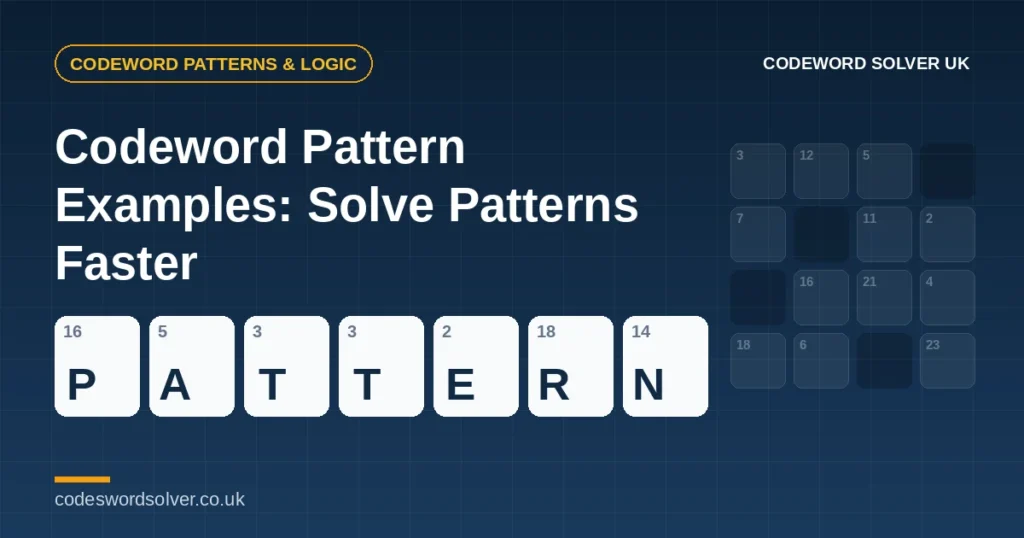
Codeword pattern examples make number-based word puzzles much easier to understand. Instead of giving you normal crossword clues, a Codeword puzzle places a number in each letter square. Each number represents one letter, and the same number keeps the same letter throughout the grid. Codeword is also known as a Coded Crossword or Code Cracker.
That rule turns every repeated number into useful information. If a five-letter entry reads 7-12-12-4-19, you already know that the second and third letters match. You may not know the word yet, but you know its structure.
This guide explains how to read Codeword patterns, use repeated letters, test wildcard patterns, apply English letter frequency, and confirm answers through crossing words.
The goal is simple: make fewer guesses and make better deductions.
What Is a Codeword Pattern?
A Codeword pattern shows how letters repeat inside a hidden word. For clarity, this number-pattern guide converts each new letter into the next number in a sequence.
Take APPLE:
1-2-2-3-4
A is the first unique letter, so it becomes 1. P is the next new letter, so it becomes 2. Because the second P repeats, it also gets 2. L becomes 3, and E becomes 4.
This normalized pattern is a solving aid, not an official numbering system used by every Codeword publisher.
In an actual puzzle, the codes may look completely different. For example, APPLE might appear as 8-15-15-3-21.
What matters is the relationship between the positions. PuzzleMe’s Codeword rules confirm that each number maps consistently to the same letter throughout a puzzle.
Think of the pattern as the word’s skeleton. It does not tell you the word, but it tells you which bones are connected.
Codeword Pattern Examples With Repeated Letters
Repeated letters give you strong constraints because any candidate word must repeat letters in exactly the same positions.
APPLE and ADDLE: 1-2-2-3-4
APPLE follows:
1-2-2-3-4
So does ADDLE.
Both words start with one unique letter, repeat the second letter in position three, and then end with two different letters.
Suppose crossing answers reveal this shape:
A ? ? ? E
If positions two and three carry the same code, APPLE and ADDLE still fit.
However, AMPLE does not because M and P differ.
LEVEL and REFER: 1-2-3-2-1
LEVEL follows:
1-2-3-2-1
The first and fifth letters match. The second and fourth letters also match. Only the middle letter appears once.
REFER has the same pattern.
This example shows why a pattern cannot solve every word on its own. Two different words can share the same structure.
Therefore, you still need crossing entries or confirmed code-to-letter mappings to choose the right answer.
BANANA: 1-2-3-2-3-2
BANANA produces:
1-2-3-2-3-2
A appears in positions two, four, and six. N appears in positions three and five. B appears only once.
A candidate must repeat its letters in those positions, or you can reject it.
LETTER: 1-2-3-3-2-4
LETTER follows:
1-2-3-3-2-4
T repeats in positions three and four, while E appears in positions two and five. L and R appear once.
Patterns like this give you several constraints before you identify a single unknown letter.
How Wildcard Codeword Patterns Work
A wildcard marks a letter that you do not know yet.
Different puzzle tools may use a question mark, dot, or underscore for wildcards. Therefore, check the rules of the solver or website you use.
In the examples below, ? means one unknown letter.
Suppose you know a five-letter word starts with A and ends in LE:
A??LE
Possible English words include APPLE, ADDLE, AMPLE, ANGLE, and ANKLE.
Now add one Codeword constraint. Imagine positions two and three use the same number.
The structure becomes:
A X X L E
APPLE and ADDLE still work.
AMPLE, ANGLE, and ANKLE do not because their second and third letters differ.
The same method works with ?R??T. FRONT, GRANT, PRINT, and TREAT fit the visible letters, while repeated codes and crossings can narrow the list.
Why Letter Frequency Helps With Codeword Patterns
English uses some letters more often than others. That makes frequency analysis useful when you solve a substitution-style puzzle.
Emory University’s published English frequency table lists E as the most frequent letter in its dataset, followed by T, A, O, I, N, and S.
Cornell University also gives the frequency order ETAOINSRHLDCUMFPGWYBVKXJQZ from a text sample of one million words.
Therefore, how often letters appear matters: a code number that appears often across a large grid may represent a common English letter such as E or T.
However, treat frequency as a clue, not a verdict.
A single Codeword grid contains a limited set of words, so its letter distribution can differ from a large language sample.
In short, the most common number is not automatically E. The alphabet has not signed that contract.
Use frequency to form a hypothesis. Then test that hypothesis against several words.
Common Letter Pairs Can Strengthen a Guess
Pairs of letters can also help.
Emory’s frequency resource lists TH, HE, IN, EN, NT, RE, ER, AN, and TI among the most common English bigrams in its data.
Suppose two code numbers appear next to each other several times.
If other evidence suggests that the first number represents T and the second represents H, the pair TH becomes a sensible possibility.
Still, do not force the answer.
A useful Codeword deduction normally has several clues supporting it at the same time. The pattern should fit, crossing words should work, and the same code-to-letter mapping should remain valid elsewhere in the grid.
A Step-by-Step Codeword Pattern Example
Consider this five-number entry:
8-15-15-3-21
Positions two and three repeat, so its normalized structure is:
1-2-2-3-4
Now suppose a crossing word confirms 8 = A. Another solved entry confirms 21 = E.
You now have:
A ? ? ? E
Because code 15 appears twice in adjacent positions, those two letters must match:
A X X ? E
APPLE fits. ADDLE also fits.
AMPLE does not because its second and third letters differ.
Next, suppose another crossing confirms 3 = L:
A X X L E
APPLE and ADDLE remain possible.
Finally, another confirmed entry gives you 15 = P.
The answer becomes:
APPLE
The repeated code, crossing letters, and consistent number-to-letter mapping solve the entry without a lucky guess.
How to Solve Codeword Patterns More Reliably
Start with the information the grid gives you for free, and use it to fill in the missing letters. Repeated numbers, known letters, and crossing words can all reduce the number of possible answers.
A practical solving process looks like this:
- Mark confirmed letters first. Use letters supplied by the puzzle and mappings you have already proved.
- Look for repeated codes. Double letters and repeated positions reveal a word’s structure.
- Compare candidate words by pattern. Reject any word that breaks the repeated-letter structure.
- Use crossings to test candidates. A good answer should create sensible words in both directions.
- Use letter frequency as supporting evidence. Common letters can guide you, but they should not override the grid.
- Check every mapping globally. If code 14 means R in one place, it must mean R everywhere else in a standard Codeword puzzle.
- Revisit weak assumptions. If several entries become impossible, inspect the least certain assignment instead of forcing awkward words.
PuzzleMe describes the same core consistency rule: one number corresponds to one letter, and that mapping remains consistent across the puzzle.
The grid is consistent; your favorite guess is not entitled to job security.
Common Mistakes When Reading Codeword Patterns
One common mistake is treating a plausible word as a confirmed answer too early.
APPLE may fit A??LE, but so can several other words. Repeated codes and crossings decide whether APPLE actually belongs there.
Do not rely too heavily on frequency either. A particular puzzle can differ from large English samples.
Solvers can also overlook repeated positions.
If the same code appears twice in a word, those positions cannot contain different letters. That rule gives you a hard constraint, not a suggestion.
Finally, avoid changing a confirmed mapping to rescue one weak candidate.
In a standard Codeword puzzle, the same number represents the same letter across the entire grid.
Final Thoughts on Codeword Pattern Examples
The best Codeword pattern examples show why these puzzles reward logic more than random guessing.
Start by reading the structure. Notice repeated codes. Add confirmed crossing letters. Then use English letter frequency and common letter pairs as supporting clues.
Patterns such as APPLE = 1-2-2-3-4, LEVEL = 1-2-3-2-1, BANANA = 1-2-3-2-3-2, and LETTER = 1-2-3-3-2-4 make repeated-letter relationships easy to see.
Once you learn to spot those relationships, a grid of numbers starts to look far less mysterious.
You are not trying to guess every hidden word at once. You are reducing the possibilities until only a consistent answer remains.
And that is the pleasant little trick behind Codeword solving: the numbers are not getting easier. You are getting better at reading what they already tell you.
Sources
PuzzleMe Help Center by Amuse Labs explains the Codeword format, including its numbered grid, one-letter-per-number mapping, crossing words, and consistent substitutions.
Emory University Mathematics provides the English letter-frequency table and its published list of common bigrams.
Cornell University Mathematics provides an English letter-frequency ordering based on a one-million-word text sample.

Codeword Solver Team
The Codeword Solver Team builds and maintains Codeword Solver UK, a free codeword, code cracker and coded crossword solver for British puzzles. We write the solving guides published on this site and test every tool against UK dictionary word lists and real newspaper style codeword patterns.
View this author's guides →