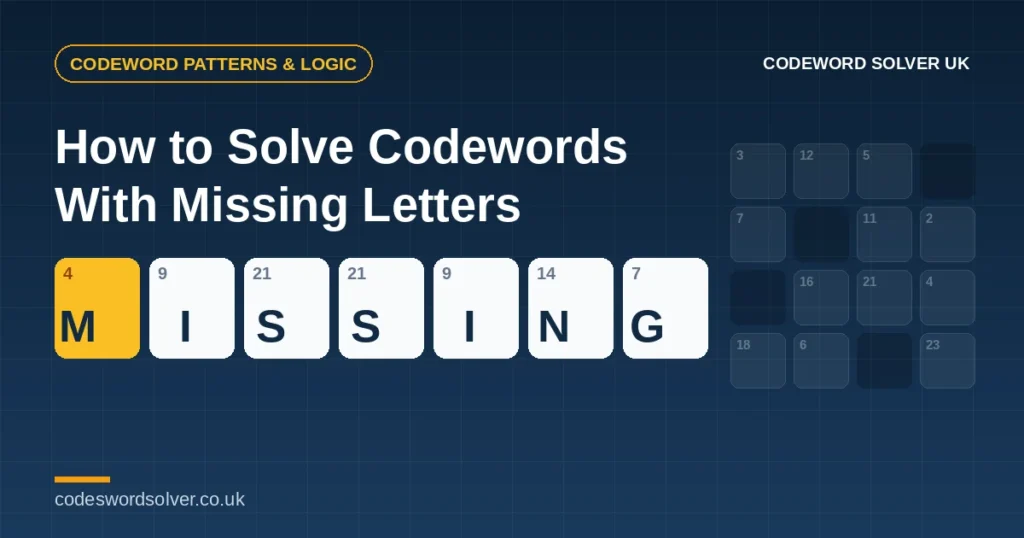
To solve codewords with missing letters, record the entry’s exact length, enter only confirmed letters and preserve the relationships between repeated numbers. Generate possible words, then test each proposed mapping against the complete key and other entries.
A blank in a codeword is not simply a missing letter in a spelling exercise. Its number may appear elsewhere, and those positions must share its eventual letter. That connection often supplies the evidence that a single incomplete word cannot provide.
This guide shows how to read the pattern, compare candidates and use a missing-letter tool without losing information from the original grid.
Start with the numbered entry
Copy the complete number sequence before replacing anything with a blank. If the entry is 6–2–6–9, positions one and three must contain the same letter. Writing ???? would hide that useful relationship. Remember what the numbers mean: repeated numbers share a letter.
Enter all supplied letters throughout the grid and update your key. A missing starter in a distant entry can conceal the easiest next deduction. Keep trial letters separate so that a search does not treat a guess as an established restriction.
The main guide, How to Solve Codeword Puzzles, explains the full solving sequence. Here, the focus is on converting incomplete information into a useful candidate comparison.
Count the squares accurately
Every position needs one letter. A six-square answer requires a six-position pattern, even if only two letters are known. Count from the original grid rather than from the word you hope will fit. Miscounts are among the common codeword mistakes.
For example, P?AN?T has six positions and admits PLANET as a spelling match. P?ANT has five positions and cannot represent PLANET. One omitted wildcard changes the search question.
Also check the start and end of the entry. A blocked square is not part of an answer, and a small printed number can be mistaken for its neighbour when copied quickly.
Preserve confirmed letters and uncertainty
Suppose an entry reads ?A?E. The A and E may come from supplied letters or reliable deductions. Leave the remaining positions open until you have evidence about them.
If you suspect the answer is GAME, do not put G and M into a search and then interpret the returned GAME as confirmation. The result follows from the restrictions you entered. Search with the reliable pattern first, then compare candidate consequences.
Use a short note such as “G/M trial from GAME” if you explore that branch. This makes it easier to undo the trial if another entry rejects it.
Repeated numbers can remove familiar candidates
Return to the sequence 6–2–6–9, with 2 = A and 9 = E. Its visible letters are ?A?E, but the first and third positions are linked. RARE and BABE fit that structure; GAME and NAME do not.
GAME would make number 6 mean both G and M. NAME would make it mean N and M. Both fail before you consider crossings or how familiar the words feel.
Different numbers also need different letters under the standard one-to-one rule. If every number in a four-letter entry differs, NOON cannot fit because it repeats both N and O.
Read how repeated numbers constrain missing letters when a basic wildcard pattern returns too many apparently suitable words.
A worked candidate check
Consider an original teaching entry numbered 3–7–12–5. The confirmed key gives 3 = S, 7 = A and 5 = E, so the entry reads SA?E.
SAFE, SAGE and SAME are three examples to investigate. They propose F, G and M for number 12. This is a working shortlist, not a claim that no other dictionary word fits.
| Candidate | Proposed mapping | What to inspect next |
|---|---|---|
| SAFE | 12 = F | Every other occurrence of 12 |
| SAGE | 12 = G | Whether G is already assigned elsewhere |
| SAME | 12 = M | Every other occurrence of 12 |
Suppose G already belongs to number 20. SAGE then conflicts with the complete key. Its spelling matches the local pattern, but the mapping fails globally.
Next, suppose an independently constrained entry containing number 12 reads ?ROG. F produces FROG, while M produces MROG, which fails the intended ordinary-word test. This separates the F/M alternatives you recorded.
Before confirming 12 = F, examine all remaining candidates and every occurrence of 12. The example shows how additional constraints narrow a shortlist; it does not replace a complete dictionary or full-grid check.
Use single-letter wildcards correctly
Our Codeword Solver Missing Letters documents ?, ., _ and * as symbols for one unknown position each. In that tool, a star does not represent an arbitrary number of letters.
Thus C*T describes three positions, while C????T describes six. Use the number of placeholders that matches the grid. Do not import the meaning of a symbol from another website or a file-search system.
Keep the pattern free of spaces and use documented syntax. For more examples, see Codeword Wildcards Explained.
Understand what a search result establishes
A candidate tool searches its available word list using the constraints it receives. It may not know your entire number key or relationships between separate entries. A returned word is therefore a candidate to check.
If you use anonymous wildcards for repeated numbers, manually enforce the repetitions afterwards. If the tool supports a linked-number format, follow its examples carefully rather than assuming how multi-digit labels are interpreted.
Do not treat the first suggestion as the intended answer. Likewise, one result in a limited dictionary does not prove uniqueness across every word the publisher might allow.
When no words appear
Recount the positions and recheck every fixed letter. Then remove the least certain trial letter while keeping reliable constraints. Change one thing at a time so that you can identify which restriction caused the empty result. If the solver finds no matches, the pattern or a fixed letter is usually wrong.
Review the selected dictionary and the publisher’s spelling conventions. British forms can differ in length or letter order from American forms. COLOUR and COLOR, for instance, cannot occupy the same number of squares.
A broader list may reveal an unfamiliar but valid word. Verify its meaning and puzzle eligibility. Do not accept an invented spelling merely because it makes a difficult corner look complete.
Choose the next blank by its connections
You do not have to solve an entry from left to right. Find the unresolved number that appears in the clearest other context. One strong linked entry may settle a blank more easily than repeatedly searching the original word. The crossing words around it often settle the blank first.
After confirming a letter, enter it everywhere and scan the grid again. Newly improved patterns may now be more informative than the word you were previously studying.
If several candidates survive, record their differences and move on. Leaving a blank unresolved is appropriate when the evidence has not yet distinguished the alternatives.
Common questions about missing codeword letters
Does every blank in a search represent a different letter?
Not necessarily. A plain wildcard usually leaves the position open. The original grid numbers determine whether two positions must match or differ. Preserve that information separately if the search does not encode it.
Should I test vowels first?
Only as a hypothesis. Word structure may suggest vowels, but an unknown position can also be a consonant or Y. Do not exclude valid candidates through a rule the grid does not impose.
Can I confirm a word from its crossing alone?
A crossing supplies one constraint. The whole word must also match its length, repeated numbers and complete key. Letters introduced by the same guess do not provide independent confirmation of that guess.
Finish with a consistent key
Check every completed entry in both directions and compare each square with the number key. Confirm that repeated numbers agree and that different numbers do not share a letter.
The useful result is not merely a filled blank. It is a mapping that works throughout the puzzle. Keep that wider check in view, and missing letters become connected decisions rather than isolated guesses.
Sources
- Codes Word Solver: Missing Letters Solver and wildcard instructions.
- Puzzler: Codeword rules.
- Lovatts Puzzles: Code Cracker instructions.

Codeword Solver Team
The Codeword Solver Team builds and maintains Codeword Solver UK, a free codeword, code cracker and coded crossword solver for British puzzles. We write the solving guides published on this site and test every tool against UK dictionary word lists and real newspaper style codeword patterns.
View this author's guides →