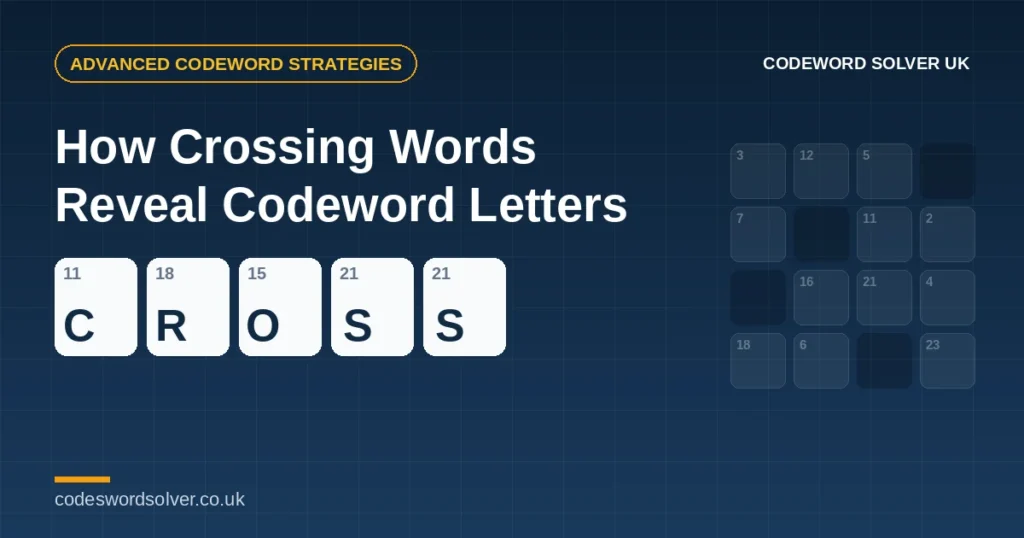
Crossing words reveal codeword letters by making two answers share the same cell. When one answer establishes that letter, the other gains a confirmed position. In a codeword, the deduction goes further: every cell with the same number must take the same letter, even on the other side of the grid.
The useful skill is deciding whether a crossing really confirms a candidate or merely repeats your original guess. This guide uses a small constructed fragment to show both situations and gives you a practical routine for following the evidence.
Two ways codeword entries connect
A physical crossing occurs where an across and a down answer share one square. There is only one letter in that square, so the answers cannot disagree about it.
A number connection occurs when separate squares carry the same number. Those squares also require the same letter in the standard codeword format. The words do not have to touch.
Lovatts’ Code Cracker instructions describe this consistent mapping throughout the grid. To see how it affects different word shapes, review following matching numbers between entries. For a second illustration, see the worked pattern examples.
| Connection | What is shared? | What a confirmed letter changes |
|---|---|---|
| Across and down crossing | One physical cell | Both intersecting answers |
| Matching numbers elsewhere | The same number-to-letter assignment | Every occurrence of that number |
Use both relationships. Focusing only on the immediate crossings can hide a much clearer deduction in a distant word.
Start with independently confirmed information
Copy all supplied letters into the key and every matching square before comparing candidates. Then separate established deductions from letters you have entered provisionally.
This distinction matters because a crossing inherits whatever confidence its letter deserves. A supplied T provides firm evidence. A T entered because you guessed CAT remains a hypothesis when it appears in another word.
If you use pencil notes, keep tentative assignments beside the key rather than mixing them with confirmed ones. In a digital interface, use any supported notes feature, or keep a separate record.
Our guide to checking deductions before filling more cells explains why several consequences of one guess do not automatically become independent proof.
A small fragment with an unresolved crossing
The following is a constructed teaching fragment, not a complete newspaper puzzle. Each row and column forms a three-letter entry. Assume the confirmed key gives 4 = C, 9 = A, 7 = R, 3 = E and 16 = N. Number 12 is still unknown.
| Column 1 | Column 2 | Column 3 |
|---|---|---|
| 4 · C | 9 · A | 12 · ? |
| 9 · A | 7 · R | 3 · E |
| 12 · ? | 3 · E | 16 · N |
The top row reads CA?, the middle row reads ARE, and the bottom row reads ?EN. The first column also reads CA?, while the third reads ?EN.
You might propose T for number 12, producing CAT and TEN. That is plausible, but P would produce CAP and PEN. Both proposals make ordinary words in this fragment, so the local crossings do not settle the choice.
This is a useful moment to stop guessing and look elsewhere. The fragment gives a consistency check, but it does not yet identify the intended mapping.
Use a distant entry to resolve the shared number
Now suppose another entry elsewhere in the constructed puzzle has numbers 3 18 12 7 9. Number 18 has independently been established as X. With the existing key, the word reads EX?RA.
EXTRA is a fitting candidate and proposes 12 = T. In contrast, the P proposal from CAP and PEN would give EXPRA, which does not provide the ordinary dictionary completion needed here.
Check EXTRA’s complete mapping: E belongs to 3, X to 18, T to 12, R to 7 and A to 9. Its five distinct letters match five distinct numbers. Also check that T has not already been assigned to another number.
With that independent context supporting T, return to the fragment. Both occurrences of 12 become T, producing CAT, ARE and TEN across and down. The distant entry supplied information that the local crossings lacked.
In a real puzzle, check the publisher’s permitted vocabulary and any other occurrences of the number before confirming the assignment. The example illustrates the reasoning without claiming that a small fragment always has a unique answer.
How to Solve Two Connected Codeword Words
When two entries share more than one unknown number, compare whole pairs of answers. Checking only one crossing may leave a conflict hidden at the other shared position.
In this original example, confirmed mappings give ?A?E for 8–1–9–2 and ?O?E for 8–3–9–2. You already know 1 = A, 2 = E and 3 = O. The unknowns, 8 and 9, must each keep the same value in both entries.
| First candidate | Proposed mappings | Required second word |
|---|---|---|
| CAKE | 8 = C; 9 = K | COKE |
| CARE | 8 = C; 9 = R | CORE |
| MADE | 8 = M; 9 = D | MODE |
These three pairs are consistent locally if their letters remain available. This is an illustrative shortlist, not every dictionary possibility. CARE and MODE are individually familiar, but they cannot be paired here: number 8 would have to mean both C and M, while number 9 would have to mean both R and D.
Now suppose an independently solved part of the grid already assigns M to number 14. Under the standard one-to-one mapping, 8 cannot also be M, so MADE/MODE is eliminated. The other pairs survive that check, but neither is proved.
Choose the next useful entry
The remaining pairs agree on 8 = C and differ on number 9. If this were a complete candidate list, C would follow; because it is only a shortlist, keep that conclusion provisional. Look for another occurrence of 9 surrounded by confirmed letters. An entry that distinguishes K from R will help more than one where both still work.
Use How Linked Number Patterns Reveal Words in Codeword Puzzles for more shared-number logic. For a broader walkthrough, follow the steps for solving codewords with missing letters. Keep a pair provisional until its proposed mappings survive the rest of the grid.
Compare candidates at the crossing position
When an across entry has several candidates, identify the precise position where they differ. If LAKE and LATE are the remaining examples, the third letter is the unresolved question. To decide between LAKE and LATE, start from what the numbers mean.
Find the down entry through that cell and every other occurrence of its number. A strongly constrained word elsewhere may distinguish K from T more easily than the across entry does.
Keep the candidate set honest. LAKE and LATE may be the two words you remember, but that alone does not establish that they are the only permitted answers. A dictionary or suitable search can broaden the set.
For shorter connected entries, use recognising patterns in three-letter answers to generate possibilities, then apply the numbers and confirmed letters as filters.
Check repeated letters before trusting a crossing
A candidate may agree with the crossing letter but still fail elsewhere in its own entry. Suppose a five-letter word has the pattern 1 2 3 2 1. LEVEL fits, while LEVER does not, even though both share their first four letters.
The last position must repeat the first. An intersecting E in position two cannot compensate for the wrong final letter. Always compare the complete word with its number pattern.
Likewise, two different numbers cannot both become L in a standard one-to-one codeword. Use checking every repeated position in an answer when a word appears convincing but a connected entry keeps failing.
Avoid circular confirmation
Imagine you guess CAT, place T in its last cell, and then read TEN in the crossing entry. Saying “TEN proves CAT” overlooks where the T came from. Both words may depend on the original guess, as the teaching fragment showed.
A stronger check uses letters established independently of that guess. In the distant EX?RA example, E, X, R and A were already known. They supplied additional constraints on the disputed number.
When unsure, ask: “Would this evidence still exist if I removed my first guess?” If the answer is no, treat it as a consequence of the hypothesis rather than independent support.
This does not make tentative exploration useless. It simply helps you distinguish a promising branch from a deduction you can safely keep.
What to do when connected answers disagree
First check transcription. Confirm the number in the shared cell, the direction of each entry and the placement of every known letter. A copied number or overlooked repeated square can create a false contradiction.
Next review tentative assignments. Preserve supplied letters and independently verified mappings. Reconsider the candidate that introduced the unsupported letter, along with any later deductions that depended on it. If an assignment collapses, remove it and recover from a wrong letter.
Finally, check spelling and vocabulary. An unfamiliar completion deserves a proper dictionary check; failing to recall a word is not proof that none exists. Equally, do not invent a spelling to rescue an attractive across answer.
Use a tool to compare the connected information
You can compare entries sharing the same unknown when several patterns are difficult to hold in mind. Follow the tool’s syntax and enter confirmed letters accurately. Run the comparison in the grid solver.
If a guessed letter is included as fixed text, the results will depend on that assumption. Keep a note of it and repeat the search without it if the connected words fail.
Inspect returned candidates against the original grid. A tool’s word collection and supported constraints determine its results; it may not automatically enforce every relationship you know from the puzzle.
A repeatable crossing routine
- Choose a constrained entry and record its surviving candidates.
- Identify the numbers on which those candidates differ.
- Inspect the crossing entries and distant occurrences of those numbers.
- Use independently confirmed letters to test the alternatives.
- Check the complete mapping, then propagate any confirmed letter everywhere.
After updating the grid, scan again. One resolved crossing can create a simpler deduction elsewhere. Follow that new evidence instead of staying with the same difficult entry out of habit. For the full method, see the advanced solving strategies.
Sources
- Lovatts: Code Cracker instructions and shared-number mapping.
- Puzzler: Codeword rules and construction guidance.
- Codeword Solver: Repeated-number relationships and solving without guessing.

Codeword Solver Team
The Codeword Solver Team builds and maintains Codeword Solver UK, a free codeword, code cracker and coded crossword solver for British puzzles. We write the solving guides published on this site and test every tool against UK dictionary word lists and real newspaper style codeword patterns.
View this author's guides →