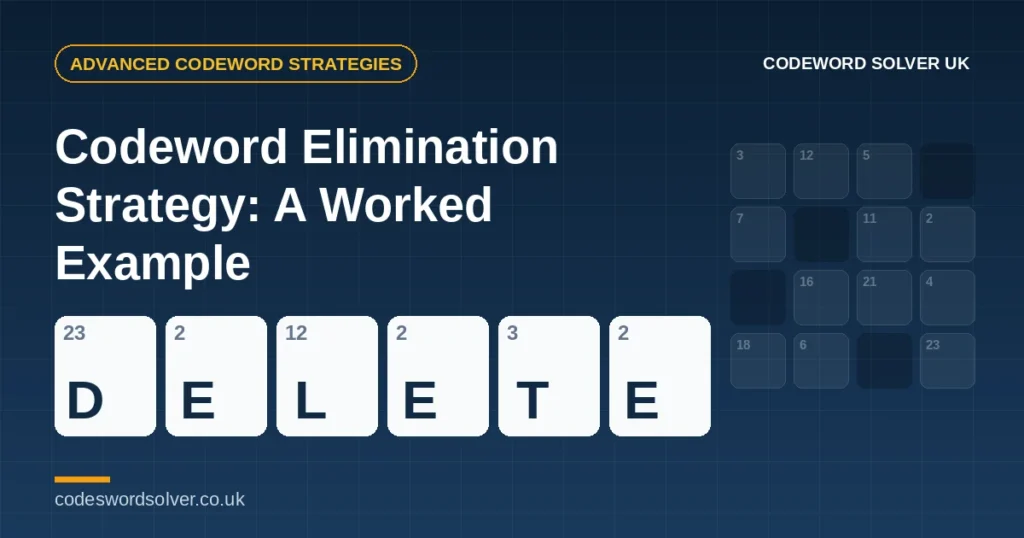
A codeword elimination strategy removes answers that conflict with the grid before you decide which answer is correct. Start with the entry’s length, repeated numbers and confirmed letters, then check each proposed mapping against the rest of the key. Every rejected candidate should have a clear reason.
This method is especially useful when several familiar words seem to fit. It replaces “that word looks likely” with a smaller, documented set of possibilities. You can make progress even when you cannot yet finish the entry.
What counts as a valid reason to eliminate a word?
Some checks are decisive. A six-letter word cannot fill five cells. A word with a double letter cannot fit different numbers in those positions. A candidate cannot change a supplied letter or assign an already confirmed letter to a second number.
Other observations are weaker. An unusual word, an unexpected vowel or a rare letter may deserve investigation, but none is automatically a contradiction. Distinguish a rule violation from a preference for familiar vocabulary.
The standard number-mapping rules are described in publisher instructions such as Lovatts’ Code Cracker guidance. Our explanation of what matching numbers require shows how those rules become practical filters.
Build a candidate list from the exact pattern
Copy the entry’s numbers before writing possible words. Mark repeated positions and insert confirmed letters. This prevents a candidate from shaping your memory of the pattern. For unknown letters, see how wildcards work.
For an entry reading ?A?E, your initial thoughts might include BAKE, CAKE, GAME, NAME and PAGE. These are illustrative candidates, not a complete dictionary list. Other words may fit, and you must keep that limitation in mind.
If all four numbers differ, each candidate must have four different letters. If the first and third numbers match, every candidate in that example list fails. The visible A and E alone are not enough to establish structural compatibility.
A small table with “candidate”, “proposed mappings” and “reason removed” can be more useful than repeatedly erasing answers in the grid.
Apply the cheapest filters first
Check length and known letters before doing a complicated crossing analysis. These checks take little effort and often remove a candidate immediately.
Next compare the entire repetition structure. Equal numbers must produce equal letters, and different numbers must produce different letters in the standard format. Check non-adjacent repeats as carefully as double letters.
Then inspect the global key. A candidate can look correct locally but reuse a letter already assigned elsewhere. Catch that conflict before tracing several connected words.
| Order | Filter | Example reason for rejection |
|---|---|---|
| 1 | Length | The candidate has six letters for five cells |
| 2 | Confirmed letters | Position two requires A, but the word has O |
| 3 | Repeat structure | Two different numbers would both become L |
| 4 | Global key | K already belongs to another number |
| 5 | Connected entries | A proposed mapping contradicts independent evidence |
| 6 | Vocabulary policy | The exact form is excluded by the puzzle’s rules |
A worked elimination table
Consider this constructed four-cell entry: 4 6 11 19. The confirmed key gives 6 = A and 19 = E. All four numbers differ, so the entry is ?A?E with no repeated letters.
Suppose K is already confirmed as number 15. This immediately excludes candidates that would assign K to number 11. Apply that information to our small example list.
| Candidate | Proposes for 4 | Proposes for 11 | Result |
|---|---|---|---|
| BAKE | B | K | Reject: K belongs to 15 |
| CAKE | C | K | Reject: K belongs to 15 |
| GAME | G | M | Survives this check |
| NAME | N | M | Survives this check |
| PAGE | P | G | Survives this check |
Now suppose an independent entry establishes 11 = M. PAGE fails, leaving GAME and NAME from this list. Both agree with the current entry, so you still cannot choose between them.
Finally, a separate confirmed crossing establishes 4 = N. NAME now fits every position. The conclusion depends on those confirmed mappings, not on NAME being more familiar than GAME.
In a real puzzle, keep checking for candidates beyond your original shortlist. Two surviving examples do not prove that exactly two permitted answers remain.
Use the key in both directions
Many solvers remember to ask, “What letter belongs to number 11?” Fewer consistently ask, “Does this letter already belong to a different number?” Both questions are necessary.
A practical key can include a number-to-letter list and an alphabet with used letters marked. When a candidate introduces a letter, check both records. This catches conflicts that are easy to miss when entries are far apart.
If your notes disagree, resolve the discrepancy before continuing. Do not overwrite a confirmed mapping simply because a new candidate is attractive. Revisit the evidence behind each assignment and preserve supplied letters.
Distinguish contradiction from missing vocabulary
Suppose a candidate turns another entry into an unfamiliar string. That is a reason to pause, not necessarily a reason to reject it. You may have overlooked an accepted word or a valid inflected form. Several candidates can survive as multiple solutions until one is tested.
Check the exact spelling in a suitable dictionary and consider the publisher’s restrictions. Also verify that you copied every number and letter correctly. A transcription error can make a valid candidate seem impossible.
An empty tool result needs similar care. It may mean no word in that tool’s collection matches the entered constraints. It does not establish that no permitted word exists anywhere. If the result stays empty after correcting the key, read it as empty results, not as proof of contradiction.
Use a search based on confirmed letters to broaden your candidate list when memory is the limiting factor. Apply any global mapping constraints that the search cannot express yourself.
Compare the positions on which candidates differ
When two candidates survive, identify the exact numbers that separate them. If GAME and NAME are the remaining examples, the first number is the useful question: G or N?
Find every occurrence of that number. Look first at the entry with the strongest confirmed context. An almost complete answer elsewhere may settle the shared number more easily than the original word.
Do not spend equal time rechecking positions on which both candidates already agree. Once the common letters have been properly checked, focus your effort on the unresolved difference.
You can compare possibilities across connected entries when several words share the disputed number. Keep the original grid nearby so you can verify the relationships directly.
Avoid circular elimination
Circular reasoning occurs when you use an assumption to support itself. For example, you choose NAME, infer 4 = N, use that N to suggest another word, and then treat the second word as independent proof of NAME.
The second word may provide useful consistency checking, but it began with the same assumption. Mark that dependency. It becomes stronger evidence only when other confirmed information excludes the alternatives. Treating a checked assumption as proof is one of the mistakes to avoid.
The guide to checking deductions before committing explains why a plausible branch and a proved mapping are different stages of solving.
Keep an elimination record you can reverse
Write short reasons such as “wrong length”, “11 cannot be K” or “conflicts with supplied R”. This lets you avoid repeating failed tests and shows which exclusions depend on uncertain information.
If a provisional mapping later changes, restore candidates rejected only because of that mapping. Candidates rejected for fixed length or supplied-letter conflicts remain excluded. That is the moment for recovering from a mapping error.
This is particularly useful in difficult puzzles where several tentative ideas interact. A reversible record prevents one mistaken assumption from permanently removing the correct answer from consideration.
Frequently asked questions
Can I confirm the last word left on my list?
Only if the list covers the permitted possibilities and the checks are sound. If it is merely the last word you can remember, seek further evidence.
Should rare words be eliminated first?
No. Familiarity is not a codeword rule. Check whether the word is accepted and whether it fits the exact constraints.
What should I do when every candidate fails?
Recheck transcription, tentative mappings, spelling and dictionary coverage. The original list may be incomplete, or an earlier assumption may be wrong.
Sources
- Lovatts: Code Cracker instructions.
- Puzzler: Codeword rules and construction guidance.
- Codeword Solver: Repeated-number relationships and solving without guessing.

Codeword Solver Team
The Codeword Solver Team builds and maintains Codeword Solver UK, a free codeword, code cracker and coded crossword solver for British puzzles. We write the solving guides published on this site and test every tool against UK dictionary word lists and real newspaper style codeword patterns.
View this author's guides →