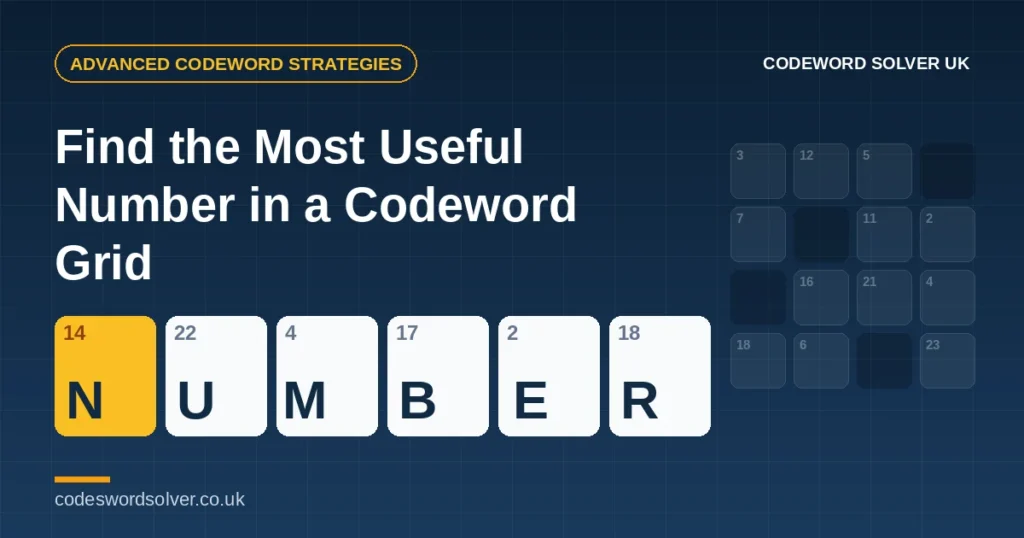
The most useful number in a codeword grid is the one you can investigate productively now. Look for a number in an almost completed word, one that separates a short list of candidates, or one whose confirmed letter would clarify several other entries. The most frequent number is not automatically the best next target.
This guide gives you a practical way to choose where to focus when the grid stalls. You do not need a complicated scoring system. A few observations about context and consequences can turn a vague search into a specific next move.
Separate frequency from usefulness
The frequency of letters tells you how many numbered cells would receive a letter. Usefulness also depends on how easily you can establish that letter and what new information it would create.
A number appearing twelve times in mostly blank entries may offer little immediate evidence. Another appearing only twice could complete a recognisable word and distinguish two candidates elsewhere. Investigating the second number may be the better move.
General English frequency is a separate issue again. Peter Norvig’s word-corpus analysis measures language usage, not the solving value of a particular cell. Puzzler’s guidance also cautions against assuming ordinary text frequencies transfer directly to codewords.
Use familiar letters as starting possibilities, then let the actual grid determine which possibility deserves attention.
Look for a strong local context
Scan for an entry with only one or two unknown positions. Read the number pattern as well as the visible letters. A repeated unknown may represent only one unresolved mapping even when it occupies several cells.
For example, LE?EL contains one unknown position, while ?E?E? looks less complete. However, if the first, third and fifth cells in the second pattern share one number, the problem is not three independent missing letters.
Conversely, several filled cells do not always mean the answer is nearly settled. A pattern such as ?A?E still has many familiar candidates. Judge the actual options, not merely the proportion of letters filled.
Write a small candidate list when you can. The list reveals which unknown number would resolve the uncertainty and which positions the candidates already share.
Compare a few promising numbers
You do not need to evaluate all 26 numbers on every turn. Pick two or three that occur in useful-looking entries and compare them with a simple note.
| Observation | Question | Why it helps |
|---|---|---|
| Known-letter context | Is one occurrence nearly solved? | It may provide a direct deduction |
| Candidate differences | Do surviving words disagree on this number? | Its value may separate alternatives |
| Repeat structure | Does it form a distinctive repeated pattern? | That can restrict possible letters |
| Reach | How many useful entries would change? | One mapping may open several new checks |
| Reliability | Are the surrounding letters confirmed? | Avoids building on an unstable assumption |
These are questions for judgement, not a guaranteed ranking formula. A number that scores well on paper can still remain ambiguous. Be ready to move on when the available evidence does not separate its candidates. Use elimination to rank the survivors before committing to a number.
A worked choice between three numbers
Imagine the following observations in a constructed puzzle. Number 13 occurs eleven times, mostly in open entries. Number 6 occurs five times and has several plausible letters. Number 19 occurs three times, including in a tightly constrained word.
| Number | Occurrences | Best available context | Initial priority |
|---|---|---|---|
| 13 | 11 | Mostly blank entries | Useful later, but little evidence now |
| 6 | 5 | Several unresolved candidates | Worth recording for comparison |
| 19 | 3 | An entry reading Q?EEN | Investigate first |
The five-cell entry has numbers 2 19 5 5 7, with 2 = Q, 5 = E and 7 = N independently established. QUEEN matches the visible letters and repeated E, proposing 19 = U.
Check that U is not already assigned to another number. Then inspect the other two occurrences of 19. If they agree with the proposal, this relatively infrequent number can provide an immediate, useful mapping.
The example does not establish that rare numbers are generally better. It shows why strong context can outweigh raw count in the current state of a puzzle.
Find numbers that separate candidate words
Suppose an entry has two remaining candidates in your checked set: COLD and CORD. They differ only in the third position. The number in that position is the useful question, because its value would distinguish L from R. Compare their number patterns before choosing which occurrence to test.
Investigating a number in a shared position may confirm information both words already imply, but it will not separate those two alternatives. Look for the disputed number in other entries instead.
If another occurrence sits in a strongly constrained word, work there. You do not have to solve the original entry directly. A codeword lets you establish a mapping wherever the evidence is clearest and carry it back.
Remember that an incomplete candidate list can mislead you. “These are the two words I thought of” is weaker than “these are the only permitted words after checking”. Keep that uncertainty visible.
Use repeated structures as evidence
A number appearing in a doubled position can be promising, especially when other letters are known. But the presence of a double does not identify a particular letter by itself.
Look at all its occurrences. A proposed L in a double-letter entry must also fit every isolated occurrence of the same number elsewhere. This wider view can eliminate candidates that looked convincing locally.
The guide to following the same number through different words explains why repeated numbers create a global relationship. Treat that relationship as an opportunity to compare evidence, not as a reason to guess a common double. That agreement also holds at crossings.
Count cells consistently
If you do count occurrences, scan the physical grid one cell at a time. A crossing square belongs to two answers but is still one numbered cell. Counting every across answer and every down answer separately changes what you are measuring.
It can also be useful to note the number of affected entries, which is a different measure from cell count. Two appearances in one word may offer less variety of context than two appearances in separate, well-constrained words.
Keep those observations distinct. Write “four cells, three entries” rather than merging them into an unclear score. The purpose is to choose a sensible next investigation, not to create a statistical model of the whole puzzle.
Avoid high-impact guesses without supporting evidence
A frequent number can spread an error widely if you assign it too quickly. Its reach makes checking more important, not less.
Before entering a provisional letter everywhere, record that it is provisional. If the proposal creates several attractive words, check whether those words rely on independent letters or merely on the same initial assumption.
The method for testing deductions carefully can help you keep that distinction clear. A mapping should gain confidence from evidence, not from the number of cells you have filled with it.
Use tools to explore a specific question
A tool is more useful when you bring it a precise uncertainty: a fixed-length pattern, known letters and a disputed repeated number. Searching the whole puzzle without a clear question can produce more candidates than you can use.
You can work from the numbered grid in the tool or compare entries that share an unknown, following the instructions for each input format.
Check results against the global key and the publisher’s vocabulary. If a tool cannot express a particular constraint, do not assume it has applied that constraint automatically.
Reassess after every confirmed mapping
The best next number changes as the grid develops. Once you confirm U in the worked example, the other U positions may create an almost completed answer involving a previously unpromising number.
Take that new deduction before returning to an old, difficult target out of habit. A quick scan after each confirmed assignment often reveals a simpler route than continuing the analysis that first caught your attention.
Frequently asked questions
Should I always start with the most frequent number?
No. Compare its context with other options. A near-complete word can provide stronger evidence than a large occurrence count.
What if my chosen number stays ambiguous?
Record the surviving possibilities and investigate another entry. Useful progress can come from changing the question.
Do I need to count every number?
No. Count only when it helps compare promising targets. Clear word patterns and confirmed crossings can make a full count unnecessary.
Sources
- Puzzler: Codeword solving guidance.
- Peter Norvig: English letter-frequency analysis.
- Codeword Solver: Repeated-number rules and solving without guessing.

Codeword Solver Team
The Codeword Solver Team builds and maintains Codeword Solver UK, a free codeword, code cracker and coded crossword solver for British puzzles. We write the solving guides published on this site and test every tool against UK dictionary word lists and real newspaper style codeword patterns.
View this author's guides →