Codeword Number Patterns Explained: A Practical Solving Guide
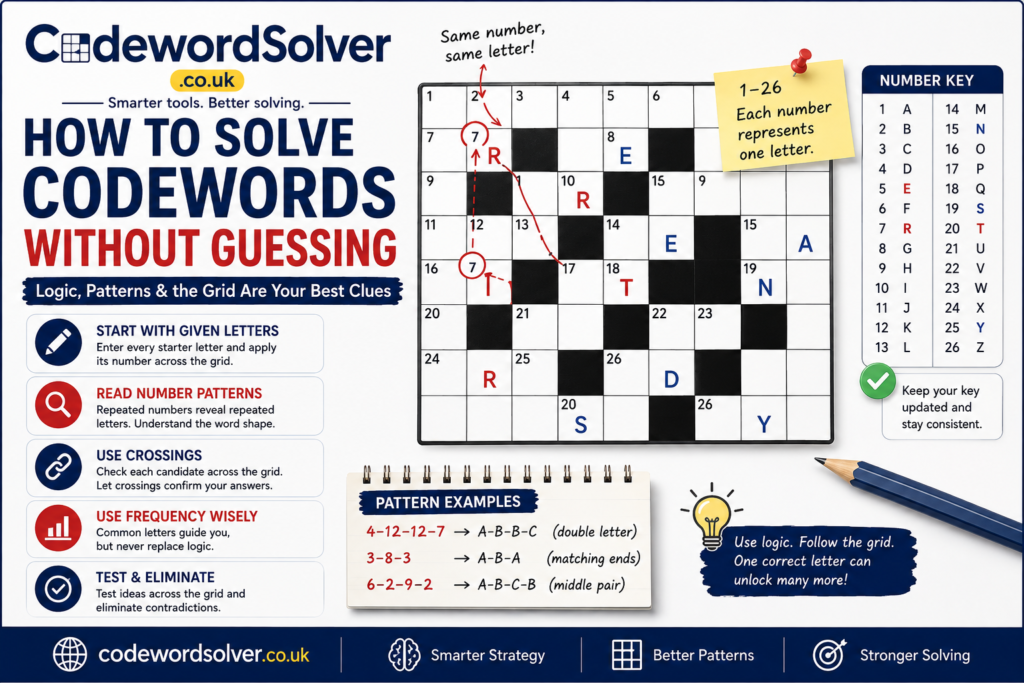
Codeword number patterns can make a puzzle look more complicated than it really is. You see a crossword-style grid, but ordinary clues are missing. Instead, each white square contains a number, and those numbers form a substitution code.
In the standard Codeword format described by Puzzler and AmuseLabs, numbers from 1 to 26 stand for letters of the alphabet. The same number represents the same letter throughout the grid. Different numbers represent different letters. Solvers use number patterns, starter letters, crossings, and English word structure to uncover the solution.
What Are Codeword Number Patterns?
A codeword number pattern is the structure created by the numbers in a word slot. Repeated numbers show repeated letters, while different numbers point to different letters.
Consider this example:
8 – 14 – 14 – 3 – 9
You do not know the word yet. However, you already know that its second and third letters match because both positions contain 14.
You can express the same structure as A-B-B-C-D.
Any five-letter candidate must follow that exact repetition pattern. A word with different letters in positions two and three cannot fit.
How the Number-to-Letter Code Works
A standard Codeword is a type of coded crossword. Puzzler also lists names such as Code-Breaker and Code-Cracker for related versions of the puzzle.
Puzzler describes its Codeword as a completed crossword grid in which letters are replaced by numbers from 1 to 26. AmuseLabs gives a similar rule: each numbered cell corresponds to a letter, and the same number keeps the same value throughout the puzzle.
The number itself does not tell you its letter. For example, 1 does not automatically mean A, and 26 does not automatically mean Z.
Suppose you prove that 7 = R. Every square marked 7 can then become R. Because the grid contains crossing words, one correct mapping can reveal information in several places at once.
How to Read Codeword Number Patterns
Start With Repeated Numbers
Repeated numbers provide strong structural clues because they show exactly where a letter repeats.
For example, 5 – 11 – 11 – 2 has the pattern A-B-B-C. Therefore, the second and third letters must match.
Another example is 4 – 9 – 4 – 12. Its pattern is A-B-A-C, so the first and third letters are identical.
You still do not know which letters they are. Even so, you can reject any candidate that breaks the pattern.
Use Starter Letters First
Published Codeword puzzles often give decoded starter letters to help the solver enter the grid. Puzzler says a standard Codecracker usually provides three starter letters, although presentation can vary by puzzle or platform.
Treat each starter as a grid-wide clue.
Imagine you have 12 – 6 – 18 – 6 and know that 6 = E. The word becomes _ E _ E.
Next, scan the grid for every other 6. Each occurrence also becomes E.
Check Crossing Words Before You Commit
Codeword entries cross one another like crossword answers. Therefore, a letter choice must work in every affected word.
A candidate may look convincing across the grid but create nonsense in a down entry. If that happens, question the candidate.
This cross-checking process makes Codeword more logical than it may first appear. A good answer must work locally and across the wider grid.
Useful Codeword Patterns to Recognize
Double-Letter Patterns
Adjacent repeated numbers represent doubled letters.
Typical shapes include A-B-B-C, A-B-C-C-D, and A-A-B-C.
Puzzler specifically recommends watching for double-letter combinations when solving Codewords. Its guide notes common pairs such as LL, EE, SS, OO, TT, FF, RR, NN, PP, and CC.
However, a repeated number does not prove which doubled letter you have found. It only proves that the two positions use the same letter.
So, do not see A-B-B-C and immediately decide that B-B must be EE or LL. Instead, use confirmed letters and crossings to test the idea.
Repeated Letters With a Gap
Separated repetitions can be just as useful.
For example, 3 – 8 – 15 – 8 – 20 has the form A-B-C-B-D. The second and fourth letters match.
If another entry confirms that 8 = A, both positions immediately become A.
Similarly, patterns such as A-B-A, A-B-C-A, and A-B-C-B-D narrow your choices. Only words with the same repetition structure can fit.
Word Endings and Suffixes
Known endings can help after you confirm a few letters.
Puzzler notes that solvers may use common endings and gives examples such as ING and ED. However, its guide also explains that Codeword compilers may avoid obvious suffixes because they can make a puzzle too easy.
Therefore, an ending such as -ING can be a useful hypothesis. However, it should not become a confirmed mapping simply because it looks familiar.
Check the relevant numbers elsewhere in the grid first.
Can Letter Frequency Help With Codeword Puzzles?
Letter frequency can help, but it is weaker than many beginners expect.
Puzzler warns that general English letter-frequency rankings do not map perfectly onto a Codeword grid. A puzzle uses a particular selection of words, so its letter distribution can differ from ordinary written English.
Therefore, the most common number in a grid does not automatically equal E.
Frequency works better as supporting evidence. For instance, if a number appears often and several word patterns suggest a vowel, frequency may strengthen your theory.
However, crossings and established mappings still offer stronger confirmation.
In short, use frequency to ask a question, not to declare an answer.
A Simple Codeword Number Pattern Example
Consider this fictional five-letter entry:
7 – 13 – 13 – 4 – 19
Assume the puzzle has confirmed that 19 = E. You now have _ _ _ _ E.
The pattern also tells you that positions two and three contain the same letter.
Next, imagine a crossing confirms that 7 = A. You get A _ _ _ E.
Now you can consider five-letter words that start with A, end with E, and contain a doubled letter in positions two and three.
However, do not accept a candidate merely because it fits this slot. Test the proposed values for 13 and 4 everywhere those numbers appear.
That final check separates deduction from a lucky guess.
Common Mistakes When Solving Codeword Patterns
The first mistake is treating the numbers as alphabet positions. Codeword uses a substitution mapping, so number 5 does not inherently mean E.
The second mistake is ignoring the one-to-one pattern. If two positions contain different numbers, they represent different letters in the standard Codeword format described above.
A third mistake is solving one word in isolation. Every mapping affects the grid, so a locally convincing answer can still be globally wrong.
Finally, avoid changing several uncertain mappings at once. Test one idea, check its crossings, and then continue.
Otherwise, one bad guess can spread through the puzzle faster than office gossip.
A Practical Codeword Solving Strategy
Start by entering every supplied starter letter wherever its number occurs. Then inspect short entries and words with repeated-number patterns.
Next, convert difficult sequences into abstract shapes such as A-B-B-C-D. This makes repeated letters easier to see.
After that, use crossings to test each new mapping. As more letters appear, consider familiar English word structures and endings.
You can also use letter frequency when the grid provides supporting evidence. However, do not let frequency override stronger clues.
Most importantly, separate confirmed mappings from tentative ideas. Good Codeword solving is less about guessing quickly and more about making deductions that survive every cross-check.
Why Codeword Number Patterns Make Solving Easier
Codeword number patterns reduce the size of the problem.
Instead of asking, “Which five-letter word belongs here?” ask a more precise question: “Which five-letter word matches these known letters and this exact repetition pattern?”
Crossings narrow the possibilities further. Once you establish a new number-to-letter mapping, every matching square changes with it.
As a result, progress often accelerates after several reliable mappings are in place. Each confirmed letter creates new partial words, and those partial words create fresh deductions.
Final Thoughts on Codeword Number Patterns
Codeword number patterns reveal the structure behind a numbered grid. Repeated numbers identify repeated letters. Starter letters provide anchors. Crossings test your assumptions, while familiar word shapes help you form sensible candidates.
The most reliable approach is simple: read the pattern, apply confirmed letters, test a candidate, and check the mapping across the grid.
Do not assume that a frequent number must be E. Likewise, do not treat 1 as A by default. Most of all, do not force a word that breaks the established number pattern.
Once you learn to read those relationships, Codeword becomes much less mysterious.
The numbers are not obstacles. They are the clues.
Sources and Further Reading
The factual puzzle rules and solving principles in this guide were checked against the official Puzzler Codeword Guide and AmuseLabs PuzzleMe Codeword documentation. Puzzler provides detailed guidance on starter letters, double letters, suffixes, and letter frequency, while AmuseLabs documents the standard numbered-grid mechanics.
Ready to try the solver?
Put what you've learned into practice with our free Codeword Solver.
Try the Codeword Solver