Repeated Letters in Codeword Puzzles: How to Solve Them
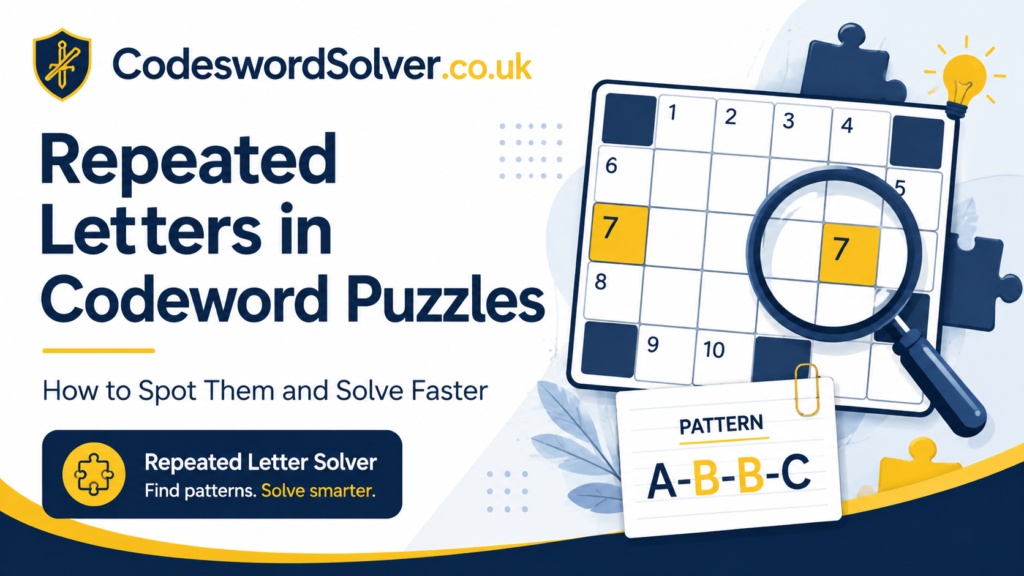
Repeated letters in codeword puzzles can reveal far more than they first appear to. When the same number appears twice in one word, those positions must contain the same letter. You may not know the letter yet, but you already know part of the word’s structure.
That small clue can remove many impossible answers. Better still, once you identify the letter behind that number, you can place it everywhere the same number appears.
As a result, one correct deduction can unlock several words at once.
This guide explains how repeated-letter patterns work, why they matter, and how to use them without relying on random guesses.
What Do Repeated Letters Mean in a Codeword Puzzle?
A standard Codeword puzzle uses a crossword-style grid, but it does not provide normal crossword clues. Instead, numbered cells represent letters.
Puzzler’s official Codeword instructions state that every different number represents a different letter. They also confirm that the same number always represents the same letter.
PuzzleMe by AmuseLabs describes the same core system. Its Codeword documentation explains that each numbered cell corresponds to a letter and that the same number keeps the same letter throughout the puzzle.
For example, imagine this four-number entry:
12 – 7 – 7 – 19
Its pattern is:
A – B – B – C
The second and third letters must match. At the same time, the first and last letters must differ from the repeated letter and from each other.
Words such as BOOK and FEED fit that pattern.
However, the pattern alone does not prove either answer. You still need confirmed letters and crossing words to choose the correct one.
Why Repeated Letters in Codeword Puzzles Matter
Repeated numbers reduce the number of words that can fit an entry.
Suppose you face a four-letter word with no known letters. Many English words could fit.
Now suppose the code pattern shows that positions two and three use the same number. That condition immediately removes words such as ROAD, TIME, and CARD.
Therefore, repeated letters in codeword puzzles give you useful information before you decode the actual letter.
They also affect the wider grid.
If you discover that number 7 represents O, every cell marked 7 becomes O. As a result, one solved relationship can reveal parts of several other words.
Strong solvers therefore treat the grid as one connected system rather than a collection of separate words.
How to Read a Repeated-Letter Pattern
A simple way to understand number patterns is to replace each new number with a temporary letter.
Consider:
5 – 18 – 5
You can rewrite the shape as:
A – B – A
Now you know that the first and third letters match. The middle letter must differ.
Words such as DID, EYE, and POP follow this structure.
Next, consider:
6 – 14 – 2 – 2 – 14 – 9
Its structure becomes:
A – B – C – C – B – D
The word LETTER fits exactly:
L – E – T – T – E – R
This example contains two useful relationships. The T appears as a double letter, while the E repeats in separated positions.
Therefore, repeated letters do not need to sit next to each other.
Double Letters Are Only One Type of Repeat
Double letters often catch the eye first.
Think of OO in BOOK, PP in APPLE, or TT in LETTER.
However, repeated letters can appear much farther apart.
Take LEVEL:
A – B – C – B – A
The first and fifth letters match. The second and fourth letters also match.
Nothing appears as an adjacent double, yet the pattern reveals plenty of information.
Now consider PAPER:
A – B – A – C – D
Here, the first and third letters match.
So, when you scan a Codeword grid, do not look only for identical numbers sitting side by side. Also check whether a number returns later in the same entry.
A Reliable Method for Repeated Letters in Codeword Puzzles
When working with repeated letters in codeword puzzles, a simple process helps you avoid unnecessary guessing.
- Mark the repeated numbers. Convert the number sequence into a structure such as ABBC, ABA, or ABCCBD.
- Add confirmed letters. If you already know that number 12 represents E, place E in every cell marked 12.
- Build candidates that match the full pattern. Do not rely on word length alone. A candidate must repeat letters in exactly the required positions.
- Check crossing entries. A word may look perfect by itself but fail when another word crosses it.
- Update the whole grid. Once a number-to-letter mapping becomes secure, apply it everywhere that number appears.
This process keeps your solving logical.
More importantly, it stops one attractive guess from poisoning half the grid. Codewords can produce enough alphabet soup without your assistance.
Different Numbers Must Represent Different Letters
This rule is easy to overlook, yet it can eliminate bad candidates quickly.
Suppose a three-letter entry contains:
4 – 11 – 9
All three numbers differ.
Therefore, a word such as MOM cannot fit.
MOM repeats M in the first and third positions. In a standard Codeword puzzle, those matching letters would need the same number.
This means the pattern works in both directions.
Repeated numbers tell you which positions must match. Different numbers tell you which positions must contain different letters.
Puzzler states this one-to-one relationship directly in its published Codeword instructions.
Codeword Solver also applies this constraint when checking candidate words against number patterns.
Use Crossing Words Before You Commit
Repeated-letter patterns narrow your choices, but they do not always leave one answer.
Return to this pattern:
A – B – B – C
Both BOOK and FEED fit.
Now suppose a crossing word confirms that the final number represents D.
FEED still fits, while BOOK fails.
That gives you stronger evidence than intuition.
Therefore, treat every candidate as provisional until the surrounding grid supports it. A good answer must satisfy its own pattern and the mappings created by crossing words.
If a new crossing creates a contradiction, revisit the weakest assumption instead of forcing other answers to fit it.
Do Not Guess a Double Letter Too Early
Seeing two identical numbers together may tempt you to assign a familiar pair such as EE, LL, OO, SS, or TT.
Sometimes you will be right.
Still, the repeated number proves only that the letters match. It does not reveal which letter they represent.
For example, imagine this pattern:
A – B – B – C – D
You know positions two and three contain the same letter. That fact is certain.
Their identity remains unknown until other evidence supports it.
Therefore, use double letters as structural clues first. Then combine them with confirmed mappings, crossings, and the rest of the pattern.
That keeps a sensible possibility from turning into an unsupported certainty.
Look Closely at Words With Multiple Repeats
Entries with several repeated relationships can be especially useful because they contain more structural information.
Again, look at LETTER:
A – B – C – C – B – D
A valid candidate needs the same letter in positions two and five.
It also needs another repeated letter in positions three and four.
Meanwhile, positions one and six must differ from those repeated groups.
That is far more restrictive than simply knowing that the answer contains six letters.
Likewise, a structure such as:
A – B – C – B – A
contains two separate mirrored relationships.
For this reason, words with multiple repeats often deserve early attention.
Common Mistakes With Repeated Letters in Codeword Puzzles
One common mistake is checking only adjacent double letters.
A repeated number later in a word can provide just as much useful information.
Another mistake is forgetting that different numbers stand for different letters. If two cells contain different code numbers, a candidate cannot place the same letter in both positions under standard Codeword rules.
Solvers also run into trouble when they isolate one word from the rest of the puzzle.
Crossings matter because every confirmed mapping can affect several other entries.
Finally, do not choose an obscure word simply because its repeated-letter structure fits.
Pattern matching tells you what can work. It does not prove what does work.
Instead, prefer candidates that agree with the complete grid and the vocabulary style of the puzzle.
Are Repeated Letters Always the Best Starting Point?
Not necessarily.
A repeated pattern becomes especially useful when it combines with known letters or strong crossings.
Without those extra clues, even a distinctive pattern may produce several possible words.
Meanwhile, a shorter entry with two confirmed letters may give you a faster breakthrough.
Therefore, look for the most constrained part of the grid rather than automatically choosing the longest word.
A strong starting point often combines several signals: known letters, repetition, a distinctive structure, and helpful crossings.
Why Pattern Logic Beats Random Guessing
A good Codeword deduction should explain more than one cell whenever possible.
For example, identifying a repeated number may confirm two positions inside one word. That same mapping may also complete letters elsewhere in the grid.
Random guesses work differently.
A guess may appear convincing in one entry, yet it can create contradictions in several others.
Therefore, each candidate should satisfy all known constraints before you treat it as confirmed.
This approach may feel slower for the first few moves. In practice, it usually saves time because you spend less effort repairing incorrect assumptions.
Final Thoughts
Repeated letters in codeword puzzles reveal structure before they reveal the answer.
The same number must represent the same letter. In a standard Codeword, different numbers also represent different letters.
That gives you two powerful tests.
First, matching numbers show where letters repeat.
Second, different numbers rule out candidates that repeat a letter in the wrong positions.
For the best results, combine these patterns with confirmed mappings and crossing words. Then update the whole grid whenever you prove a new number-to-letter pair.
In short, do not ask only, “What word fits?”
Ask, “What word fits every constraint?”
That small change turns repeated letters in codeword puzzles from a visual detail into one of your strongest solving tools.
Sources
Puzzler Codeword instructions. Primary puzzle instructions confirming that different numbers represent different letters and identical numbers keep the same letter.
PuzzleMe by AmuseLabs Codeword documentation. Explains Codeword grids, numbered cells, and consistent number-to-letter mapping.
Codeword Solver Instructions and methodology. Provides practical examples of repeated-number and distinct-number constraints in candidate matching.
Ready to try the solver?
Put what you've learned into practice with our free Codeword Solver.
Try the Codeword Solver