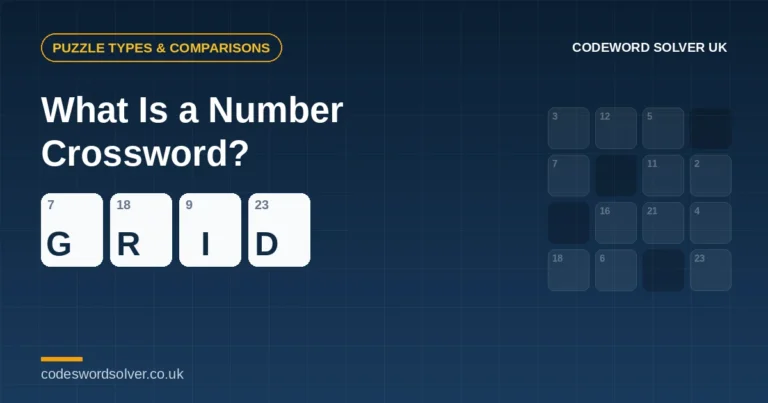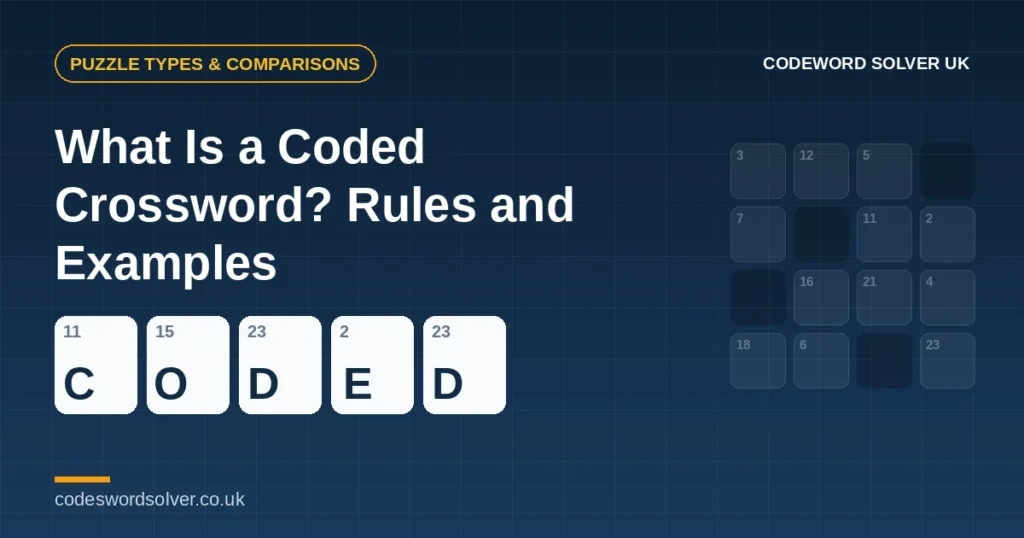
A coded crossword is a crossword-style word puzzle that replaces letters with numbers. Instead of solving written clues, you work out which letter each number represents. Once you crack a number, that letter applies everywhere the same number appears in the grid.
You may also see this puzzle called a codeword, code cracker, or code breaker. Amuse Labs lists “Coded Crossword” and “Code Cracker” as alternative names for Codeword. Puzzler also uses names such as Code-Cracker and Code-Breaker.
At first, the grid can look like somebody fed a crossword through a calculator. However, once a few letters fall into place, the grid often opens up quickly.
How Does the Puzzle Work?
A standard codeword puzzle uses a completed crossword-style grid. Each white square contains a number, usually from 1 to 26. Every number corresponds to one letter of the alphabet, and the same number represents the same letter throughout the puzzle.
For example, imagine that number 8 represents E. Every square marked 8 must then contain E. If number 12 represents R, every 12 must contain R.
That consistency creates the puzzle’s logic. One correct letter can help several crossing words at once.
Puzzler says its codeword format includes at least one occurrence of every letter in the alphabet. It also provides starter letters to give the solver a way into the grid. A standard codecracker usually gives three starter letters, although formats can vary by publisher.
What Is the Difference Between a Coded Crossword and a Regular Crossword?
A regular crossword gives you written clues, which is the first difference between codewords or crosswords. You solve those clues, enter the answers, and use crossing letters to confirm your choices.
This puzzle removes the conventional clue list. Instead, the numbered grid provides the information you need. You identify letter values through word patterns, crossings, repeated numbers, and vocabulary.
That changes the main skill involved. In a regular crossword, you interpret clues. In this format, you decode a consistent substitution system.
For instance, a pattern such as 4-9-9-15-2 tells you that the second and third letters match. Crossings then help you test words that fit.
Is It the Same as a Cryptic Crossword?
No. These are different puzzle types.
Cryptic crosswords use written clues built around conventions such as definitions and wordplay. Depending on the clue, that wordplay can involve anagrams, hidden answers, reversals, abbreviations, or other devices. The Guardian’s beginner material describes the normal cryptic structure as involving definition and wordplay, although some special clue types work differently.
By contrast, a codeword normally has no conventional clue list. Instead, you solve the numbered substitution system and reconstruct the words in the grid.
Put simply, a cryptic crossword asks you to decode clues, while this puzzle asks you to decode letters.
Why Do Repeated Numbers Matter?
Repeated numbers provide some of the strongest information in a codeword, and patterns in the numbers are what make them so useful.
Suppose a word has the number pattern 6-14-14-3. You immediately know that its second and third letters match. That structure narrows the possible words before you identify every letter.
The same idea works across the whole grid. If you discover that 14 represents O, every 14 becomes O. Several incomplete entries may suddenly become recognizable.
Puzzler recommends watching for repeated letters and common word endings. However, it also warns against relying too heavily on general letter-frequency rules because a constructed puzzle may not mirror ordinary English prose.
How to Solve a Coded Crossword Step by Step
1. Enter the Starter Letters First
Start with every letter the puzzle gives you. Then find each matching number throughout the grid and enter that letter in every corresponding square.
This step creates reliable information rather than guesses. It can also expose useful fragments in several words at once.
2. Look for Repeated-Letter Patterns
Next, scan for entries with repeated numbers. A pattern such as 5-11-11-7 tells you that positions two and three contain the same letter.
Likewise, 3-8-6-3 shows that the first and last letters match. However, do not commit too early. Test any likely word against its crossings first.
3. Use Short Words Carefully
Short words can unlock several letter values, but they may fit many answers. Therefore, use crossing information before you confirm them.
A three-letter word with one known letter may have several reasonable solutions. Another crossing often provides the evidence you need.
4. Check Common Endings and Letter Combinations
Common structures can provide useful hints. Endings such as -ing, -ed, -er, or -ly may fit some entries. Familiar combinations such as TH, CH, SH, ST, and QU can also help.
Still, patterns are clues rather than proof. Puzzler notes that compilers may avoid obvious suffixes because they can make a codeword too easy.
5. Test Every New Letter Across the Grid
Whenever you assign a letter to a number, apply it to every occurrence of that number. Then inspect all affected words.
If several entries become impossible, revisit your assumption. A wrong mapping can spread quickly. Fortunately, a correct one can unlock half the neighborhood.
6. Keep a Clear Number-to-Letter Key
Use the puzzle’s code table if it provides one, or use a coded crossword solver to record every confirmed number-letter pair as you solve.
A clear key prevents repeated work. It also shows which numbers still need attention.
Should You Use Letter Frequency?
Letter frequency can help, but treat it as supporting evidence rather than a rule.
You may assume the most common number represents E. However, Puzzler explains that a codeword’s construction can produce a different distribution from ordinary written English. It also notes that puzzle compilers may deliberately restrict common letters or easy patterns.
A safer method combines starter letters, repeated patterns, crossings, word length, and plausible vocabulary. When several signals agree, you have a much stronger deduction.
Are Coded Crosswords Always Numbered 1 to 26?
The standard English-language format — the usual number crossword — uses numbers from 1 to 26 because the English alphabet contains 26 letters. Amuse Labs and Puzzler both describe Codeword puzzles with this system.
However, the number-letter assignments are not fixed from one puzzle to the next. Number 5 might represent E in one puzzle and M in another.
So, memorizing one puzzle’s code will not give you a secret shortcut. It will simply give your next puzzle an opportunity to laugh at you.
Are Coded Crosswords Good for Beginners?
Yes, especially for people who enjoy vocabulary, deduction, and pattern recognition.
The main beginner mistake is treating a plausible word as a confirmed word. Instead, check whether every new letter works across the grid. That habit stops one uncertain guess from creating several false answers.
If one corner feels stubborn, move elsewhere. Another answer may reveal the letter you need.
Coded Crossword, Codeword, Code Cracker, and Code Breaker
The terminology varies, but these names can refer to the same core puzzle family.
Amuse Labs calls Codeword a puzzle also known as Coded Crossword or Code Cracker — the codeword vs code cracker distinction is only a name. Puzzler lists Code-Breaker and Code-Cracker among its alternative names for Codeword.
The essential attributes remain consistent: a crossword-style grid, numbered cells, a number-to-letter mapping, and no conventional clue list. The same number keeps the same letter value throughout a given puzzle.
Publishers can still vary details such as grid design, starter letters, interface features, or house rules. Therefore, check the instructions when you use a new puzzle source.
Final Answer: What Is a Coded Crossword?
A coded crossword is a word puzzle that replaces letters in a crossword-style grid with numbers. Each number represents a letter, and the same number keeps that letter value throughout the puzzle.
Instead of answering conventional crossword clues, you crack the code through deduction. Starter letters, repeated-number patterns, crossing words, common letter combinations, and vocabulary all help.
For beginners, the best approach is simple. Enter the starter letters, inspect repeated patterns, test likely words, and verify every new mapping across the grid.
Once several letters connect, the puzzle becomes much less mysterious. What first looked like mathematical paperwork starts behaving like a word game again.
Frequently Asked Questions
What is another name for a coded crossword?
Common names include codeword, code cracker, and code breaker. Amuse Labs and Puzzler use these terms for the same core puzzle family.
Does every number represent one letter?
Yes, in the standard Codeword format. The same number represents the same letter throughout a puzzle.
Do coded crosswords have clues?
They normally do not use conventional Across and Down clues. Instead, the numbered grid, starter letters, crossings, and word patterns provide the information needed to solve the puzzle.
How many starter letters does a coded crossword give you?
The exact number can vary. Puzzler says a standard codecracker usually gives three starter letters.
What is the best first move?
Enter every starter letter wherever its number appears. Then look for repeated-number patterns, short words, and useful crossings before making further deductions.
Sources
- Puzzler — Codeword Puzzles Guide
- Amuse Labs PuzzleMe Help Center — Codeword
- The Guardian — Cryptic Crosswords for Beginners

Codeword Solver Team
The Codeword Solver Team builds and maintains Codeword Solver UK, a free codeword, code cracker and coded crossword solver for British puzzles. We write the solving guides published on this site and test every tool against UK dictionary word lists and real newspaper style codeword patterns.
View this author's guides →