“Number crossword” can be an ambiguous description. It may refer to a crossword-shaped puzzle whose answers are numbers, or someone may use it informally for a codeword, where printed numbers stand for letters. Read the instructions and check what belongs in the completed cells before choosing a solving method.
The quickest distinction is simple: are you filling the grid with words, numerical answers to clues, or supplied number strings? Those tasks can look similar on the page but require different kinds of evidence.
This guide explains three formats, gives original examples and shows why the numbers printed in a grid do not always perform the same job.
Identify your puzzle at a glance
| What you see | Likely format | What you enter |
|---|---|---|
| Number labels in letter cells and a few decoded letters | Codeword or coded crossword | Letters forming words |
| Across and down clues asking for numerical values | Crossnumber or cross-figure style | Digits forming numerical answers |
| A grid plus a list of numbers grouped by length | Number-fit or number-jig style | The supplied digit strings |
These are practical identifying features, not a claim that every publisher uses identical names. Variants can add extra conditions, so the instructions remain authoritative.
Codewords: the numbers stand for letters
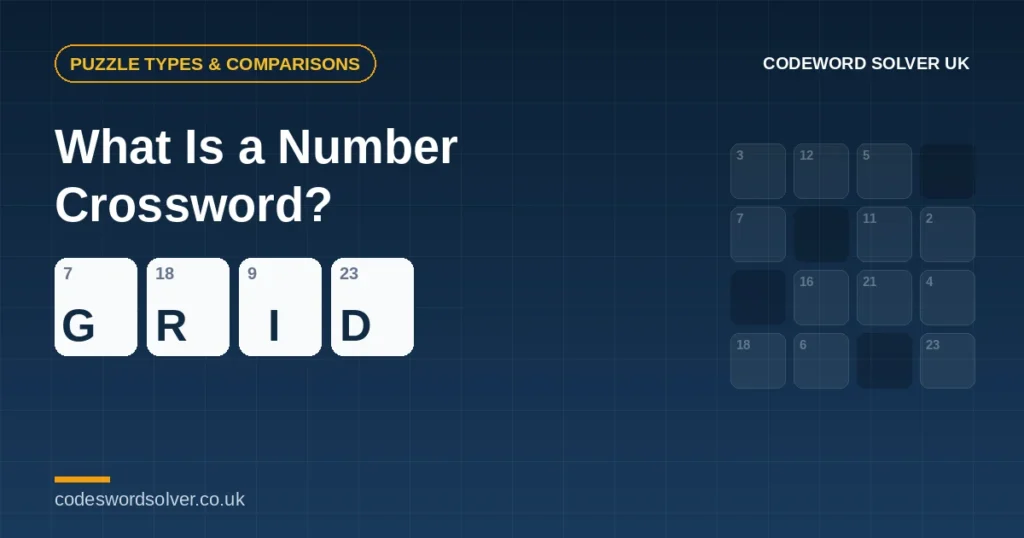
A standard codeword uses a consistent number-to-letter substitution. If 8 represents O, every cell labelled 8 contains O. Different numbers represent different letters, and the completed entries form words.
The number labels are not quantities to calculate. A cell labelled 18 does not require eighteen letters or a two-digit answer. It identifies one letter in the shared key.
Consider the original teaching entry 4–8–8–12, with 4 = B and 12 = K. It reads B??K with matching middle letters. BOOK is a candidate because both occurrences of number 8 can become O.
You must still compare that proposal with the complete key and other entries. If O already belongs to another number, BOOK conflicts with the standard mapping rule. A codeword vs crossword comparison shows where the two puzzle types part company.
Read how a coded crossword uses numbered letters if this matches the puzzle in front of you.
Crossnumbers: the answers are numerical
In a crossnumber, across and down entries hold digits. Clues may describe calculations, properties of numbers or relationships between entries. The digits at a crossing must agree.
For an original simple clue, “Seven squared” gives 49. It occupies two cells: 4 and 9. If a crossing answer uses the second cell, that crossing must contain 9 at the shared position.
A clue such as “a two-digit square” is less specific. It gives a set of possibilities, and other clues or crossings must narrow it. You should not choose the first square you remember.
NRICH’s Mini Cross-Number provides an example of this mathematical style, using clues about cubes and a relationship between entries. That is a different task from substituting letters for codeword labels.
Use arithmetic constraints carefully
Suppose an entry is a two-digit square ending in 4. Among the two-digit squares, 64 fits. If an independently established crossing supplies the final 4, the arithmetic property narrows the entry sharply.
However, check the exact clue. “Square number”, “square of an even number” and “one less than a square” impose different requirements. A numerical answer that fits the cells can still fail the stated condition.
Follow any instructions about leading zeros, repeated digits, base or answer formatting. Do not import a restriction from Sudoku or a different crossnumber simply because both puzzles use digits.
Number-fit puzzles: place a supplied list
A number-fit puzzle gives you number strings to place in a grid. You generally use length and intersecting digits to determine their positions. The task is placement rather than decoding an alphabet or answering a vocabulary clue.
Puzzler describes its Number Jig as the numerical counterpart of a word-fit puzzle and instructs solvers to place the listed numbers. Its terminology includes Number Fit and other related names.
As an original example, suppose a three-cell slot has 7 in its middle cell. From the supplied candidates 274 and 472, both fit that crossing. A second confirmed digit at the first or last position may distinguish them.
If the first digit is independently established as 2, 274 fits while 472 does not. The deduction comes from the supplied list and positions, not from treating 2, 7 and 4 as letter codes.
Do not rearrange the digits casually
When a listed entry is 274, its order matters. You cannot turn it into 247 unless the puzzle’s instructions explicitly allow that operation. Likewise, do not reverse an entry merely because the reversed digits fit a convenient crossing.
Track which listed entries have been used, including duplicate strings if the puzzle provides them. A correct placement must satisfy both the grid and the inventory of supplied entries.
Three different roles for a printed number
A number in a grid can identify a clue, label a letter or form part of the answer. Confusing these roles creates mistakes before solving has really begun. Reading the number patterns tells you which role applies.
| Role | Example | Meaning |
|---|---|---|
| Clue reference | 7 Across | Look up the clue for that entry |
| Substitution label | 7 = R | Every cell labelled 7 contains R |
| Answer digit | The 7 in 274 | The digit is part of the numerical entry |
In a conventional crossword, clue numbers normally identify starting positions. Their presence alone does not make the puzzle a mathematical crossnumber or a coded crossword.
Check whether the finished answer is supposed to be a word or a numerical value. That question resolves much of the ambiguity around “number crossword”.
Which solver should you use?
For numbered letters forming words, the Coded Crossword Solver is relevant. Preserve repeated-number relationships and the existing letter key when comparing suggestions. A codeword grid solver can check the whole grid at once, instead of one entry at a time. If only a few letters are missing, a missing letters solver can suggest candidates that fit the pattern.
For numerical clue answers, use arithmetic reasoning and the relevant crossnumber rules. A word dictionary search cannot determine whether a number is a square, a cube or a specified multiple of another entry.
For a number-fit puzzle, organise the supplied strings by length and inspect crossing digits. A general codeword tool should not be assumed to accept that task merely because both interfaces contain numbers.
Read the tool’s supported input before entering a grid. Choosing a matching search mode is more useful than trying to force one puzzle type into another tool’s syntax.
Begin with the most constrained information
The three formats share a useful habit: start where the available evidence is strongest. In a codeword, that may be an entry with starters and a distinctive repeat. In a crossnumber, it may be a precise calculation. In a number-fit, it may be a length with few possible listed entries.
After confirming an answer or mapping, carry its consequences through the puzzle. Then inspect the newly restricted entries rather than staying with the same difficult corner.
Keep guesses visibly separate from established information. Several consequences of one guess are not independent proof that the guess was correct.
For the word-based format, How to Solve Codeword Puzzles provides a complete starting routine.
Common questions about number crosswords
Is a number crossword the same as Sudoku?
No. Standard Sudoku uses row, column and region constraints rather than across and down clue answers. A grid containing digits is not enough to identify its rules.
Do codeword numbers follow alphabetical order?
Not as a general solving assumption. The labels form the puzzle’s substitution key. Do not assume 1 = A or 2 = B unless the instructions explicitly supply that system.
Do numerical crosswords require advanced mathematics?
It depends on the puzzle. A simple example may use basic calculations, while another may require more specialised properties. Read the clues and difficulty guidance rather than judging only by the layout.
What should I do if the title is unclear?
Look for starter letters, mathematical clues or a supplied number list. Then read the instructions and examine one completed example if available. Identify the task before choosing a strategy or solver.
Sources
- NRICH, University of Cambridge: Mini Cross-Number.
- Puzzler: Number Jig puzzle guide.
- Puzzler: Codeword and Crossword puzzle guides.

Codeword Solver Team
The Codeword Solver Team builds and maintains Codeword Solver UK, a free codeword, code cracker and coded crossword solver for British puzzles. We write the solving guides published on this site and test every tool against UK dictionary word lists and real newspaper style codeword patterns.
View this author's guides →