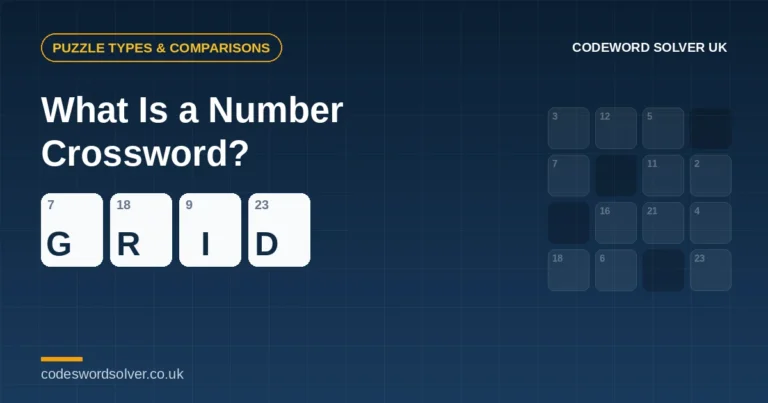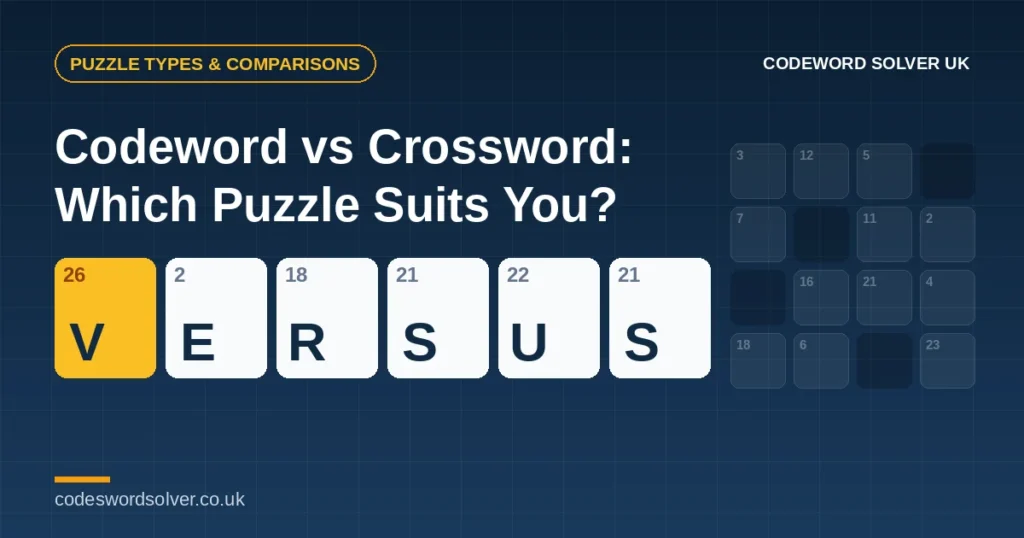
In a codeword vs crossword comparison, the main difference is how you discover the answers. A conventional crossword gives clues for words in a grid. A codeword replaces letters with numbers and asks you to reconstruct a shared letter key, usually with a few supplied letters to get started.
Choose a codeword if you enjoy recognising spelling patterns and tracking consistent substitutions. Choose a crossword if you prefer interpreting definitions, recalling knowledge or working through wordplay. Neither format is automatically easier: the particular puzzle and your experience matter more than the label.
The comparison below refers to standard numbered codewords and conventional clued crosswords. Publishers also create variants, so check the instructions whenever a puzzle uses familiar terminology in an unfamiliar way.
Codeword and crossword differences at a glance
| Feature | Codeword | Clued crossword |
|---|---|---|
| Main information | Numbered letters and starter mappings | Clues and answer lengths |
| Meaning of numbers | Numbers identify letters throughout the grid | Numbers usually identify where clue answers begin |
| Core task | Recover a consistent substitution key | Find answers satisfying the clues and crossings |
| Useful habits | Track repetitions and update every occurrence | Interpret clues and use crossing letters |
| Typical uncertainty | Several words fit a numbered pattern | Several answers fit a clue |
| Final check | Words and number-to-letter assignments agree | Answers fit clues, lengths and crossings |
Both involve vocabulary and intersecting words. The difference is the source of the initial evidence and the way one answer helps the rest of the puzzle.
How a codeword gives you information
In a standard codeword, the same number represents the same letter wherever it appears. Different numbers represent different letters. If number 8 means R, every square marked 8 must contain R.
A repeated-number pattern therefore reveals something before any letters are known. The sequence 3–7–7–12 requires its middle letters to match. It could match the repetition structure of BOOK, but not BOAT.
Starter mappings add fixed letters. You enter them throughout the grid and look for words compatible with the resulting patterns. Each confirmed new mapping may reveal letters in several distant entries.
If you want a detailed walkthrough, read How to Solve Codeword Puzzles. The essential habit is to keep one consistent key for the entire puzzle.
How a crossword gives you information
A conventional crossword supplies a clue for each answer. A quick crossword may use a short definition or synonym, while a general-knowledge crossword may ask for a name, place or fact. Cryptic crosswords use additional wordplay conventions.
The clue number normally directs you to the answer’s starting square. It does not assign a letter value to every square carrying that number. Confusing those two uses of numbers is a common obstacle when switching formats.
Crossing answers supply letters that narrow a clue’s possibilities. If a four-letter answer already has B in the first square and K in the last, you can compare candidate words with that pattern as well as with the clue’s meaning.
A crossword answer is not confirmed merely because it forms a dictionary word. It must also answer the clue in the intended way and agree with its crossings.
The same answer, reached in two different ways
Consider the answer BOOK. In a simple crossword, an original clue might be “Bound volume for reading (4)”. The definition and length suggest BOOK, and crossing letters help you check it.
In a codeword, an entry might instead show 3–7–7–12, with starters 3 = B and 12 = K. You see B??K with matching middle letters. BOOK proposes 7 = O.
That proposal must also work wherever number 7 occurs elsewhere. If another number already has a confirmed O assignment, the candidate conflicts with the key even though BOOK fits the local shape.
The crossword route begins with meaning. The codeword route begins with spelling structure and shared substitutions. Vocabulary helps with both, but the evidence you use to justify the answer differs.
What kind of solving do you enjoy?
If you like following a small set of rules
A codeword may appeal because the same substitution principles apply throughout the grid. You can record candidates, compare repeated positions and eliminate contradictions without needing a separate verbal clue for each entry.
However, it is not a vocabulary-free logic puzzle. You still need to recognise plausible words and understand the publisher’s word rules. An unfamiliar answer can hold up progress even when the mapping structure is clear.
If you like definitions and general knowledge
A quick or quiz-style crossword offers direct prompts. One clue may give you a way in even if another is unfamiliar, and the solved answer can provide crossing letters for nearby entries.
Choose the clue style carefully. Enjoying straightforward synonyms does not necessarily mean you will immediately enjoy cryptic conventions or specialist themed knowledge. Treat those as different experiences within the crossword family.
If you like comparing alternatives
Both formats offer this. In a crossword, you compare meanings and crossings. In a codeword, you compare the mappings each candidate would create and test them throughout the grid.
Try one modest puzzle of each type and notice which unresolved questions feel interesting. Your preference may depend on the day, the setter or the amount of time you have.
Is a codeword easier than a crossword?
There is no dependable overall ranking. A codeword with helpful starters and familiar words may be approachable, while a sparse start can require patient analysis. Crossword difficulty varies with clue style, vocabulary and how much crossing information the grid provides.
Experience also changes the comparison. A regular crossword solver may quickly recognise clue conventions but initially forget to propagate codeword letters. A regular codeword solver may handle repetition effortlessly but find a cryptic clue unfamiliar.
Use the publisher’s difficulty label as a rough starting point, then judge whether the puzzle gives you a useful amount of challenge. Avoid choosing solely by grid size: a small grid can still provide limited information.
Tools help in different ways
For a codeword, a pattern tool can suggest words matching known positions. A repeated-letter tool can help when several positions share a number. You still need to compare candidates with the complete key. A codeword solver vs crossword solver comparison shows which tool fits each format.
The Coded Crossword Solver is relevant when your puzzle uses encoded letters. Read the input instructions before entering grid numbers, because different tools represent patterns differently.
For a conventional crossword, a dictionary or reference can help with a definition or fact. A pattern match alone cannot decide whether a word answers the clue. Keep the clue visible while checking suggestions.
Using help is a personal choice unless you are following competition rules. If you want practice, seek the smallest hint that lets you continue rather than automatically revealing a complete answer.
Do coded crosswords count as codewords?
“Coded crossword” is often used for a number-to-letter grid puzzle, but names vary between publishers. Identify the mechanism from the instructions instead of relying only on the heading.
If numbers represent letters consistently across the grid, you are dealing with the substitution method discussed here. If numbers point to a list of clues, use the clue-based method. A hybrid puzzle may combine information from both. If the numbers stand for letters, the puzzle is effectively a number crossword.
The guide to understanding a coded crossword’s rules explains the terminology in more detail. If you are choosing between similar tools, a codeword vs code cracker comparison will help you tell them apart.
How to switch formats without carrying over the wrong habit
When moving from crosswords to codewords, stop looking for a separate definition for each entry. Copy every starter throughout the grid, then inspect repeated numbers and partly filled words. Update all occurrences after confirming a mapping.
When moving from codewords to crosswords, treat the clue as essential evidence. A fitting word is only a candidate until it satisfies the clue. Do not infer that a repeated clue number creates a shared letter key.
In either format, keep guesses distinguishable from established letters. A confident-looking wrong answer can mislead later work, while a clearly marked candidate remains easy to reconsider.
Choose a puzzle for your next session
Pick a codeword for a session centred on letter patterns and a shared key. Pick a quick crossword for direct definitions, or explore another crossword style when its clue conventions interest you. A codeword vs cryptogram comparison can help if you are choosing between a grid puzzle and a message puzzle.
Start at a comfortable difficulty and complete the final checks. You do not need to decide which format is universally better. The useful choice is the one whose solving process you want to spend time on.
Sources
- Puzzler: Crossword puzzle guide.
- Puzzler: Codeword puzzle guide.
- Codes Word Solver: Coded Crossword rules and solver guidance.

Codeword Solver Team
The Codeword Solver Team builds and maintains Codeword Solver UK, a free codeword, code cracker and coded crossword solver for British puzzles. We write the solving guides published on this site and test every tool against UK dictionary word lists and real newspaper style codeword patterns.
View this author's guides →