What Is a Code Cracker?
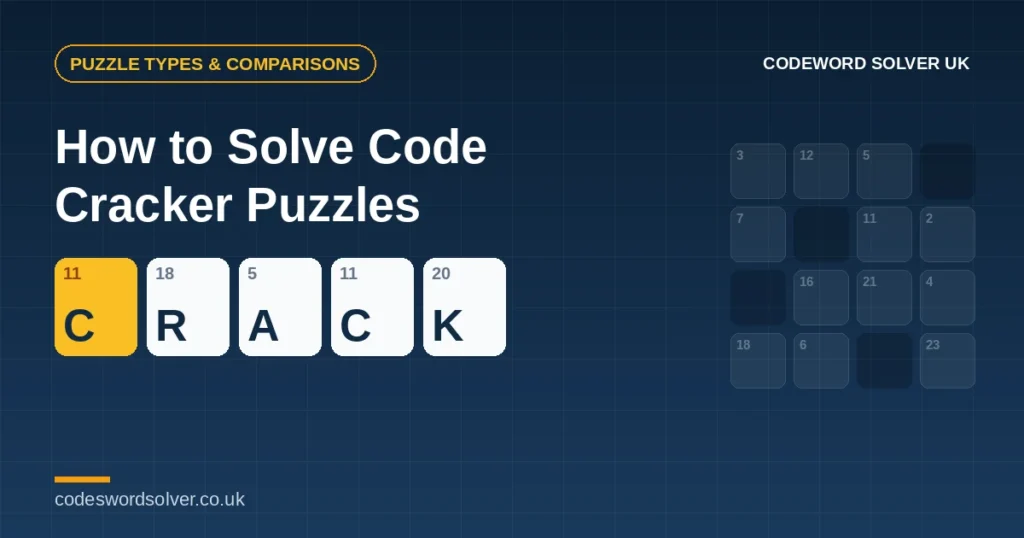
A code cracker is a codeword by another name. The grid is a set of numbered squares, each number stands for one letter, and the same number always stands for the same letter. Two or three letters are given at the start. Your job is to work out the rest. This guide shows how to solve code cracker puzzles, step by step, from the first given letters.
The name is most familiar from the daily Code Cracker in the New Zealand Herald, Simon Shuker’s Code-Cracker, a long-running puzzle. In the UK the same puzzle type usually goes by the name codeword, and it appears in national papers and puzzle books. Whatever the name on the page, the solving method is the same.
Code Cracker vs Codeword
There is no real difference between the two. Both use a number key, both give starter letters, and both are solved by patterns and crossings. The confusion comes from the names. A code cracker is not a cryptogram, which hides a message in prose, and it is not a crossword, which gives written clues. It is a grid puzzle solved with logic.
If you want the full comparison, our guide to codeword vs code cracker sets out the rules side by side.
How to Solve Code Cracker Puzzles, Step by Step
Work in this order and do not skip ahead.
- Read the given letters. They anchor the whole grid. A given E, T or A is worth more than a rare letter, because it appears in many words.
- Fill the short words first. Two and three letter slots have very few possible answers, so they confirm letters fast.
- Use the doubles. A number that repeats inside a word is a double letter. EE, LL, SS, OO and TT cover most of them.
- Use word endings. A word that ends in a familiar pattern, such as TION or ING, narrows the candidates sharply. Our guides to words ending in TION and words ending in ING list the common ones.
- Check the crossings. Every letter you place must make a real word in both directions. If a crossing fails, the guess is wrong.
- Verify the grid. Read every completed word across and down before you call it done.
Pattern Tricks
Patterns do most of the work. A four-letter slot with the pattern 1-2-2-1 can only be words like DEED, SEES or NOON. A five-letter slot with the pattern 1-2-3-2-1 fits LEVEL and REFER. Learn to read the shape before you think of letters, and the candidate list shrinks to a handful.
Linked patterns help too. When two words share numbers, solving one gives letters to the other. Our guide to codeword number patterns explains how to read them.
When You Get Stuck
A stalled grid usually means one of two things. Either a pattern was counted wrong, or a confirmed letter conflicts with the key. The most common error is entering a pattern with the wrong number of digits, which makes a solver return no matches at all. Our guide to why a solver finds no matches covers that check.
If the grid is genuinely stuck, go back to the most useful number, the one that crosses the most unsolved words, and work from there. Do not guess a whole word to force progress. One wrong letter found late costs far more than one found early.
Using a Solver
A solver is a checking tool, not a replacement for solving. Enter the number pattern of a slot, add any letters you already know, and the code cracker solver returns matching words. Pick the one that fits the crossings, then move on. If you lean on it for every word, you learn nothing. If you use it to test a guess, you learn fast.
Conclusion
A code cracker is a codeword with a different name on the page. Start with the given letters, fill short words and doubles, use endings and crossings, and verify the grid at the end. The method works on every grid, from the Herald’s daily puzzle to a UK paper’s weekend codeword.

Codeword Solver Team
The Codeword Solver Team builds and maintains Codeword Solver UK, a free codeword, code cracker and coded crossword solver for British puzzles. We write the solving guides published on this site and test every tool against UK dictionary word lists and real newspaper style codeword patterns.
View this author's guides →