What Is a Codeword?
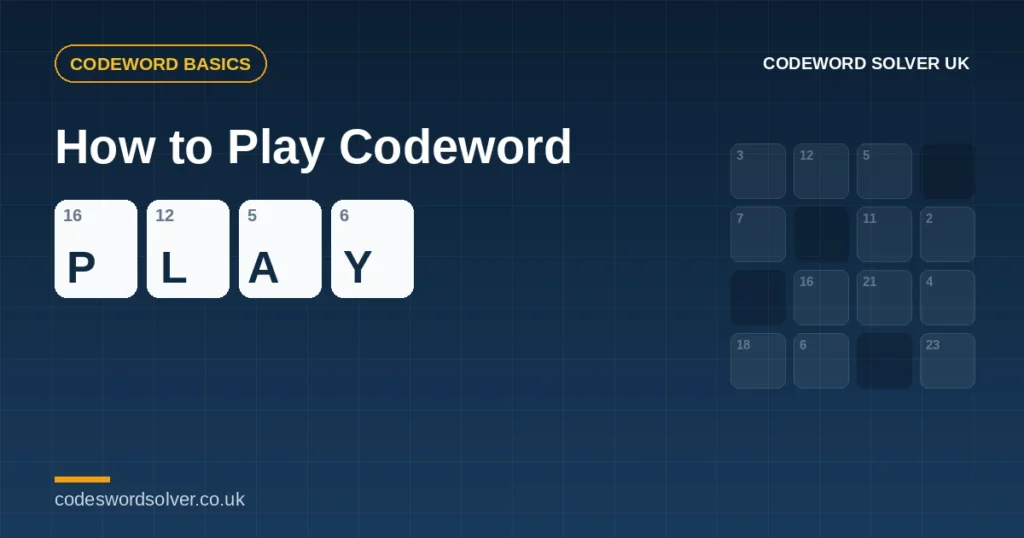
A codeword is a crossword-style grid with one twist: every letter is replaced by a number. The numbers 1 to 26 stand for the 26 letters of the alphabet, and the same number always stands for the same letter. If 7 is E in one square, it is E in every square. Two or three letters are given to start you off, and your job is to work out the rest until the grid is full of real words. This page explains how to play codeword, step by step, from your first grid.
It looks hard at first. It is not. Once you know the method, a first grid takes patience, not luck.
How the Grid Works
Each white square holds one number. A word in the grid is a run of numbers, and the pattern of those numbers is your main clue. A four-letter word with the pattern 1-2-2-1 has its first and last letters the same, and its middle two letters the same. Words that fit that shape include DEED, SEES and NOON.
Words cross each other, so every letter you confirm helps in two directions. That is the whole game: use what you know to narrow what you do not know, one letter at a time.
How to Play Codeword: Your First Five Moves
Start every grid the same way.
- Read the given letters. They are your anchor. A given E or T tells you more than a given Q, because common letters appear in many words.
- Find the short words. Two and three letter slots are the easiest to fill, because very few words fit. A two-letter slot with a repeated number can only be a small set of words.
- Look for doubles. A number that appears twice in a row inside a word is a double letter, and English has a short list of common doubles: EE, LL, SS, OO and TT.
- Try the common letters. E, T, A, O, I and N are the most frequent letters in English. If a number appears many times across the grid, it is probably one of these. Our guide to letter frequency shows the full order.
- Check every crossing. Before you commit to a word, read the words it crosses. If one crossing makes a nonsense word, your guess is wrong.
A Worked Mini Example
Take a three-letter slot with the pattern 1-2-1. The first and last letters match, so the word could be MUM, DAD or EYE. Now look at the crossings. If the middle letter crosses a word that needs an A, the answer is DAD. If it needs a U, the answer is MUM. The pattern gives you the shape, the crossings give you the answer. That is how every codeword is solved.
Try the same thinking on our worked mini puzzles when you are ready for a full grid.
Common Beginner Mistakes
Beginners usually lose a grid in one of four ways. First, guessing a whole word without checking its crossings. Second, ignoring double letters, which are the strongest clue in the grid. Third, using American spellings in a UK puzzle. British codewords use FAVOURITE, COLOUR and ORGANISE, and an American word list will lead you astray. Fourth, filling in a letter that breaks another word and not noticing until the end.
Our list of 10 common codeword mistakes covers each of these in detail.
Check Your Answer
When the grid is full, read every word across and down. Each one must be a real word, and each one must fit its crossings. If one word looks wrong, do not rub out the whole grid. Work backwards from the crossings around it, because the error is usually one letter, not ten. The guide to checking a codeword answer walks through that check.
If you get stuck, the free codeword solver takes a number pattern and known letters and returns matching words. Use it to test a guess, not to replace the thinking.
Conclusion
Playing a codeword is a method, not a talent. Learn the grid, start with short words and doubles, trust the crossings, and check your answer at the end. Your first grid will be slow. Your tenth will not be. If you want printed grids to practise on, UK publisher Puzzler prints codewords in its magazines and runs daily codewords online.

Codeword Solver Team
The Codeword Solver Team builds and maintains Codeword Solver UK, a free codeword, code cracker and coded crossword solver for British puzzles. We write the solving guides published on this site and test every tool against UK dictionary word lists and real newspaper style codeword patterns.
View this author's guides →