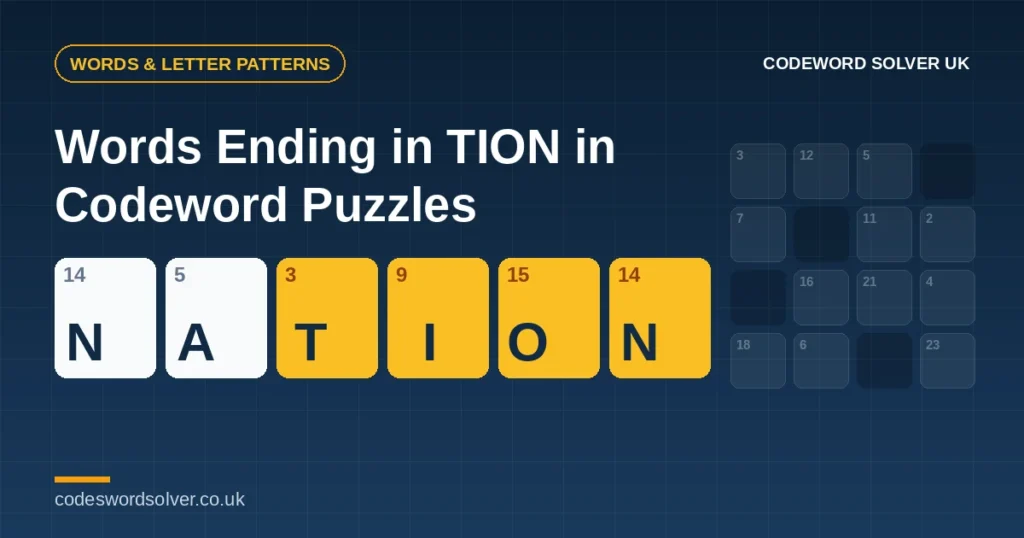
Words ending in TION can help you solve a codeword when the final four positions support T, I, O and N. Start by checking the number pattern, then compare the whole word with your confirmed key. The ending is a useful candidate to test, not a rule that every long entry must follow.
A confirmed TION ending can reveal four different mappings. However, those letters may also occur earlier in the word, which creates additional restrictions. STATION, for example, repeats T; NOTION repeats both N and O.
The lists below group examples by exact length and show how to turn a familiar ending into reliable evidence. They are reference examples, not a frequency ranking or a complete list of permitted answers for every publisher.
What the TION ending tells you
In the standard one-to-one codeword format, T, I, O and N must correspond to four different numbers. If the final four squares repeat a number, they cannot spell TION. This check works even before you know any of those letters.
Suppose the final squares are 6–11–3–8. TION is structurally possible because all four numbers differ. The sequence 6–11–3–6 is incompatible: it requires the first and last letters of the ending to match.
Next, compare the proposed assignments with the complete key. If number 3 already means E, that ending cannot be TION. If O already belongs to number 15, assigning O to number 3 would also break the one-to-one rule.
For a broader introduction to common suffixes, see Common Codeword Word Endings. This article concentrates on checking the exact four-letter sequence rather than guessing from how a word sounds.
TION words grouped by length
Count every letter in the answer. The ending occupies four squares, so a six-letter TION word leaves two positions before it. The table includes familiar nouns, but their suitability still depends on the puzzle’s dictionary and the letters already established.
| Length | Examples | Useful observation |
|---|---|---|
| 5 | CATION | A technical word; verify its meaning and dictionary acceptance |
| 6 | ACTION, MOTION, NATION, NOTION, OPTION, POTION | NOTION repeats N and O; OPTION repeats O |
| 7 | CAUTION, EMOTION, FICTION, MENTION, PORTION, SECTION, STATION | STATION repeats T |
| 8 | ADDITION, ADOPTION, DONATION, LOCATION, POSITION, QUESTION, SOLUTION | ADDITION has adjacent Ds and two Is |
| 9 | ATTENTION, EDUCATION, OPERATION, SELECTION | ATTENTION contains adjacent Ts and a repeated N |
| 10 | DECORATION, GENERATION, INVITATION, REVOLUTION | INVITATION repeats I, N and T |
CATION illustrates why an ending list needs care. It ends in the letters TION, but you should not invent a rule that every entry is an everyday action noun formed by adding the same suffix. Codewords depend on exact spelling; word formation is a separate question.
Long codeword words can provide more mappings, but they may also contain several repeated letters. Do not assume that a long candidate fits simply because its first letter and ending agree.
A worked example using STATION
Consider the original teaching entry 2–6–9–6–11–3–8. Suppose you already know 2 = S and 9 = A. The visible pattern is S?A????, and positions two and four share number 6.
If you test TION in the final four positions, the proposed key becomes 6 = T, 11 = I, 3 = O and 8 = N. Because number 6 also occurs in position two, the entry becomes STATION.
This candidate fits the length, known letters and internal repetition. Its T in position two is not an extra guess: it follows from the same number appearing at the start of the proposed ending.
| Position | Number | Candidate letter |
|---|---|---|
| 1 | 2 | S |
| 2 | 6 | T |
| 3 | 9 | A |
| 4 | 6 | T |
| 5 | 11 | I |
| 6 | 3 | O |
| 7 | 8 | N |
Now inspect other occurrences of 6, 11, 3 and 8. A candidate that fits this entry can still fail elsewhere. Keep the proposed mappings tentative until the wider grid supports them or eliminates the alternatives you are considering.
If number 11 already represents another letter, reject the TION hypothesis instead of overwriting the confirmed key. If it conflicts only with an earlier guess, review the evidence behind both candidates.
Use repetitions to separate similar candidates
MOTION, NOTION and POTION all have six letters and end in TION. Their repeated-letter structures differ, which makes the numbers more useful than the ending alone.
MOTION and POTION follow A–B–C–D–B–E: the second and fifth letters match. NOTION follows A–B–C–D–B–A: its first and last letters match as well.
Therefore, an entry whose first and last numbers differ cannot be NOTION under the standard rules. You can reject it without knowing the first letter. Conversely, matching first and last numbers rule out MOTION and POTION for that entry.
These checks illustrate how repeated letters narrow a candidate list. Preserve the original number sequence in your notes so that a wildcard search does not hide the distinction.
Do not confuse TION with a similar sound
English spelling does not give every similar-sounding ending the same letters. VERSION and MISSION finish in SION, while ACTION finishes in TION. A sound-based hunch cannot replace a square-by-square comparison. The same caution applies to words ending in ING.
If the final pattern is ?ION, both TION and SION may deserve consideration before the first letter is known. Use another occurrence of that number to test T against S. Do not decide only because you have recently solved several TION words.
Likewise, a word ending in TIONS needs an additional square. ACTION has six letters; ACTIONS has seven. Plural formation changes the required length, and the final S must also fit the key.
Where the puzzle permits them, related forms can be useful candidates. However, a possible plural is not evidence that the entry is plural. Confirm the complete spelling and length before proposing its mappings.
Search with the information you actually know
You can use the Codeword Solver Missing Letters to explore a partly filled entry. For an eight-letter candidate with a confirmed TION ending, a pattern such as ????TION preserves the length and final letters.
If TION is only a hypothesis, keep a separate search without that assumption. Comparing the searches helps you avoid treating your own input as independent confirmation. A tool will naturally return TION words when you ask it to do so.
After searching, compare each candidate with repeated numbers and the complete key. A basic unknown-letter pattern may omit relationships that the original grid requires. The tool’s suggestions are a shortlist to check, not a replacement for those relationships. Use the grid solver to check the shortlist against the whole grid before fixing another letter.
What to do when several TION words survive
Compare the positions where the remaining candidates differ. If MOTION and POTION are your current alternatives, the first letter is the immediate distinction. Find the corresponding number elsewhere rather than repeatedly checking the shared ending.
A crossing with several confirmed letters may settle that number. A distant entry using the same number can be equally useful. In a codeword, the shared key connects entries even when they do not meet in the grid.
Record what would separate the candidates. “Need M or P at number 12” gives you a specific next task. “Probably MOTION” does not explain why one candidate deserves preference.
Questions about TION in codewords
Does seeing ION prove the previous letter is T?
No. LION, UNION and words ending in SION show why that shortcut fails. Check the preceding number, the full length and the remaining letters.
Can I solve four numbers at once from this ending?
You can propose four mappings at once. Confirm them by checking the complete word and their consequences elsewhere. Keep the entire proposal reversible if it depends on one uncertain candidate.
What is the safest next step?
Verify the four different final numbers, test the ending against the key and compare whole-word repetition. Then look for independent evidence in the rest of the grid before committing the new letters.
Sources
- Cambridge Dictionary, English Grammar Today: Suffixes.
- Puzzler: Codeword rules and solving guidance.
- Codes Word Solver: Missing Letters Solver input guidance.

Codeword Solver Team
The Codeword Solver Team builds and maintains Codeword Solver UK, a free codeword, code cracker and coded crossword solver for British puzzles. We write the solving guides published on this site and test every tool against UK dictionary word lists and real newspaper style codeword patterns.
View this author's guides →