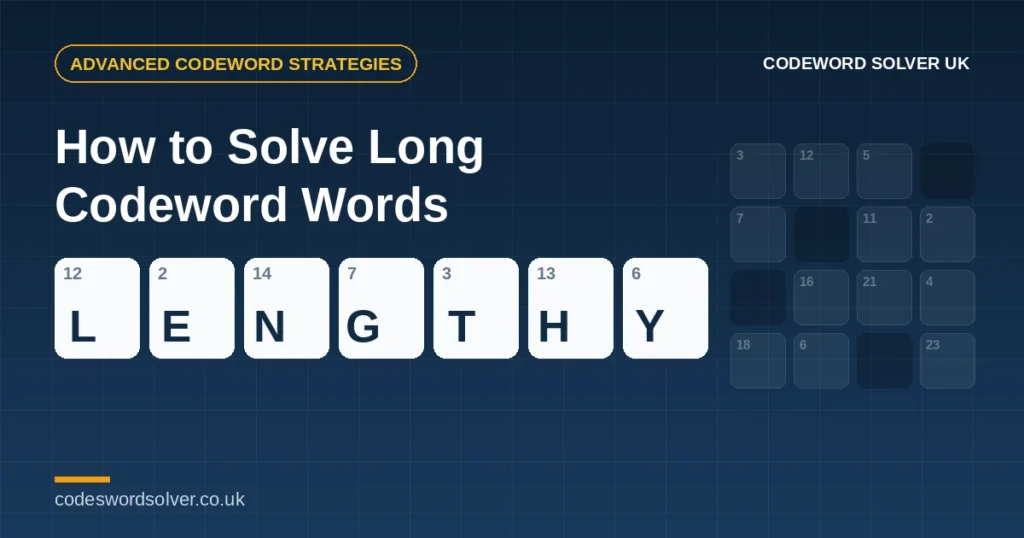
If you want to solve long Codeword words without filling the grid with risky guesses, start with structure rather than vocabulary. Every confirmed letter, repeated number, crossing, and word ending gives you another constraint.
A Codeword puzzle uses one consistent number-to-letter system. Once you identify a number correctly, that letter applies everywhere the same number appears. Therefore, a long answer can become one of the most useful entries in the grid.
What Is a Codeword Puzzle?
A Codeword is a crossword-style puzzle without standard clues. Each cell contains a number from 1 to 26, and each number represents a letter. The same number represents the same letter throughout the puzzle.
AmuseLabs confirms this format and notes that some puzzles provide a few pre-revealed number-letter pairs. Puzzler gives the same core rule and says a standard codecracker often supplies three starter letters, although the exact number can vary.
This consistent mapping makes deduction more useful than blind guessing. If number 12 represents E, every 12 must represent E.
Why Long Codeword Words Can Help You
Long Codeword words look harder because they contain more unknown positions. However, once several letters become known, their length can work in your favor.
Puzzler notes that Codeword compilers often avoid words longer than ten letters. Identifying one can reveal enough letters to make the rest of the puzzle much easier.
So, do not guess a long word too early. Build reliable mappings elsewhere, then return when the entry becomes more distinctive.
In other words, the giant word glaring at you from the middle of the grid may eventually become your best friend. It just has terrible timing.
How to Solve Long Codeword Words Step by Step
1. Enter Every Starter Letter First
Begin with information the puzzle has already confirmed.
Place each starter letter everywhere its matching number appears. The number-letter relationship applies across the entire grid.
Next, scan the long entries for useful fragments, repeated letters, or recognizable endings. Puzzler recommends the same basic approach: enter the starter letters wherever their numbers appear, then look for words that begin to suggest themselves.
This step may seem obvious, but it creates the foundation for every later deduction.
2. Build the Word From Confirmed Letters
Separate confirmed letters from guesses.
If a long entry has eleven positions but only two known letters, it may still allow too many possibilities. Instead of forcing an answer, work elsewhere until crossings or other mappings reveal more positions.
Read the developing answer as a pattern. Known vowels, repeated-number positions, and endings can narrow the options. Every letter must still agree with the code.
This approach helps you solve long Codeword words with evidence rather than wishful thinking.
3. Check Repeated Numbers and Double Letters
Repeated numbers create strong constraints.
If the same number occurs twice in a word, both positions must contain the same letter. If identical numbers sit together, the answer contains a double letter.
Puzzler lists common double-letter pairs that can help Codeword solvers, including LL, EE, SS, OO, TT, FF, RR, NN, PP, and CC.
Use these patterns to reject candidates quickly. If a proposed answer places different letters in positions represented by the same number, it cannot be correct.
That tiny check can save you from creating a grid-wide mess later.
4. Look for Common Word Endings
Suffixes can make a long Codeword answer easier to recognize.
Puzzler identifies endings such as -ing, -ed, -en, -est, -able, -ist, and -ness as useful patterns. However, it also notes that compilers may limit common suffixes so puzzles do not become too easy.
Therefore, treat a suffix as a clue rather than a guarantee.
If the final three positions could form ING, test I, N, and G against every occurrence of their numbers elsewhere. Reject the theory if it creates contradictions.
A promising ending is useful. An ending that survives the whole grid is much better.
5. Use Crossing Words
When a long entry remains too open, solve its crossing words.
Each crossing can supply another confirmed letter. Several crossings may transform an unreadable pattern into an obvious answer without requiring a speculative guess.
This is a safe way to solve long Codeword words because it uses evidence from other parts of the grid.
If one entry refuses to cooperate, move sideways. Sometimes the shortest route to a long answer runs through another word entirely.
6. Use Letter Frequency as a Hint
Letter frequency can support a deduction, but it should not control one.
Puzzler warns that standard English letter-frequency rankings do not perfectly fit Codeword puzzles. Puzzle grids contain selected words, and compilers can control how frequently particular letters appear.
Puzzler says vowels and letters such as R, T, N, D, and L may occur frequently, while X, J, Q, and Z are likely to appear less often.
However, that does not mean the most common number must represent E.
Instead, combine frequency with crossings, repeated numbers, and word structure. Frequency gives you a possibility; the grid must give you confirmation.
7. Solve Short Words to Unlock Long Ones
A long word does not need to be your first target; try five-letter entries first.
Short entries can provide useful mappings once one or two positions become known. A solved short word may reveal a pair that fills several positions in your long answer.
Once the long word becomes clear, the process can reverse. It may reveal several new letters elsewhere in the grid, so use the grid solver to check them.
That chain reaction explains why Codeword solving can change quickly. For ten minutes, the grid looks stubborn. Then one useful word turns half of it into free information.
8. Break the Word Into Smaller Parts
Do not treat a twelve-letter pattern as one enormous problem.
Look for a prefix, root, suffix, double letter, or repeated sequence. Then test each possible component against the number mapping.
A familiar ending may clarify the final letters while crossings reveal the beginning. You can then focus on the unresolved middle.
Breaking long Codeword words into recognizable sections reduces the number of possibilities you need to consider at once.
More importantly, it keeps your reasoning connected to information that actually appears in the grid.
9. Track Used and Unused Letters
Keep an accurate number-letter key as you solve.
Mark confirmed mappings clearly. Also notice which alphabet letters remain unused.
Puzzler states that in its standard Codeword format, every letter of the alphabet appears at least once in the grid.
Unused letters can therefore become helpful near the end of that type of puzzle. Before relying on this as an elimination rule, however, confirm that your particular puzzle follows the same full-alphabet format.
Good bookkeeping may not sound exciting, but neither does erasing eighteen incorrect squares.
10. Verify the Whole Word Before Committing
Before accepting a long answer, test every new mapping it creates.
Ask yourself:
- Do repeated numbers produce repeated letters in the correct positions?
- Do all confirmed mappings agree with the candidate?
- Do the newly decoded letters create plausible patterns elsewhere?
If the answer survives all three checks, you have strong evidence.
A long answer can introduce several mappings at once. A correct answer can open the puzzle quickly; a wrong one can spread confusion just as fast.
Common Mistakes When You Solve Long Codeword Words
The biggest mistake is turning a possibility into a confirmed answer too early.
Another common error involves assuming that the most frequent number must represent E. Puzzler specifically warns against depending too heavily on standard letter-frequency analysis when solving Codewords.
Solvers can also overtrust common endings. Three unknown final squares do not automatically mean ING.
Finally, never ignore contradictions elsewhere in the grid. A candidate must fit every occurrence of every number it decodes.
If something refuses to fit, use an elimination strategy to recheck your assumptions before reaching for an obscure dictionary word.
What to Do When a Long Codeword Word Will Not Fit
Stop guessing and return to confirmed information, starting with reading number patterns.
Recheck the starter letters, your number-letter key, and any answers you entered with low confidence. Then solve another part of the grid to create additional crossings.
You may discover that the long answer was never the real problem. One incorrect mapping elsewhere can make an ordinary word look impossible.
Also consider the puzzle’s editorial rules. Puzzler says its Codeword construction avoids proper nouns, phrases, hyphenated words, and foreign words that have not become fully accepted in English.
Other puzzle providers may publish their own rules or word lists. Therefore, use the conventions of the puzzle you are actually solving.
Final Thoughts
The best way to solve long Codeword words is to combine confirmed mappings, repeated-number patterns, crossings, common endings, and careful elimination.
Start with the given letters. Solve shorter answers when they offer safer progress. Then return to the long entry after the grid gives you enough evidence.
Most importantly, verify every new mapping across the puzzle.
A long Codeword answer may look like the grid’s biggest headache. With enough confirmed letters, it can become the shortcut that cracks the whole puzzle.
Frequently Asked Questions
Are Long Words Always Harder in Codeword Puzzles?
No. A long word may look harder at first, but several confirmed letters can make its pattern distinctive.
Puzzler even notes that compilers often avoid words longer than ten letters because identifying one can reveal many letters across the puzzle.
Should I Use Letter Frequency to Solve a Codeword?
Yes, but use it only as supporting evidence.
Codeword grids do not necessarily reflect normal English letter-frequency rankings. Puzzler advises solvers not to rely too heavily on frequency analysis alone.
What Should I Solve First in a Codeword Puzzle?
Start with the supplied letters and place them everywhere their numbers occur.
After that, look for promising word patterns, useful crossings, repeated letters, and shorter entries that can reveal more mappings.
Should I Guess an -ING Ending?
You can test an -ING ending, but do not assume it.
Check whether the three number mappings consistently produce I, N, and G everywhere else they occur. Puzzler identifies -ing as a useful common ending while also noting that setters may restrict obvious suffixes.
Why Are Repeated Numbers So Useful?
One number represents the same letter wherever it appears in a standard Codeword puzzle. Therefore, repeated numbers reveal repeated letters and reduce the number of possible answers.
Sources

Codeword Solver Team
The Codeword Solver Team builds and maintains Codeword Solver UK, a free codeword, code cracker and coded crossword solver for British puzzles. We write the solving guides published on this site and test every tool against UK dictionary word lists and real newspaper style codeword patterns.
View this author's guides →