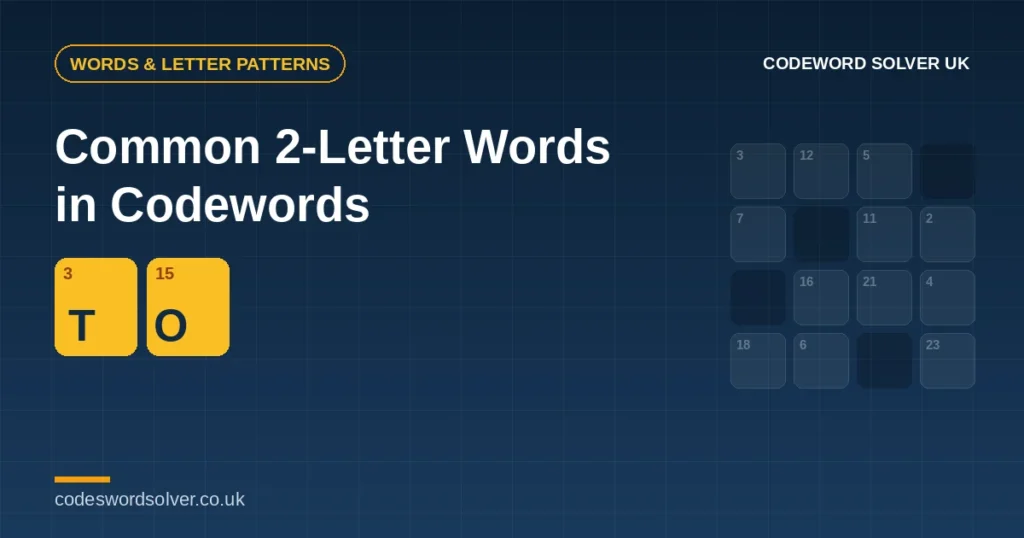
Common 2-letter words can help with codeword puzzles when the grid allows two-letter entries. Useful possibilities include AN, AS, AT, BE, BY, DO, GO, HE, IF, IN, IS, IT, ME, NO, OF, ON, OR, SO, TO, UP, US and WE. The right answer depends on the numbers and confirmed letters, not on where a word appears in a list.
First check that your puzzle actually contains two-letter answers. Some grids use longer minimum entries. If yours has none, move straight to the working through short three-letter entries rather than trying to split a longer answer into smaller words.
A useful two-letter word reference
The table below groups familiar examples by their first letter. It is a practical reference, not a measured ranking of newspaper answers or a complete dictionary. A publisher may use a broader or narrower vocabulary.
| First letter | Examples to consider | Useful observation |
|---|---|---|
| A | AM, AN, AS, AT | A known initial A still leaves several possibilities |
| B | BE, BY | Y can occupy the second position |
| D or G | DO, GO | A confirmed final O does not decide the first letter |
| H | HE | Check the same H number elsewhere |
| I | IF, IN, IS, IT | The second letter needs independent evidence |
| M | ME, MY | Either E or Y may follow M |
| N | NO | Do not reverse its order to ON |
| O | OF, OH, ON, OR, OX | A less frequent letter can still make an ordinary word |
| S or T | SO, TO | Use the first number to distinguish them |
| U or W | UP, US, WE | Test both letters against the key |
Norvig’s book-corpus analysis places several two-letter words among frequent words in ordinary text. However, book usage does not establish how often a compiler selects them for codewords. Avoid treating a general language list as an answer sheet.
Read the number pair before the word list
In a standard one-to-one codeword, two different numbers represent two different letters. A pair such as 4 9 needs an AB structure: the first letter differs from the second. Every example in the table above has that structure.
A pair such as 4 4 needs the same letter twice. None of the listed examples qualifies. Do not enter TO, OF or IN simply because the answer has two cells; all three would assign different letters to the same number.
Also check the existing key before making a shortlist. If number 4 is already A, your candidate must begin with A. If N belongs to number 12, then 4 9 cannot be AN, because number 9 cannot borrow number 12’s letter.
The publisher’s instructions define the puzzle you are solving. Lovatts’ Code Cracker instructions, for example, explain that matching numbers carry the same letter throughout its grid.
Filter words with one confirmed letter
A confirmed letter turns a broad list into a smaller question. For wildcard patterns such as A?, begin with AM, AN, AS and AT if they fit the puzzle’s vocabulary. For ?O, DO, GO, NO, SO and TO are useful familiar possibilities.
These are starting sets, not exhaustive sets. That distinction matters: if you assume your own list contains every acceptable word, you can make a false deduction by elimination. Check a suitable dictionary or the publisher’s guidance when an unfamiliar candidate becomes relevant.
Write only the changing letters in your notes when space is tight. For A?, a note reading “M/N/S/T” is easier to scan than four full words. Cross out a candidate only when you can state the reason.
Do not infer sentence grammar from neighbouring entries. A codeword grid is generally a collection of crossing answers, not a continuous passage. An adjacent word does not make a preposition or pronoun grammatically necessary.
A worked example using AT and TO
Here is a constructed example using vowels. A two-letter entry has numbers 4 9, with 4 = A confirmed. Your provisional shortlist is AM, AN, AS and AT. You cannot choose between those four from the first entry alone.
Elsewhere, a three-letter entry reads 9 6 11. Independent evidence has already established 6 = O and 11 = P, so it reads ?OP. Consider what each provisional second letter from the first entry would do here.
| First entry proposal | Number 9 becomes | Other entry becomes |
|---|---|---|
| AM | M | MOP |
| AN | N | NOP |
| AS | S | SOP |
| AT | T | TOP |
MOP, SOP and TOP are all ordinary words, so the extra entry does not settle the choice. NOP would need checking against the publisher’s vocabulary. This is exactly where a solver should resist announcing a solution too early.
Now suppose an independently verified crossing fixes number 9 as T. The first entry becomes AT, and the second becomes TOP. A third entry 9 6, if present, becomes TO. One confirmed mapping has helped several entries without relying on frequency.
The key lesson is to distinguish “this candidate works here” from “this candidate is established”. Multiple surviving answers are a normal intermediate state.
Use reversed pairs without confusing them
Some familiar two-letter words form useful reversed pairs, including ON and NO. If the grid contains 3 8 and 8 3, the two answers must reverse their letters under the same mapping.
That relationship can suggest ON/NO, but it does not prove that pair. Other accepted reversed words may exist, depending on the vocabulary. A confirmed O or N in another entry would make the observation much stronger.
Copy the numbers in order. A common practical mistake is remembering that “these two numbers make ON” and then writing ON again where the order is reversed. The mapping belongs to each number, not to the pair as a whole.
Check unusual words against the right dictionary
Short-word lists from other games may include abbreviations, interjections or specialist terms that your codeword publisher does not allow. A word accepted in one word game is not automatically suitable for a newspaper codeword.
Use a dictionary and letter frequency to verify a candidate’s spelling and meaning, then check whether the puzzle permits that kind of entry. Proper nouns and abbreviations deserve particular attention. Capital letters in the grid do not, by themselves, make a candidate a proper name.
If a candidate appears unfamiliar, do not reject it merely for being new to you. Equally, do not accept it just because a search engine returns a page containing those letters. You need a word entry that matches the relevant sense and spelling.
When to use a solver
Use the test a pattern with our tool when you want help checking possibilities against first letters worth trying. Enter the exact length in the missing letters solver and follow the tool’s supported pattern syntax. If the tool cannot express a constraint, apply that constraint yourself afterwards.
Before using a result, confirm that its two letters agree with the key and that each proposed mapping works wherever its number occurs. A matching pattern is a candidate-generation step, not a replacement for the rest of the grid.
For a broader solving routine, follow the a practical routine for solving the grid. Two-letter entries are one useful route into a puzzle, but an almost finished longer answer may offer a clearer deduction.
Frequently asked questions
Does every codeword contain two-letter words?
No. Inspect the grid and read its instructions. This reference is relevant only when two-letter entries are permitted and present.
Should I always try OF or TO first?
No. Start with confirmed letters and the number pattern. A familiar word that conflicts with a known mapping is immediately unsuitable.
Can I use the same letter for two different numbers?
Not in the standard one-to-one format described here. Keep a single key and check both directions: number to letter and letter to number.
Put the reference to work
Choose one two-letter entry, copy its numbers, and apply the confirmed mappings. Build a short candidate list, then investigate the same numbers in other words. Leave the entry provisional until the evidence distinguishes the remaining candidates.
This approach makes short words useful without giving them more certainty than they deserve. Two cells can provide a valuable connection, but the whole grid decides which word belongs there.
Sources

Codeword Solver Team
The Codeword Solver Team builds and maintains Codeword Solver UK, a free codeword, code cracker and coded crossword solver for British puzzles. We write the solving guides published on this site and test every tool against UK dictionary word lists and real newspaper style codeword patterns.
View this author's guides →