UK newspaper codewords and American codeword puzzles can use the same basic number-to-letter solving method. The practical differences to check are the publisher’s spelling conventions, accepted vocabulary, starter letters and individual puzzle instructions. A country label alone does not define a separate set of codeword rules.
If you normally solve British puzzles and pick up an American collection, keep your pattern-solving skills. Adjust the words you consider and read the new instructions carefully. This guide explains what to compare before you decide that a familiar-looking answer is wrong.
The shared idea behind the puzzles
A codeword replaces letters in a word grid with numbers. You recover the letter assignments and use them throughout the puzzle. This is different from solving a conventional crossword by answering a separate written clue for each entry.
Penny Dell’s description of its Codewords identifies an unclued crossword format with numbered answer cells. British publisher Puzzler describes the corresponding codeword format. These examples support the shared mechanism, rather than a claim that every publication is identical.
In the standard one-to-one format used throughout our examples, equal numbers require equal letters and different numbers require different letters. Apply that logic before considering whether an answer looks more British or American.
What to compare when changing publishers
| Feature | What to check | Why it affects solving |
|---|---|---|
| Spelling | British, American or another stated convention | Letter count and repeat positions can change |
| Vocabulary | Dictionary policy and excluded word types | A recognised word may still be unsuitable |
| Starter letters | Exactly which mappings are supplied | These establish the reliable starting key |
| Alphabet coverage | Whether every letter must appear | This changes what unused letters imply |
| Grid rules | Minimum entry length and special instructions | Familiar solving shortcuts may not apply |
| Digital assistance | How hints and error checks behave | Automatic filling is not necessarily confirmation |
Use this checklist for two British publishers as well as for a British and an American one. Variation within a market can be just as relevant as variation between countries.
Spelling can change more than one cell
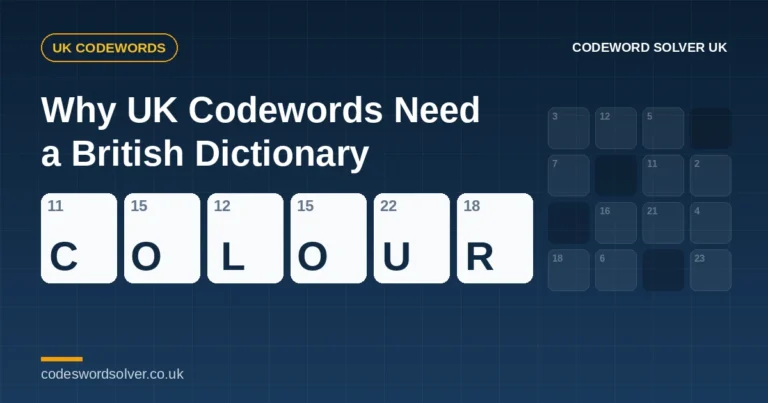
COLOUR has six letters, while COLOR has five. You cannot place them interchangeably in a fixed-length entry. CENTRE and CENTER both have six letters, but their British endings occupy different positions.
The UOC spelling guide documents these British and American spelling conventions. For a longer reference table, see our spelling differences that change puzzle answers.
The codeword implication is easy to overlook: changing a spelling also changes which number represents a letter at each position. A word may have the right meaning and length yet fail the repeated-number structure.
Before rejecting an unfamiliar spelling, check the actual dictionary entry and the publication’s convention. Before accepting a familiar spelling, check every numbered cell. Neither familiarity nor nationality overrides the grid.
A worked comparison using CENTRE and CENTER
Consider two constructed six-cell patterns. CENTRE has the structure 1 2 3 4 5 2, because E occurs in positions two and six. CENTER has the structure 1 2 3 4 2 5, because E occurs in positions two and five.
Suppose an entry has numbers 6 11 3 18 9 11. The second and last cells share number 11. CENTRE fits that repeat arrangement; CENTER does not. This conclusion follows from the number pattern before any national spelling preference is considered.
Now imagine the fifth cell, rather than the sixth, also carried 11. CENTER would have the appropriate repeated positions instead. You would still need to verify C, E, N, T and R against the rest of the key.
This example shows why switching dictionaries cannot repair an incorrectly copied pattern. First establish what the cells require, then find an accepted spelling that satisfies those requirements.
British English does not mean every word uses ISE
Do not reject ORGANIZE automatically in a British puzzle. British usage includes both ISE and IZE traditions for some words. The University of Oxford style guide explicitly distinguishes its preference for ISE from Oxford University Press’s IZE preference.
That distinction is a reason to consult the publisher’s dictionary policy, not a reason to allow either letter everywhere. Some words do not offer that choice. Check the specific word rather than applying a blanket replacement.
For a codeword entry, write the candidate’s actual spelling in full. If you are considering two variants, compare their differing positions with confirmed mappings. A known S or Z may settle the choice directly.
Vocabulary policy matters more than stereotypes
It is tempting to imagine one list of common British codeword words and a separate list of “American codeword words”. In practice, the vocabulary you need depends on the individual puzzle and its accepted reference works.
Everyday regional words can broaden your candidate search, but they do not provide definitions in an unclued puzzle. A word you associate with one country can still be recorded in dictionaries elsewhere. Use word length, mappings and dictionary labels together.
Our guide to why a British dictionary helps UK codewords explains the practical filtering issue. Choosing an appropriate word list reduces irrelevant candidates, while the grid remains the final structural test.
Do not import assumptions from other games. An abbreviation allowed in a conventional crossword or a word accepted in a tile game is not automatically an allowed codeword answer.
Do not assume the starter letters or alphabet rules
Count the supplied mappings in the puzzle you are solving. Enter them throughout the grid before making deductions. A new publication may give you a different amount of help from the one you usually solve.
Likewise, read any statement about alphabet coverage. If the instructions guarantee every letter appears, an unused letter becomes relevant during the final checks. Without that guarantee, you should not force a rare letter into an answer merely to complete the alphabet.
These are edition-level checks. There is no need to decide that a puzzle must follow a particular rule simply because it came from a UK newspaper or an American collection.
Why an American-style crossword is a different comparison
“American-style crossword” and “American codeword” should not be treated as interchangeable labels. The former usually refers to a crossword format with written clues, whereas the codeword mechanism discussed here uses letter substitutions.
If you open a puzzle and see across and down clues, read its instructions before applying a codeword strategy. A grid can resemble another grid visually while asking you to solve a different problem.
The same caution applies to cryptic crosswords. Their wordplay conventions do not become codeword rules merely because both puzzles contain crossing words. Identify the task first, then choose the appropriate solving method.
A routine for solving an unfamiliar edition
- Read the title and instructions to confirm the puzzle type.
- Copy all starter mappings into one clear key.
- Check the spelling convention and any vocabulary restrictions.
- Solve a constrained entry using its exact number pattern.
- Verify the candidate’s spelling in an appropriate dictionary.
- Apply each confirmed mapping everywhere and recheck crossings.
If you use our check a pattern using the UK tool, keep its British focus in mind when working on another publisher’s puzzle. A tool’s results need to match the puzzle’s vocabulary policy as well as its numerical constraints.
UK newspaper codeword tips for unfamiliar editions say to write down any rule that differs from your usual puzzle before you begin. A short note can prevent repeated mistakes, especially when moving between print and digital formats.
Frequently asked questions
Are UK codewords harder than American codewords?
There is no reliable answer based on country alone. Compare the specific grid, supplied letters, vocabulary and difficulty label rather than assuming a national ranking.
Can I use the same solving strategy for both?
Yes, when both use the standard number-to-letter format. Keep the pattern checks and adapt your candidate vocabulary to the publisher.
What if two spellings both seem to fit?
Check all differing letters against the key and other entries. If ambiguity remains, keep both candidates provisional until a further constraint resolves it.
Sources
- Penny Dell: Codewords format description
- Puzzler: Codeword format
- UOC: British and American spelling
- University of Oxford: Word usage and spelling

Codeword Solver Team
The Codeword Solver Team builds and maintains Codeword Solver UK, a free codeword, code cracker and coded crossword solver for British puzzles. We write the solving guides published on this site and test every tool against UK dictionary word lists and real newspaper style codeword patterns.
View this author's guides →