British word endings can help you narrow a codeword answer when the final cells are partly solved. Useful patterns include OUR in COLOUR, RE in CENTRE, and ISE or IZE in words that permit those variants. The important step is to translate the spelling into the exact numbered structure.
This guide focuses on testing endings in the grid. For a broader spelling reference, see the differences between British and American answer forms. Here, you will work through length, repeated letters and existing mappings before deciding whether an ending is correct.
British endings to recognise
The following examples reflect established spelling conventions described by the University of Oxford and the UOC language guide. They are not a frequency ranking of common word suffixes, and not every word ending in the same letters follows the same convention.
| Ending or form | Examples | Practical check |
|---|---|---|
| OUR | COLOUR, FAVOUR | Allow all three final letters and check earlier repeats |
| RE | CENTRE, FIBRE, LITRE | Do not reverse the last two letters automatically |
| ISE or IZE in eligible words | ORGANISE, ORGANIZE | Check the word and the publisher’s preference |
| YSE | ANALYSE, PARALYSE | Keep this distinct from the ISE/IZE choice |
| CE or SE in particular word pairs | LICENCE, LICENSE | Check the complete word and its accepted use |
| Double L before ING in some forms | TRAVELLING, MODELLING | Count the extra letter and preserve the repeated L |
These are cues for candidate generation. A six-letter entry ending OUR does not automatically become COLOUR. You still need the first three letters, the repeat pattern and the wider key to agree.
Worked example one: test OUR in COLOUR
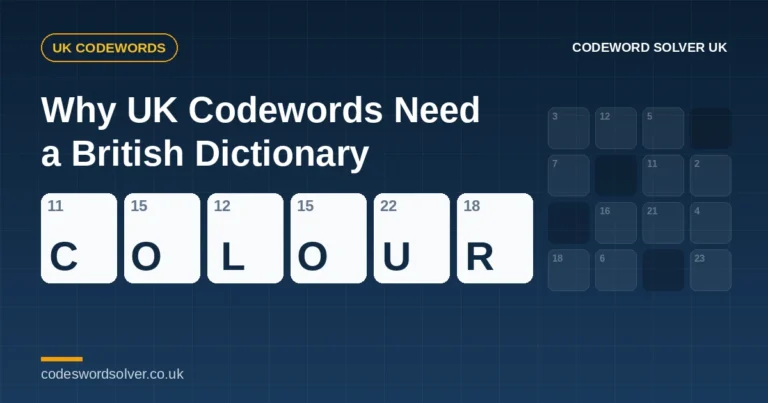
Consider a constructed six-cell entry 4 8 11 8 17 6. Suppose the first letter is C and the last is R. Positions two and four carry the same number, so those letters must match.
COLOUR, in a British dictionary, fits the pattern: C O L O U R. It proposes 8 = O, 11 = L and 17 = U. The repeated O is just as important as the ending OUR.
FAVOUR is also six letters and ends in OUR, but it has six different letters. It cannot fit this repeated-number pattern, even before the confirmed C excludes it. This demonstrates why an ending is only part of the test.
Now check the three proposed mappings elsewhere. If U is already confirmed as number 19, COLOUR fails because it would assign U to number 17 as well. If the mappings remain consistent, keep the candidate while you gather crossing evidence.
Worked example two: distinguish RE from ER
Suppose a five-letter entry shows F I B ? ?. FIBRE and FIBER are both familiar spellings in their respective conventions, and both contain five different letters. The word shape alone therefore cannot distinguish them.
If the final two numbered cells are 12 and 7, and number 7 is confirmed as E elsewhere, FIBRE agrees with that mapping. FIBER would require the last number to be R, so it fails the confirmed-letter check.
In another grid, different established mappings might point to FIBER. You would then check whether that spelling is allowed in the puzzle rather than silently changing a confirmed letter to impose a British preference.
Be careful with words such as METRE and METER, which can also differ in meaning and usage. The spelling rule is not a command to replace every ER with RE. A dictionary check prevents mechanical substitutions from creating unsuitable answers.
Worked example three: ISE and IZE need a word check
ORGANISE and ORGANIZE each have eight different letters. Their difference is at position seven. If an entry reads O R G A N I ? E, a number-pattern test alone will not choose between S and Z.
The University of Oxford’s house style uses ISE, while its guidance acknowledges Oxford University Press’s different preference. British English therefore does not justify a blanket rule that every eligible word must use S.
Check the exact word in an appropriate dictionary, then consult the publisher’s convention if one is stated. Finally, test the unknown number wherever it appears. A confirmed mapping to S or Z elsewhere can settle the candidate.
Do not extend this choice to every word ending in ISE. ADVISE, for example, is not changed to ADVIZE. Recognising a possible ending should make the search more precise, not create new spellings.
Worked example four: YSE has a different pattern
ANALYSE has seven letters and repeats A in positions one and three. Its abstract structure is A B A C D E F. The same repeat structure also fits ANALYZE, so repeated numbers alone do not determine the S or Z.
Imagine the entry’s last three numbers are 5, 14 and 9. The candidate ANALYSE proposes 5 = Y, 14 = S and 9 = E. Compare those assignments with the key, including any S or E already allocated to another number.
If a different entry independently confirms 14 = S, that supports the British form. If nothing confirms it yet, keep the spelling choice provisional. The existence of a regional convention does not turn a possible mapping into a proved one.
This distinction matters because an ISE/IZE decision and a YSE/YZE decision are not interchangeable spelling rules. Check the whole word rather than a three-letter ending in isolation.
Length changes before ING
TRAVELLING contains ten letters, while TRAVELING contains nine. The longer form also has adjacent repeated Ls. A fixed grid can distinguish those forms through ING endings, length and repeated-number structure.
In TRAVELLING, positions six and seven are L. They must share a number. If those cells have different numbers, the proposed spelling cannot fit the standard one-to-one format.
Do not apply a double-L rule to every word indiscriminately. Check the actual dictionary spelling and the base word. Our article on recognising doubled letters in English words gives further background.
When counting, write the full proposed answer under the numbered cells. That small step is more reliable than relying on pronunciation or a remembered word length.
Keep endings separate from suffix assumptions
An ending is simply the final sequence of letters you can see. A suffix is a word-building element. For solving purposes, a useful ending does not always need to function as a suffix.
Likewise, identifying a plausible suffix does not establish the complete word. A candidate might have the right ending but the wrong length, an impossible repeated letter, or an existing-key conflict.
Use a wider reference for final letter patterns when no specifically British form seems useful. That guide covers general endings such as ED, ER and ING, which can also occur in a UK puzzle.
A quick way to test an ending
- Count the answer cells and copy all numbers in order.
- Insert confirmed letters before proposing an ending.
- Write the complete candidate, including its exact spelling.
- Compare every repeated letter with the repeated numbers.
- Check whether each new letter is already assigned elsewhere.
- Inspect all other occurrences of the proposed numbers.
If a candidate fails, record the reason. “U already belongs to 19” is decisive within the current confirmed key. “It looks unusual” is a reason to solve entries with missing letters and check a dictionary, not a structural contradiction.
You can also test the pattern with a UK-focused tool. Keep any unconfirmed ending separate from supplied letters so you can widen the search again if the results are unhelpful.
Frequently asked questions
Does every British codeword use the same spelling policy?
Do not assume so. Follow the individual publisher’s instructions and dictionary convention, especially where British English permits variants.
Should I change a confirmed letter to make a British ending fit?
No. Recheck the proposed word first. Supplied letters and independently established mappings take priority over a spelling hunch.
What is the best next move after spotting an ending?
Find another occurrence of one of its unknown numbers. An almost completed word elsewhere may provide the independent check that confirms or rejects the proposal.
Sources
- University of Oxford: Word usage and spelling.
- Universitat Oberta de Catalunya: British and American spelling conventions.
- Codeword Solver: Common word endings and repeated-letter patterns.

Codeword Solver Team
The Codeword Solver Team builds and maintains Codeword Solver UK, a free codeword, code cracker and coded crossword solver for British puzzles. We write the solving guides published on this site and test every tool against UK dictionary word lists and real newspaper style codeword patterns.
View this author's guides →