British vs American Codeword Spellings: A Clear Guide for Puzzle Solvers
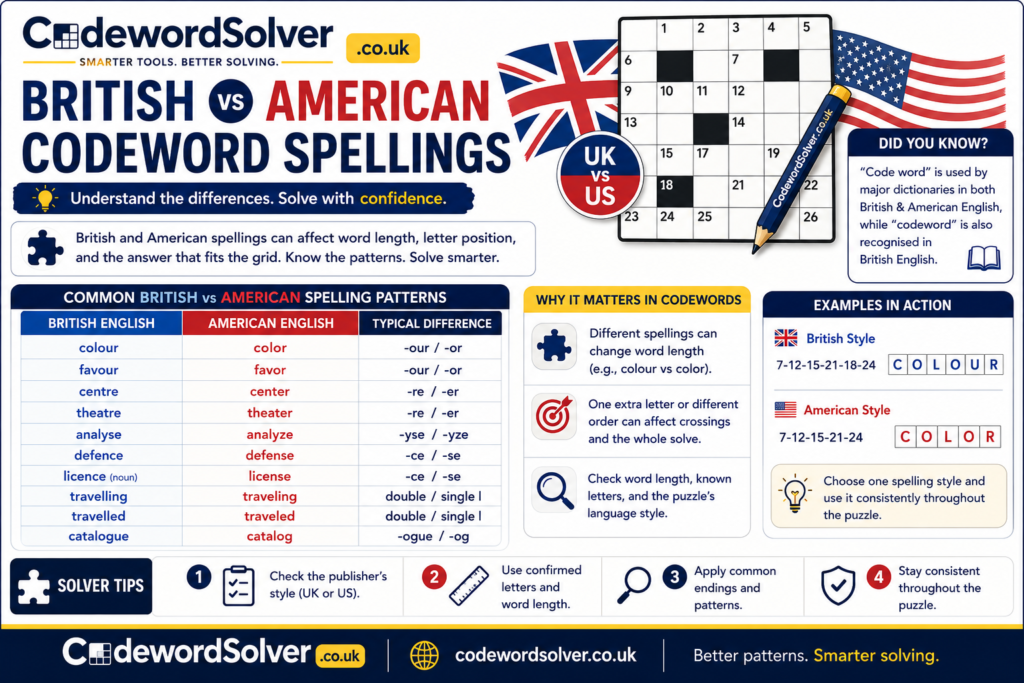
British vs American codeword spellings can make a simple puzzle surprisingly tricky. A solver may know the word but still hesitate between colour and color, centre and center, or travelling and traveling.
These are not mistakes. They reflect established conventions in British English and American English. In codeword puzzles, those differences can affect word length, letter position, and the answer that fits the grid.
This guide explains the main spelling patterns, important exceptions, and dictionary evidence behind them. It also shows why puzzle creators should choose one spelling style and use it consistently.
Is It “Codeword” or “Code Word”?
Before comparing spellings inside puzzles, it helps to settle the term itself.
Cambridge Dictionary lists code word as two words in both its main English entry and American Dictionary entry. Merriam-Webster also uses code word as its headword. Collins, however, has a British English entry for codeword as one word.
So, there is no simple British-versus-American rule for the compound. Code word has strong dictionary support on both sides of the Atlantic, while codeword also has recognised British dictionary support.
For a puzzle website, consistency matters most. Choose a house style, then use the same form in titles, instructions, category pages, and descriptions.
Why British and American Spellings Matter in Codeword Puzzles
Most regional differences in codeword puzzles come from normal spelling conventions.
The University of Oxford lists pairs such as colour/color, organise/organize, analyse/analyze, centre/center, travelling/traveling, and travelled/traveled. Cambridge University Press also distinguishes forms such as labour/labor, defence/defense, and programme/program.
In normal prose, readers understand both versions easily. In a codeword, however, one extra letter or one changed position can affect several answers.
For example, colour has six letters, while color has five. Centre and center have the same length, but their final letters appear in a different order.
Common British vs American Spelling Patterns
| British English | American English | Typical difference |
|---|---|---|
| colour | color | -our / -or |
| favour | favor | -our / -or |
| centre | center | -re / -er |
| theatre | theater | -re / -er |
| analyse | analyze | -yse / -yze |
| defence | defense | -ce / -se |
| licence (noun) | license | -ce / -se |
| travelling | traveling | doubled/single l |
| travelled | traveled | doubled/single l |
| catalogue | catalog | -ogue / -og |
These patterns are useful, but they are not universal laws. Dictionaries record variants, and publishers may follow different house styles.
Therefore, combine spelling knowledge with confirmed letters, word length, and the publication’s language style.
Colour vs Color: The -our and -or Pattern
One of the easiest differences to spot is British -our versus American -or.
British English commonly uses colour, favour, labour, neighbour, and honour. American English normally uses color, favor, labor, neighbor, and honor.
The University of Oxford gives colour/color as a standard example. Cambridge University Press also uses labour/labor when explaining UK and US spelling.
For solvers, this pattern matters because it can change word length. Sometimes one missing u really is the whole mystery. English likes drama, but not every puzzle needs it.
Centre vs Center and Theatre vs Theater
British English normally prefers centre and theatre. American English normally prefers center and theater.
The University of Oxford lists centre/center under the British -re and American -er pattern.
Unlike colour/color, these pairs keep the same number of letters. The challenge comes from letter order.
As a result, confirmed letters can settle the answer quickly. The same logic applies to theatre/theater.
Analyse vs Analyze Is Not the Same as Organise vs Organize
The analyse/analyze pair deserves special attention because it does not follow exactly the same rule as organise/organize.
The University of Oxford lists analyse as British and analyze as American. Cambridge University Press adds an important detail: in its UK guidance, words ending in -yse, such as analyse and catalyse, keep the s even when a publication otherwise uses -ize spellings.
So, a British publication may use organize and still write analyse. American English normally uses analyze. The same broad distinction applies to paralyse/paralyze.
For codeword players, one confirmed s or z can reveal the spelling system.
Organise or Organize? British English Allows Both Traditions
It is tempting to say British English always uses -ise, while American English always uses -ize. That rule is too simple.
The University of Oxford’s public style guide uses organise as its British form. Cambridge Dictionary, however, labels organize as “UK usually organise,” showing that the z spelling can also occur in British English.
Cambridge University Press tells authors to standardise British texts to either -ise or -ize, depending on the chosen style.
Oxford University Press publications can follow their own editorial conventions. Therefore, writers and solvers should not assume that the University of Oxford website’s house style governs every OUP publication.
For solvers, the practical lesson is simple: do not reject organize only because a puzzle is British.
Defence, Licence, and Practice Need Extra Care
Some British spellings depend on grammar as well as geography.
The University of Oxford gives British defence versus American defense. It also distinguishes British licence as a noun from license as a verb. American English uses license for both.
Likewise, British English uses practice as the noun and practise as the verb. American English uses practice for both.
These distinctions matter when a puzzle gives little grammatical context. In that case, crossing letters and regional style become more useful.
Travelling vs Traveling
British English normally doubles the l in travelling, travelled, and traveller. American English commonly uses traveling, traveled, and traveler.
The University of Oxford explicitly lists these pairs in its British-American spelling table.
Here, word length helps. Traveller has nine letters, while traveler has eight.
If an answer looks perfect but refuses to fit, check the spelling convention before blaming the setter. The grid may simply be carrying a different passport.
Catalogue vs Catalog
British English usually uses catalogue, while American English commonly uses catalog.
Cambridge Dictionary labels catalogue as the UK form and catalog as the US form. However, its American Dictionary also recognises catalogue as a variant. Merriam-Webster likewise lists catalog with catalogue as a variant.
So, catalog is a strong American default, but catalogue is not automatically wrong in American usage.
For codeword puzzles, follow the publication’s preferred dictionary or house style.
Programme vs Program
British English commonly uses programme for schedules and planned activities, but program for computer applications. The University of Oxford and Cambridge University Press both document this distinction.
American English generally uses program across these meanings. Cambridge Dictionary, for example, identifies program as the US counterpart of British programme in general usage.
Therefore, context matters. A British puzzle about software may still require program, while a British puzzle about a television schedule is more likely to use programme.
Should Codeword Creators Use British or American English?
Either spelling system can work well. The real problem is inconsistency.
A puzzle aimed mainly at British players should normally follow a recognised British dictionary or house style. A puzzle aimed at American players should follow an American standard.
International puzzle sites can support both. However, they should tell players which convention applies when spelling can affect an answer.
Consistency makes puzzles fairer. Randomly mixing colour, center, travelling, and defense can create needless uncertainty.
Tips for Solving British and American Codeword Spellings
When a word looks almost right, check regional spelling before discarding it. Pay attention to -our/-or, -re/-er, -yse/-yze, doubled l, and selected -ce/-se differences.
Next, treat the puzzle’s origin as a clue, not absolute proof. British publishers can use different -ise/-ize styles, and dictionaries may record more than one accepted form.
Also trust confirmed letters. If the grid strongly supports an unfamiliar spelling, verify it in a reliable dictionary rather than changing correct letters from memory.
Frequently Asked Questions
Is “colour” British and “color” American?
Yes. Colour is the standard British form, while color is the standard American form. The University of Oxford lists the pair as a representative spelling difference.
Is “organize” wrong in British English?
No. Organize can occur in British English, although organise is more common in many British style guides. Cambridge Dictionary marks organize as “UK usually organise.”
Is “codeword” one word or two?
Both forms have reputable dictionary support. Cambridge Dictionary and Merriam-Webster use code word as their headword, while Collins has a British English entry for codeword.
Which spelling should a codeword puzzle use?
A codeword puzzle should follow the dictionary or house style chosen by its publisher. British and American forms can both be correct; consistent usage makes the puzzle clearer.
Final Thoughts on British vs American Codeword Spellings
British vs American codeword spellings become easier once you recognise a few recurring patterns.
Think colour/color, centre/center, analyse/analyze, defence/defense, and travelling/traveling. However, organise/organize, catalogue/catalog, and programme/program show why context and house style still matter.
For solvers, regional spelling provides an extra clue. For creators, consistent spelling removes avoidable ambiguity.
And if an answer seems perfect except for one suspicious u, do not assume the grid has turned against you. It may simply be speaking British English.
Ready to try the solver?
Put what you've learned into practice with our free Codeword Solver.
Try the Codeword Solver