Why UK Codewords Need a British Dictionary
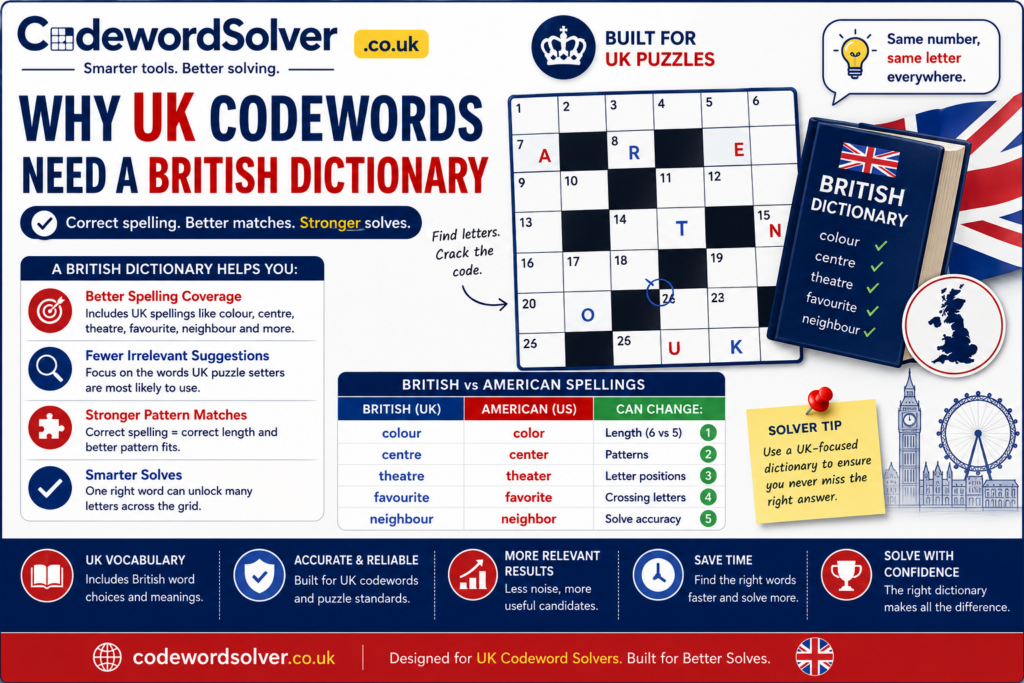
UK codewords may look like pure logic puzzles, but vocabulary matters just as much. A solver can identify patterns, repeated numbers and likely vowels. However, it still needs real words to test those deductions. That is why a British dictionary can make a real difference when a puzzle targets UK English.
PA Media describes Codeword as a crossword-like grid without standard clues. Each white square contains a number, and each number represents one of the 26 letters. Solvers gradually uncover that number-to-letter mapping and use each confirmed letter to unlock more words.
The logic sounds universal. The vocabulary is not.
British and American English share most of their language. However, spelling and everyday word choice sometimes differ. In normal conversation, those differences rarely cause trouble. In a codeword grid, one letter can affect several crossing answers.
Therefore, the dictionary becomes part of the solving engine.
What Makes UK Codewords Different?
A codeword gives you fewer direct hints than a standard crossword. Instead of reading clues, you infer letters from patterns.
For example, if the same number appears several times, it must represent the same letter each time. Repeated numbers inside a word also reveal repeated-letter patterns. Once you identify one likely word, its letters provide new mappings across the grid.
Vocabulary then decides which candidates make sense.
A general word list may contain both British and American forms. That sounds useful, but it can create noise. A UK-focused solver should give British forms strong coverage while still recognising accepted variants.
British and American Spellings Can Change the Pattern
The British Council documents several spelling differences between British and American English. BBC Learning English highlights the same broad patterns. These include British -our versus American -or, and British -re versus American -er.
Common examples include:
| British English | American English |
|---|---|
| colour | color |
| favourite | favorite |
| neighbour | neighbor |
| centre | center |
| theatre | theater |
| metre | meter |
Cambridge Dictionary identifies colour as the UK spelling of color and centre as the UK spelling of center. It also identifies theatre as the UK form and theater as the US form.
For codewords, these differences matter in two ways.
First, some variants change word length. COLOUR has six letters, while COLOR has five. A length-aware solver should never place COLOR into a six-letter slot.
The real risk appears when a dictionary contains only COLOR. In that case, the tool may fail to offer COLOUR as a valid six-letter candidate.
Second, some variants keep the same length but change letter positions. CENTRE and CENTER both contain six letters. THEATRE and THEATER both contain seven.
Those pairs create different internal patterns. As a result, choosing the wrong regional form can produce incorrect letter mappings.
One misplaced letter can spread through a grid with impressive efficiency. Sadly, puzzles do not award points for elegant mistakes.
A British Dictionary Reduces Irrelevant Suggestions
A good UK codeword solver should reduce uncertainty rather than add to it.
Suppose a partly solved answer fits a common British spelling. If the underlying word list lacks that form, the solver may return nothing useful.
A huge international dictionary can create the opposite problem. It may bury a likely answer among less relevant alternatives.
A British dictionary gives standard UK forms reliable coverage. Therefore, it lowers the chance of missing an intended answer because the database follows another regional convention.
However, a solver should not simply delete every American-looking form. British English contains spelling variation of its own.
The -ise and -ize question shows why.
British English Is Not One Fixed Spelling System
Many people learn that British English uses -ise, while American English uses -ize. That shortcut is useful in some situations, but it is not a complete rule.
BBC Learning English explains that British English accepts both -ise and -ize for many verbs. For example, British writers may use apologise or apologize.
Oxford University Press also follows Oxford spelling. Its house style generally prefers -ize, -ization and -izing where those endings apply.
Therefore, a serious British word list should not simply replace every Z with S.
Instead, it should recognise accepted British variants. Where possible, it should also reflect the puzzle publisher’s editorial style.
One publication may favour organise. Another may follow Oxford spelling and use organize.
That detail matters because codewords depend on exact letters, not merely meaning.
UK Codewords Also Need British Vocabulary
Spelling is only part of the picture.
The British Council gives familiar vocabulary differences such as British flat versus American apartment, holiday versus vacation, and film versus movie.
BBC Learning English also provides material specifically covering British and American vocabulary differences.
These words are not interchangeable in every sentence. Context still matters. Even so, they show why a UK-oriented dictionary should reflect the vocabulary its audience actually uses.
A useful word list should include common British terms, standard inflections and accepted spellings. At the same time, it should avoid overwhelming users with obscure entries unless the puzzle genuinely calls for them.
More entries do not automatically create a better solver.
If a pattern strongly suggests an everyday word, users should not have to scroll through a parade of rare botanical names first.
Word Ranking Can Improve Candidate Quality
A dictionary tells a solver which words exist. Ranking helps decide which words deserve attention first.
When several candidates match the same pattern, common words often make better first checks than highly specialised terms. Therefore, a solver can use frequency, editorial vocabulary or puzzle-specific usage to order its results.
This is a design principle, not a universal law.
Puzzle setters sometimes use unusual words, names or less familiar vocabulary. A strong system should therefore rank likely answers without hiding valid alternatives.
That balance keeps the search useful without pretending English behaves perfectly.
English has never shown much interest in behaving perfectly anyway.
Repeated-Letter Logic Works Better With the Right Word List
Codeword puzzles gain much of their structure from repeated numbers.
PA Media explains the central mechanism clearly: each number represents a letter, and solvers gradually uncover those mappings across the grid.
A codeword solver can combine that structure with a British dictionary. For example, it can filter candidates by word length, known letters, repeated-letter positions and confirmed mappings.
Imagine a seven-letter answer with this pattern:
1-2-3-4-1-5-6
The first and fifth positions contain the same number. Therefore, the correct word must repeat the same letter in both positions.
Any candidate without that repetition can disappear immediately.
The dictionary supplies plausible words. Meanwhile, the code pattern supplies structural constraints. Together, they produce a much cleaner search.
Why an International Dictionary Alone Is Not Enough
An international dictionary still has value. A puzzle may contain borrowed words, names or accepted variants.
However, it should not always control the first results for UK codewords.
If British and American variants receive equal priority, users may repeatedly need to decide which spelling the setter intended. That creates extra work.
A better approach starts with British English and expands the search when necessary.
This does not mean British English is more correct than American English. Cambridge Dictionary, the British Council and BBC Learning English all recognise these varieties and document differences between them.
The issue is relevance.
A UK puzzle benefits from a word resource that understands UK spelling and vocabulary. Likewise, a puzzle created for another English-speaking market may benefit from its own regional conventions.
What Should a British Dictionary for UK Codewords Include?
A strong dictionary for UK codewords should recognise standard British spellings such as colour, centre and theatre.
It should also include accepted spelling variants where British usage allows more than one form.
Next, the dictionary should support common British vocabulary and normal word inflections. A solver also needs accurate filtering by word length and known letters.
Repeated-letter patterns matter too. If the same code number appears twice, candidate words must preserve that relationship.
Finally, the solver should rank common or contextually likely answers above extremely rare candidates. However, it should not remove those rarer possibilities completely.
These features turn a raw word list into a useful puzzle resource.
They also improve trust. When users see sensible candidates, they can focus on deduction instead of wondering whether the dictionary understands the puzzle.
A British Dictionary Supports Better Solving, Not Automatic Solving
No dictionary can replace the reasoning that makes codewords enjoyable.
A tool may suggest several words that fit one pattern. The solver still needs to test those candidates against the wider grid.
One answer may look perfect in isolation. However, it can fail when its letters conflict with mappings elsewhere.
That is part of the puzzle.
A British dictionary simply gives the solver a more relevant set of possibilities. It removes avoidable regional mismatches while leaving the deduction intact.
Think of it as a helpful assistant. It points in the right direction without stealing the pencil and finishing the puzzle while you make tea.
Why UK Codewords Need a British Dictionary
UK codewords work best when the supporting word list understands the English used by the puzzle and its audience.
British and American English differ in spelling and vocabulary. Some differences change word length, as colour/color does. Others keep the same length but rearrange letters, as with centre/center and theatre/theater.
Both situations matter in a puzzle built around exact letter positions.
A properly curated British dictionary can improve candidate quality, reduce irrelevant suggestions and help a solver preserve correct number-to-letter mappings.
However, the best approach does not treat British English as a rigid box. It recognises accepted variation. It also combines vocabulary with codeword logic, word length, repeated-letter patterns and sensible ranking.
That is the real reason UK codewords need a British dictionary.
The puzzle may be about cracking a code, but the code still has to spell the right words.
Ready to try the solver?
Put what you've learned into practice with our free Codeword Solver.
Try the Codeword Solver